Kirjojen hintavertailu. Mukana 12 390 323 kirjaa ja 12 kauppaa.

Kirjailija

Carsten A. Ullrich

Kirjat ja teokset yhdessä paikassa: 4 kirjaa, julkaisuja vuosilta 2011-2026, suosituimpien joukossa Introduction to Density Functional Theory. Vertaile teosten hintoja ja tarkista saatavuus suomalaisista kirjakaupoista.

4 kirjaa

Kirjojen julkaisuhaarukka 2011-2026.

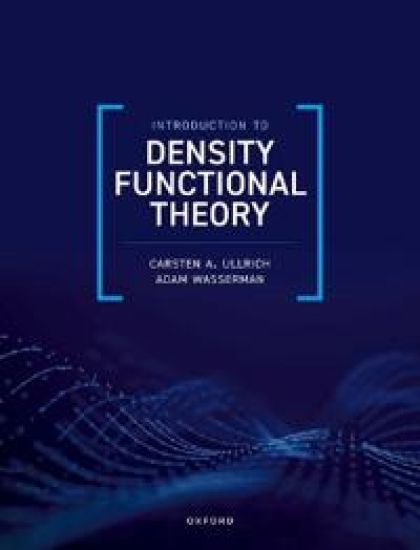
Introduction to Density Functional Theory

Introduction to Density Functional Theory

Carsten A. Ullrich; Adam Wasserman

Oxford University Press
2026
nidottu
Density functional theory (DFT) is a quantum mechanical framework in which the ground state of interacting electronic systems is completely described in terms of the electron density. This leads to a practical approach for electronic structure calculations which is very widely used in (bio)chemistry, physics, and materials science due to its reasonable computational cost and useful accuracy. This textbook presents the basic concepts and features of DFT at an introductory level, suitable for undergraduate and beginning graduate students in science and engineering. Beginning with a brief review of elementary quantum mechanics, the book then introduces essential concepts such as many-body wave functions, orbitals, Slater determinants, functionals, and the variational principle. The fundamental theorems of DFT of Hohenberg and Kohn and Kohn and Sham are formulated and explained, followed by a case study of a one-dimensional model system to illustrate the self-consistent numerical solution of the Kohn-Sham equation. To use DFT in practice, the exchange-correlation energy functional must be approximated: the most important and widely used approximations are reviewed, including the local-density approximation, generalized gradient approximations, and hybrid functionals, explaining their origin and assessing their performance with many examples. Practical aspects of molecular and solid-state calculations, such as basis sets and pseudopotentials, are introduced, together with a brief review of chemical reactivity indices. The book ends with a chapter on time-dependent DFT, discussing real-time electron dynamics and excitation energies, and additional resources are provided in several appendices. Written in an accessible and student-friendly style, the book covers the essentials of DFT and electronic structure calculations in a fully self-contained manner and without overburdening readers with formal and technical details. The book also contains many end-of-chapter exercises, including hands-on computer simulations using Python, as well as many suggestions for further reading.
Introduction to Density Functional Theory

Introduction to Density Functional Theory

Carsten A. Ullrich; Adam Wasserman

Oxford University Press
2026
sidottu
Density functional theory (DFT) is a quantum mechanical framework in which the ground state of interacting electronic systems is completely described in terms of the electron density. This leads to a practical approach for electronic structure calculations which is very widely used in (bio)chemistry, physics, and materials science due to its reasonable computational cost and useful accuracy. This textbook presents the basic concepts and features of DFT at an introductory level, suitable for undergraduate and beginning graduate students in science and engineering. Beginning with a brief review of elementary quantum mechanics, the book then introduces essential concepts such as many-body wave functions, orbitals, Slater determinants, functionals, and the variational principle. The fundamental theorems of DFT of Hohenberg and Kohn and Kohn and Sham are formulated and explained, followed by a case study of a one-dimensional model system to illustrate the self-consistent numerical solution of the Kohn-Sham equation. To use DFT in practice, the exchange-correlation energy functional must be approximated: the most important and widely used approximations are reviewed, including the local-density approximation, generalized gradient approximations, and hybrid functionals, explaining their origin and assessing their performance with many examples. Practical aspects of molecular and solid-state calculations, such as basis sets and pseudopotentials, are introduced, together with a brief review of chemical reactivity indices. The book ends with a chapter on time-dependent DFT, discussing real-time electron dynamics and excitation energies, and additional resources are provided in several appendices. Written in an accessible and student-friendly style, the book covers the essentials of DFT and electronic structure calculations in a fully self-contained manner and without overburdening readers with formal and technical details. The book also contains many end-of-chapter exercises, including hands-on computer simulations using Python, as well as many suggestions for further reading.

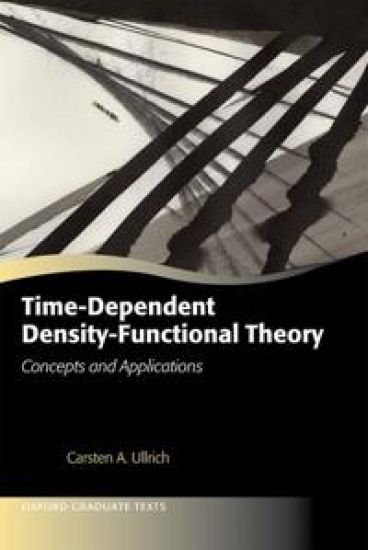
Time-Dependent Density-Functional Theory

Time-Dependent Density-Functional Theory

Carsten A. Ullrich

Oxford University Press
2019
nidottu
Time-dependent density-functional theory (TDDFT) describes the quantum dynamics of interacting electronic many-body systems formally exactly and in a practical and efficient manner. TDDFT has become the leading method for calculating excitation energies and optical properties of large molecules, with accuracies that rival traditional wave-function based methods, but at a fraction of the computational cost. This book is the first graduate-level text on the concepts and applications of TDDFT, including many examples and exercises, and extensive coverage of the literature. The book begins with a self-contained review of ground-state DFT, followed by a detailed and pedagogical treatment of the formal framework of TDDFT. It is explained how excitation energies can be calculated from linear-response TDDFT. Among the more advanced topics are time-dependent current-density-functional theory, orbital functionals, and many-body theory. Many applications are discussed, including molecular excitations, ultrafast and strong-field phenomena, excitons in solids, van der Waals interactions, nanoscale transport, and molecular dynamics.
Time-Dependent Density-Functional Theory

Time-Dependent Density-Functional Theory

Carsten A. Ullrich

Oxford University Press
2011
sidottu
Time-dependent density-functional theory (TDDFT) describes the quantum dynamics of interacting electronic many-body systems formally exactly and in a practical and efficient manner. TDDFT has become the leading method for calculating excitation energies and optical properties of large molecules, with accuracies that rival traditional wave-function based methods, but at a fraction of the computational cost. This book is the first graduate-level text on the concepts and applications of TDDFT, including many examples and exercises, and extensive coverage of the literature. The book begins with a self-contained review of ground-state DFT, followed by a detailed and pedagogical treatment of the formal framework of TDDFT. It is explained how excitation energies can be calculated from linear-response TDDFT. Among the more advanced topics are time-dependent current-density-functional theory, orbital functionals, and many-body theory. Many applications are discussed, including molecular excitations, ultrafast and strong-field phenomena, excitons in solids, van der Waals interactions, nanoscale transport, and molecular dynamics.