Kirjojen hintavertailu. Mukana 12 595 353 kirjaa ja 12 kauppaa.

Kirjailija

Cathérine Hug

Kirjat ja teokset yhdessä paikassa: 8 kirjaa, julkaisuja vuosilta 2016-2025, suosituimpien joukossa Franz Gertsch (Bilingual edition). Vertaile teosten hintoja ja tarkista saatavuus suomalaisista kirjakaupoista.

Mukana myös kirjoitusasut: Catherine Hug

8 kirjaa

Kirjojen julkaisuhaarukka 2016-2025.

Franz Gertsch (Bilingual edition)

Franz Gertsch (Bilingual edition)

Kathleen Bühler; Andreas Fiedler; Matthias Frehner; Josef Helfenstein; Cathérine Hug; Anette Hüsch; Rita Kersting; Harald Kunde

Hatje Cantz
2020
sidottu
A time of new beginnings In 1969, Franz Gertsch painted Huaa...!—which shows a wildly galloping man on horseback—after a film still from a magazine. Photographs have formed the basis for his work ever since, which he almost always takes himself. They include snapshots of the young Gertsch family, pictures from a trip to the South of France, photos of his encounters with Luciano Castelli and his dazzling circle of friends, and portraits of Patti Smith. This publication shows key works from the seventies, both in full views and with details in original size. Zeroing in on these almost abstract-looking details reveals the vibrant quality of the painting with its shimmering surfaces. FRANZ GERTSCH (b. 1930) celebrated his 90th birthday in 2020. With his participation in the documenta in Kassel in 1972 he rose to international fame as a Swiss Photorealist. The paintings in this book were done during this decisive creative phase. Exhibition An exhibition by the Museum Franz Gertsch in cooperation with the LENTOS Kunstmuseum Linz. Languages: German and English
Zeit (Time) - From Durer to Bonvicini

Zeit (Time) - From Durer to Bonvicini

Catherine Hug; Helga Nowotny; Monica Bello; Rudiger Safranski; Josef Teichmann; Sebastien Vivas; Stefan Zweifel

SNOECK VERLAGSGESELLSCHAFT MBH
2023
sidottu
Time is one of the great mysteries in the history of civilization. Its definitions are many and can be found in the most diverse disciplines, from religion to biology and economics, above all, of course, in physics, and as an well-established theme in art. Surprisingly, for all Switzerland's reputation as a watchmaking nation, few art museums in the country have yet staged an exhibition on the subject of time that spans multiple eras and disciplines. The sensual journey of the Kunsthaus Z rich through the history of time therefore now takes a comprehensive look at paintings, films, installations, performances, and real objects such as clocks from the 1550s to the present. Even though the clock as a time-measuring instrument is the starting point: temporal perspectives such as the biological, the paleontological, and even of personal sensations, are explored in depth in this show, curated by Cath rine Hug, with works by, among others, Sinzo Aanza, Giacomo Balla, Black Qantum Futurism, Manon de Boer & George van Dam, Abraham-Louis Breguet, Pieter Claesz, Honor Daumier, Jean Dubuffet, William Hogarth, Roni Horn, Monica Ursina J ger, On Kawara, Herlinde Koelbl.
Kerry James Marshall

Kerry James Marshall

Benjamin Buchloh; Aria Dean; Darby English; Mark Godfrey; Madeleine Grynsztejn; Cathérine Hug; Kerry James Marshall; Rebecca Zorach; Nikita Sena Quarshie

Royal Academy of Arts
2025
sidottu
Kerry James Marshall: The Histories is the most extensive publication on the artist to date, celebrating half a century of his work. It reveals the complex ways in which he has transformed histories of Western painting, centering Black bodies in ambitious compositions set in barber shops, public housing projects, parks, and beauty salons. It charts his use of portraiture to memorialise individuals such as Nat Turner, Harriet Tubman, and Olaudah Equiano. A new series, illustrated here for the first time, looks at under-acknowledged aspects of the history of Africa. With lavish illustrations of all the works in the accompanying exhibition, it also includes chapters on Marshall’s Rythm Mastr project and his various public commissions including his stained glass windows for the cathedral in Washington D.C.. A survey by Mark Godfrey is accompanied by shorter essays by Aria Dean, Darby English, Madeleine Grynsztejn, Cathérine Hug, Nikita Sena Quarshie, Rebecca Zorach, and an interview between Kerry James Marshall and Benjamin H.D. Buchloh.
Suzanne Duchamp

Suzanne Duchamp

Talia Kwartler; Cathérine Hug; Carole Boulbès

HATJE CANTZ
2025
sidottu
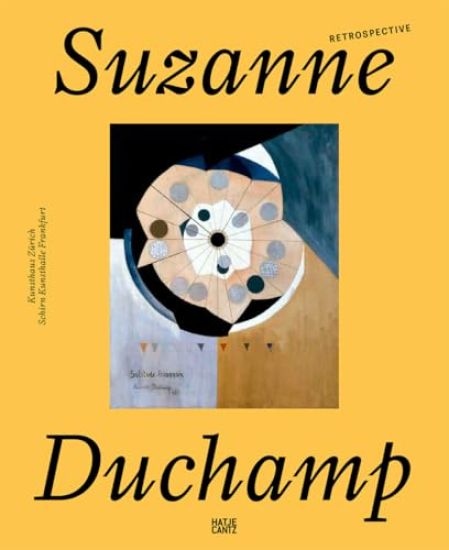
Suzanne Duchamp: Dada's hidden gem Suzanne Duchamp came from a famous family of artists: her brothers were Marcel Duchamp, Raymond Duchamp-Villon, and Jacques Villon. As a Dadaist and painter, she developed a delicate, cryptic, and humorous visual language and made her own unique contribution to the history of art. Nevertheless, she has remained largely unknown to a wider public. This catalogue accompanying her comprehensive retrospective in Zurich and Frankfurt curated by Talia Kwartler in collaboration with Cathérine Hug and Ingrid Pfeiffer presents work that Duchamp created during her association with Dada as well as further works works from earlier and later decades. Many of the over 80 artworks, documents, and photographs are being published for the first time. Complemented by latest scholarly findings by internationally renowned authors, this book thus gives Suzanne Duchamp the recognition she deserves.
DermARTologie/DermARTtology

DermARTologie/DermARTtology

Günter Burg; Michael Geiges; Cathérine Hug

Springer-Verlag Berlin and Heidelberg GmbH Co. KG
2022
sidottu
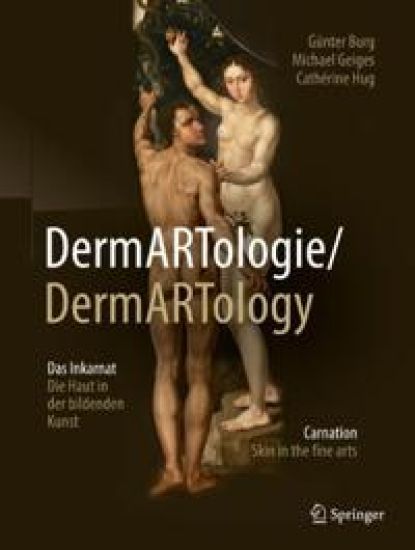
Kunst schafft betörende Illusionen für unsere Sinne, die unser Gehirn zu einem erhabenen Glücksgefühl kata­lysiert. Bei den Gemälden «Grosser Meister» rezipiert der Betrachter das Ganze und übersieht oft Details, die im vor­liegenden Buch aus mehreren Tausend Kunstwerken aufge­spürt und aus der Perspektive der Dermatologie eingeord­net und vergleichend mit Krankheitsbildern interpretiert werden. Alterungsprozesse, Muttermale, Neubildungen, Veränderungen an Hautanhangsgebilden, Binde- und Fett­gewebe, an Gefässen und Nerven stören die Makellosigkeit des Inkarnats und wurden daher -wenn überhaupt- meist unbewusst ohne medizinische Sachkenntnis vom Künstler in der zweidimensionalen Form eines Portraits dargestellt. Hingegen werden bei den dreidimensionalen dermatolo­gischen Wachsmoulagen die krankhaften Veränderungen an der Haut in bester akademischer Absicht bewusst mög­lichst naturgetreu und wirklichkeitsnah abgebildet. Der Versuch einer Erkundung von Parallelen zwischen Hautdarstellungen einst und heute zeigt, dass sich am Per­fektionswahn und dem Streben nach Makellosigkeit des Inkarnates damals wie heute nichts geändert hat und die wirklichkeitsgetreue Darstellung häufig dem vermeintli­chen Schönheitsideal geopfert und alles Krankhafte oder Anormale verdeckt wird. Art creates beguiling illusions for our senses, which cat­alyzes our brain into a sublime feeling of happiness. In the paintings of “Great Masters”, the viewer admires the whole painting and often overlooks details that are tracked down in the present book from several thousand works of art, clas­sified from the perspective of dermatology and interpreted comparatively with clinical pictures. Aging processes, moles, neoplasms, changes in skin appendages, connective and fatty tissue, vessels and nerves disturb the flawlessness of the in­carnate and were therefore - if at all - usually unconsciously depicted by the artist in the two-dimensional form of a por­trait without medical expertise. On the other hand, in the three-dimensional dermatologi­cal wax moulages, the pathological changes of the skin are deliberately depicted as realistically as possible with the best academic intentions. The attempt to explore parallels between skin representa­tions then and now shows that nothing has changed in the perfection mania and the striving for flawlessness of the in­carnate then as now and that the realistic representation is often sacrificed to the supposed ideal of beauty and every­thing pathological or abnormal is concealed.
Gerhard Richter

Gerhard Richter

Hubertus Butin; Cathérine Hug; Ann Cotten; T. J. Demos; Matias Faldbakken; Martha Stutteregger

Hatje Cantz
2020
sidottu
Gerhard Richter is one of the most famous painters of our time, worldwide. His fascinating visual spheres are characterized by a unique originality and quality, in which the abstract and the figural intertwine and permeate each other. This extensive volume of pictures concentrates entirely upon the theme of landscape in Richter’s oeuvre. Through this genre, to which Richter has remained loyal for more than sixty years, it is possible to see more than a development in the artist’s painting style. There is also a perceptible, genuine independence in many of the works, which makes him one of the most remarkable artists of our day. This book adds to the understanding of the significance and pictorial essence of Richter’s art, opening up current insights into the theme of nature and landscape in the twenty-first century.
Francis Picabia

Francis Picabia

Cathérine Hug

Museum of Modern Art
2016
sidottu
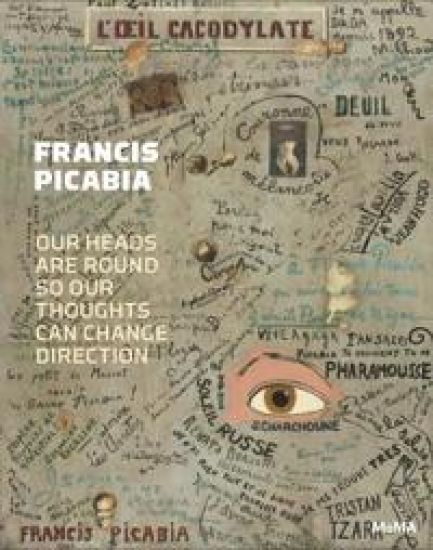
By rejecting consistency, Picabia powerfully asserted the artist's freedom to changeIrreverent and audacious, restless and brilliant, Francis Picabia achieved fame as a leader of the Dada group only to break publicly with the movement in 1921. Moving between Paris, the French Riviera, Switzerland, and New York, he led a dashing life, painting, writing, yachting, gambling, racing fast cars, and organizing lavish parties. Like no other artist before him, Picabia created a body of work that defies consistency and categorization, from Impressionist landscapes to abstraction, from Dada to stylized nudes, and from performance and film to poetry and publishing. A primary constant in his career was his vigorous unpredictability.Illustrated with nearly 500 reproductions, this sweeping survey of Picabia's eclectic career embraces the challenge of his work, asking how we can make sense of its wildly shifting mediums and styles. In her opening essay, curator Anne Umland writes that with Picabia, familiar oppositions "between high art and kitsch, progression and regression, modernism and its opposite, and success and failure are undone."In 15 superb essays, additional authors--including distinguished professors George Baker, Briony Fer, and David Joselit and renowned Picabia scholars Carole Boulb s and Arnauld Pierre--delve into the radically various mediums, styles, and contexts of Picabia's work, discussing his Dada period, his abstractions, his mechanical paintings, his appropriations of source imagery, his multifaceted relationship with print (both in his paintings and as a publisher and contributor to vanguard journals), his forays into screenwriting and theater, and his complex politics. Marcel Duchamp, of course, but also Nietzsche and Gertrude Stein make repeat appearances along the way.Turning to Picabia's contemporary legacy, Cath rine Hug maps the history of his critical reception and interviews contemporary curators and artists, including Peter Fischli, Albert Oehlen, and David Salle. A lively 30-page chronology illustrated with archival photographs and ephemera gives readers a year-by-year account of the artist's colorful life and of his interactions with fellow artists and critics, friends, and lovers.Together these essays suggest that the unruly genius of Picabia offers us a powerfully relevant and provocative alternative to the familiar narrative of modernism.Francis Picabia: Our Heads Are Round So Our Thoughts Can Change Direction accompanies the major 2016 exhibition on the artist, jointly organized by The Museum of Modern Art, New York, and the Kunsthaus Z rich.Francis Picabia was born in 1879 in Paris, the only child of a Cuban-born Spanish father and a French mother. His first success came as a painter in an Impressionist manner. He went on to become one of the principle figures of the Dada movement in New York and Paris. In 1925 Picabia moved to the south of France, where he lived and worked through World War II. Following the war, Picabia returned to Paris, where he died in 1953.