Kirjojen hintavertailu. Mukana 12 373 737 kirjaa ja 12 kauppaa.

Kirjailija

Catherine Moury

Kirjat ja teokset yhdessä paikassa: 6 kirjaa, julkaisuja vuosilta 2012-2021, suosituimpien joukossa European Parliament Ascendant. Vertaile teosten hintoja ja tarkista saatavuus suomalaisista kirjakaupoista.

6 kirjaa

Kirjojen julkaisuhaarukka 2012-2021.

Capitalising on Constraint

Capitalising on Constraint

Catherine Moury; Stella Ladi; Daniel Cardoso; Angie Gago

Manchester University Press
2021
sidottu
This book is an essential analysis of what really happens behind closed doors during and after a bailout.In the last decade, five Eurozone governments in economic difficulty received assistance from international lenders on the condition that certain policies specified in the Memoranda of Understanding were implemented. How did negotiations take place in this context? What room for manoeuvre did the governments of these countries have? After conditionality, to what extent were governments willing and able to roll back changes imposed on them by the international lenders?This book explores the constraints on national executives in the five bailed out countries of the Eurozone during and beyond the crisis, from 2008 to 2019. The authors argue that despite international market pressure and creditors’ conditionality, governments had some room for manoeuvre during a bailout and were able to advocate, resist, shape or roll back some of the policies demanded by external actors. Under certain circumstances, domestic actors were also able to exploit the constraint of conditionality to their own advantage.Capitalising on constraint shows that after a bailout programme, governments could use their discretion to revert the measures that brought the greatest benefits at a lower cost. The authors provide a valuable insight into the determinants of bargaining leverage, the importance of credibility, and the limits of conditionality that might inform the design of international and European lending during future crises.
European Parliament Ascendant

European Parliament Ascendant

Adrienne Héritier; Katharina L. Meissner; Catherine Moury; Magnus G. Schoeller

Springer Nature Switzerland AG
2020
nidottu
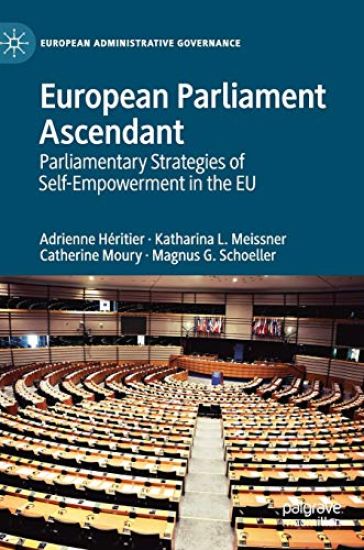
"If one wants to understand why, from its modest beginnings, the European Parliament has become a major player in EU decision-making, look no further than this book. It presents, to date, the theoretically most compelling, methodologically disciplined and empirically richest account of parliamentary self-empowerment over time, across key functions and policy areas. This volume will be a main point of reference for work on the European Parliament, the dynamics of inter-institutional politics, and EU integration more generally for years to come."—Berthold Rittberger, Professor of International Relations, University of Munich, Germany“Anyone interested in the rise of the European Parliament as a significant actor in the EU should read this book. It offers a fascinating insight into the strategies used by the Parliament to achieve its aims and the conditions for its success or failure. It ranges widely across time and policy areas to give a comprehensive analysis of the Parliament’s changing institutional position.”—Michael Shackleton, Professor of European Institutions, Maastricht University, The Netherlands, and former EP officialThis book analyses the European Parliament’s strategies of self-empowerment over time stretching across cases of new institutional prerogatives as well as substantive policy areas. It considers why and how the Parliament has managed to gain formal and informal powers in this wide variety of cases. The book provides a systematic and comparative analysis of the European Parliament’s formal and informal empowerment in two broad sets of cases: on the one hand, it examines the EP’s empowerment since the Treaty of Rome in three areas that are characteristic of parliamentary democracies, namely legislation, the budget, and the investiture of the executive. On the other hand, it analyses the European Parliament’s role in highly politicised policy areas,namely Economic and Monetary Governance and the shaping of EU trade agreements.
European Parliament Ascendant

European Parliament Ascendant

Adrienne Héritier; Katharina L. Meissner; Catherine Moury; Magnus G. Schoeller

Springer Nature Switzerland AG
2019
sidottu
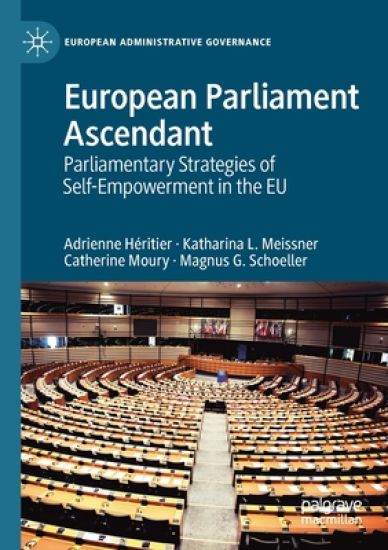
"If one wants to understand why, from its modest beginnings, the European Parliament has become a major player in EU decision-making, look no further than this book. It presents, to date, the theoretically most compelling, methodologically disciplined and empirically richest account of parliamentary self-empowerment over time, across key functions and policy areas. This volume will be a main point of reference for work on the European Parliament, the dynamics of inter-institutional politics, and EU integration more generally for years to come."—Berthold Rittberger, Professor of International Relations, University of Munich, Germany“Anyone interested in the rise of the European Parliament as a significant actor in the EU should read this book. It offers a fascinating insight into the strategies used by the Parliament to achieve its aims and the conditions for its success or failure. It ranges widely across time and policy areas to give a comprehensive analysis of the Parliament’s changing institutional position.”—Michael Shackleton, Professor of European Institutions, Maastricht University, The Netherlands, and former EP officialThis book analyses the European Parliament’s strategies of self-empowerment over time stretching across cases of new institutional prerogatives as well as substantive policy areas. It considers why and how the Parliament has managed to gain formal and informal powers in this wide variety of cases. The book provides a systematic and comparative analysis of the European Parliament’s formal and informal empowerment in two broad sets of cases: on the one hand, it examines the EP’s empowerment since the Treaty of Rome in three areas that are characteristic of parliamentary democracies, namely legislation, the budget, and the investiture of the executive. On the other hand, it analyses the European Parliament’s role in highly politicised policy areas,namely Economic and Monetary Governance and the shaping of EU trade agreements.
Coalition Government and Party Mandate
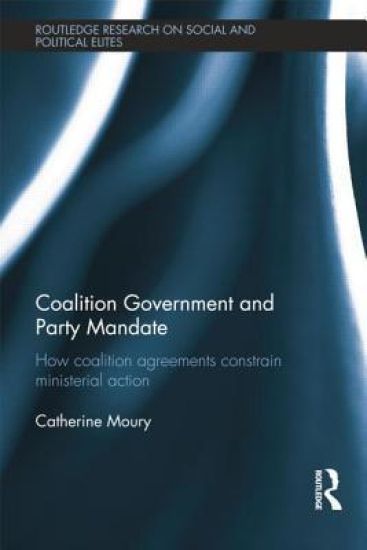
Which kind of decisions are passed by Cabinet in coalition governments? What motivates ministerial action? How much leeway do coalition parties give their governmental representatives? This book focuses on a comparative study of ministerial behaviour in Germany, Belgium, Italy and the Netherlands. It discredits the assumption that ministers are ‘policy dictators’ in their spheres of competence, and demonstrates that ministers are consistently and extensively constrained when deciding on policies. The first book in a new series at the forefront of research on social and political elites, this is an invaluable insight into the capacity and power of coalition government across Europe.Looking at policy formation through coalition agreements and the effectiveness of such agreements, Coalition Government and Party Mandate will be of interest to students and scholars of comparative politics, governance and European politics.
Changing Rules of Delegation

Changing Rules of Delegation

Adrienne Héritier; Catherine Moury; Carina S. Bischoff; Carl Fredrik Bergström

Oxford University Press
2013
sidottu
With each legislative issue, legislators have to decide whether to delegate decision-making to the executive and/or to expert bodies in order to flesh out the details of this legislation, or, alternatively, to spell out all aspects of this decision in legislation proper. The reasons why to delegate have been of prime interest to political science. The debate has concentrated on principal-agent theory to explain why politicians delegate decision-making to bureaucrats, to independent regulatory agencies, and to others actors and how to control these agents. By contrast, Changing Rules of Delegation focuses on these questions: Which actors are empowered by delegation? Are executive actors empowered over legislative actors? How do legislative actors react to the loss of power? What opportunities are there to change the institutional rules governing delegation in order to (re)gain institutional power and, with it influence over policy outcomes? The authors analyze the conditions and processes of change of the rules that delegate decision-making power to the Commission's implementing powers under comitology. Focusing on the role of the European Parliament the authors explain why the Commission, the Council, and increasingly the Parliament, delegated decision-making to the Commission. If they chose delegation, they still have to determine under which institutional rule comitology should operate. These rules, too, distribute power unequally among actors and therefore raise the question of how they came about in the first place and whether and how the "losers" of a rule change seek to alter the rules at a later point in time.
Coalition Government and Party Mandate
Which kind of decisions are passed by Cabinet in coalition governments? What motivates ministerial action? How much leeway do coalition parties give their governmental representatives? This book focuses on a comparative study of ministerial behaviour in Germany, Belgium, Italy and the Netherlands. It discredits the assumption that ministers are ‘policy dictators’ in their spheres of competence, and demonstrates that ministers are consistently and extensively constrained when deciding on policies. The first book in a new series at the forefront of research on social and political elites, this is an invaluable insight into the capacity and power of coalition government across Europe.Looking at policy formation through coalition agreements and the effectiveness of such agreements, Coalition Government and Party Mandate will be of interest to students and scholars of comparative politics, governance and European politics.