Kirjojen hintavertailu. Mukana 12 390 323 kirjaa ja 12 kauppaa.

Kirjailija

Cathie Jo Martin

Kirjat ja teokset yhdessä paikassa: 5 kirjaa, julkaisuja vuosilta 1999-2025, suosituimpien joukossa The Political Construction of Business Interests. Vertaile teosten hintoja ja tarkista saatavuus suomalaisista kirjakaupoista.

5 kirjaa

Kirjojen julkaisuhaarukka 1999-2025.

Education for All?

Education for All?

Cathie Jo Martin

Cambridge University Press
2025
pokkari
Why did Denmark develop mass education for all in 1814, while Britain created a public-school system only in 1870 that primarily educated academic achievers? Cathie Jo Martin argues that fiction writers and their literary narratives inspired education campaigns throughout the nineteenth-century. Danish writers imagined mass schools as the foundation for a great society and economic growth. Their depictions fortified the mandate to educate all people and showed neglecting low-skill youth would waste societal resources and threaten the social fabric. Conversely, British authors pictured mass education as harming social stability, lower-class work, and national culture. Their stories of youths who overcame structural injustices with individual determination made it easier to blame students who failed to seize educational opportunities. Novel and compelling, Education for All? uses a multidisciplinary perspective to offer a unique gaze into historical policymaking. This title is part of the Flip it Open Programme and may also be available Open Access. Check our website Cambridge Core for details.

Education for All?

Education for All?

Cathie Jo Martin

Cambridge University Press
2023
sidottu
Why did Denmark develop mass education for all in 1814, while Britain created a public-school system only in 1870 that primarily educated academic achievers? Cathie Jo Martin argues that fiction writers and their literary narratives inspired education campaigns throughout the nineteenth-century. Danish writers imagined mass schools as the foundation for a great society and economic growth. Their depictions fortified the mandate to educate all people and showed neglecting low-skill youth would waste societal resources and threaten the social fabric. Conversely, British authors pictured mass education as harming social stability, lower-class work, and national culture. Their stories of youths who overcame structural injustices with individual determination made it easier to blame students who failed to seize educational opportunities. Novel and compelling, Education for All? uses a multidisciplinary perspective to offer a unique gaze into historical policymaking. This title is part of the Flip it Open Programme and may also be available Open Access. Check our website Cambridge Core for details.
The Political Construction of Business Interests

The Political Construction of Business Interests

Cathie Jo Martin; Duane Swank

Cambridge University Press
2012
pokkari
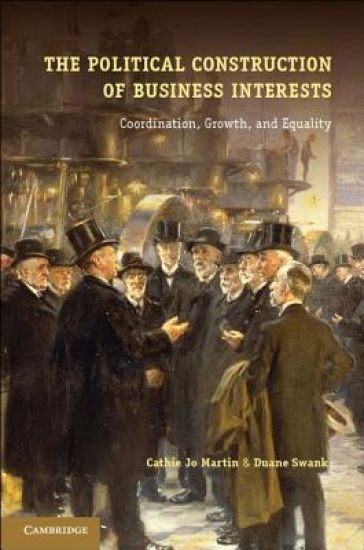
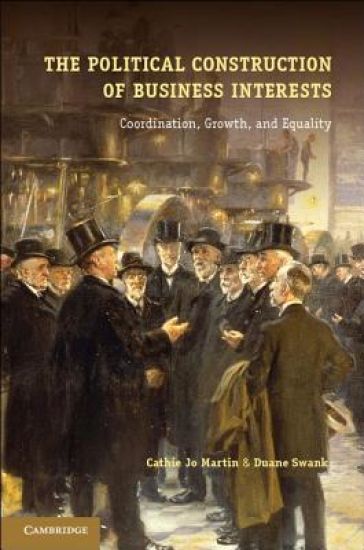
Many societies use labor market coordination to maximize economic growth and equality, yet employers' willing cooperation with government and labor is something of a mystery. The Political Construction of Business Interests recounts employers' struggles to define their collective social identities at turning points in capitalist development. Employers are most likely to support social investments in countries with strong peak business associations, that help members form collective preferences and realize policy goals in labor market negotiations. Politicians, with incentives shaped by governmental structures, took the initiative in association-building and those that created the strongest associations were motivated to evade labor radicalism and to preempt parliamentary democratization. Sweeping in its historical and cross-national reach, the book builds on original archival data, interviews and cross-national quantitative analyses. The research has important implications for the construction of business as a social class and powerful ramifications for equality, welfare state restructuring and social solidarity.
The Political Construction of Business Interests

The Political Construction of Business Interests

Cathie Jo Martin; Duane Swank

Cambridge University Press
2012
sidottu
Many societies use labor market coordination to maximize economic growth and equality, yet employers' willing cooperation with government and labor is something of a mystery. The Political Construction of Business Interests recounts employers' struggles to define their collective social identities at turning points in capitalist development. Employers are most likely to support social investments in countries with strong peak business associations, that help members form collective preferences and realize policy goals in labor market negotiations. Politicians, with incentives shaped by governmental structures, took the initiative in association-building and those that created the strongest associations were motivated to evade labor radicalism and to preempt parliamentary democratization. Sweeping in its historical and cross-national reach, the book builds on original archival data, interviews and cross-national quantitative analyses. The research has important implications for the construction of business as a social class and powerful ramifications for equality, welfare state restructuring and social solidarity.
Stuck in Neutral

Stuck in Neutral

Cathie Jo Martin

Princeton University Press
1999
pokkari
According to conventional wisdom, big business wields enormous influence over America's political agenda and is responsible for the relatively limited scale of the country's social policies. In Stuck in Neutral, however, Cathie Jo Martin challenges that view, arguing that big business has limited involvement in social policy and in many instances desires broader social interventions. Combining hundreds of in-depth interviews with careful quantitative analysis, Martin shows that there is strong support among managers for government-sponsored training, health, work, and family initiatives to enhance workers' skills and productivity. This support does not translate into political action, surprisingly, because big firms are not organized to intervene effectively. Every large company has its own staff to deal with government affairs, but overarching organizations for the most part lobby ineffectively for the collective interests of big business in the social realm. By contrast, small firms, which cannot afford to lobby the government directly, rely on representative associations to speak for them. The unified voice of small business comes through much more clearly in policy circles than the diverse messages presented by individual corporations, ensuring that the small-business agenda of limited social policy prevails. A vivid portrayal of the interplay between business and politics, Stuck in Neutral offers a fresh take on some of the most controversial issues of our day. It is a must read for anyone interested in the past, present, and future of the American welfare state and political economy.