Kirjojen hintavertailu. Mukana 12 595 353 kirjaa ja 12 kauppaa.

Kirjailija

Cecil Rousseau

Kirjat ja teokset yhdessä paikassa: 5 kirjaa, julkaisuja vuosilta 1996-2025, suosituimpien joukossa The New Mathematical Coloring Book. Vertaile teosten hintoja ja tarkista saatavuus suomalaisista kirjakaupoista.

5 kirjaa

Kirjojen julkaisuhaarukka 1996-2025.

The New Mathematical Coloring Book

The New Mathematical Coloring Book

Alexander Soifer; Branko Grünbaum; Peter Johnson; Cecil Rousseau

SPRINGER-VERLAG NEW YORK INC.
2025
nidottu
The New Mathematical Coloring Book (TNMCB) includes striking results of the past 15-year renaissance that produced new approaches, advances, and solutions to problems from the first edition. A large part of the new edition “Ask what your computer can do for you,” presents the recent breakthrough by Aubrey de Grey and works by Marijn Heule, Jaan Parts, Geoffrey Exoo, and Dan Ismailescu. TNMCB introduces new open problems and conjectures that will pave the way to the future keeping the book in the center of the field. TNMCB presents mathematics of coloring as an evolution of ideas, with biographies of their creators and historical setting of the world around them, and the world around us.A new thing in the world at the time, TMCB I is now joined by a colossal sibling containing more than twice as much of what only Alexander Soifer can deliver: an interweaving of mathematics with history and biography, well-seasoned with controversy and opinion. –Peter D. Johnson, Jr.Auburn UniversityLike TMCB I, TMCB II is a unique combination of Mathematics, History, and Biography written by a skilled journalist who has been intimately involved with the story for the last half-century. …The nature of the subject makes much of the material accessible to students, but also of interest to working Mathematicians. … In addition to learning some wonderful Mathematics, students will learn to appreciate the influences of Paul Erdos, Ron Graham, and others.–Geoffrey ExooIndiana State UniversityThe beautiful and unique Mathematical coloring book of Alexander Soifer is another case of “good mathematics”, containing a lot of similar examples (it is not by chance that Szemerédi’s Theorem story is included as well) and presenting mathematics as both a science and an art…–Peter MihókMathematical Reviews, MathSciNetA postman came to the door with a copy of the masterpiece of the century. I thank you and the mathematics community should thank you for years to come. You have set a standard for writing about mathematics and mathematicians that will be hard to match.– Harold W. KuhnPrinceton UniversityI have never encountered a book of this kind. The best description of it I can give is that it is a mystery novel… I found it hard to stop reading before I finished (in two days) the whole text. Soifer engages the reader's attention not only mathematically, but emotionally and esthetically. May you enjoy the book as much as I did!– Branko GrünbaumUniversity of WashingtonI am in absolute awe of your 2008 book.–Aubrey D.N.J. de GreyLEV Foundation
The New Mathematical Coloring Book

The New Mathematical Coloring Book

Alexander Soifer; Branko Grünbaum; Peter Johnson; Cecil Rousseau

SPRINGER-VERLAG NEW YORK INC.
2024
sidottu
The New Mathematical Coloring Book (TNMCB) includes striking results of the past 15-year renaissance that produced new approaches, advances, and solutions to problems from the first edition. A large part of the new edition “Ask what your computer can do for you,” presents the recent breakthrough by Aubrey de Grey and works by Marijn Heule, Jaan Parts, Geoffrey Exoo, and Dan Ismailescu. TNMCB introduces new open problems and conjectures that will pave the way to the future keeping the book in the center of the field. TNMCB presents mathematics of coloring as an evolution of ideas, with biographies of their creators and historical setting of the world around them, and the world around us.A new thing in the world at the time, TMCB I is now joined by a colossal sibling containing more than twice as much of what only Alexander Soifer can deliver: an interweaving of mathematics with history and biography, well-seasoned with controversy and opinion. –Peter D. Johnson, Jr.Auburn UniversityLike TMCB I, TMCB II is a unique combination of Mathematics, History, and Biography written by a skilled journalist who has been intimately involved with the story for the last half-century. …The nature of the subject makes much of the material accessible to students, but also of interest to working Mathematicians. … In addition to learning some wonderful Mathematics, students will learn to appreciate the influences of Paul Erdos, Ron Graham, and others.–Geoffrey ExooIndiana State UniversityThe beautiful and unique Mathematical coloring book of Alexander Soifer is another case of “good mathematics”, containing a lot of similar examples (it is not by chance that Szemerédi’s Theorem story is included as well) and presenting mathematics as both a science and an art…–Peter MihókMathematical Reviews, MathSciNetA postman came to the door with a copy of the masterpiece of the century. I thank you and the mathematics community should thank you for years to come. You have set a standard for writing about mathematics and mathematicians that will be hard to match.– Harold W. KuhnPrinceton UniversityI have never encountered a book of this kind. The best description of it I can give is that it is a mystery novel… I found it hard to stop reading before I finished (in two days) the whole text. Soifer engages the reader's attention not only mathematically, but emotionally and esthetically. May you enjoy the book as much as I did!– Branko GrünbaumUniversity of WashingtonI am in absolute awe of your 2008 book.–Aubrey D.N.J. de GreyLEV Foundation
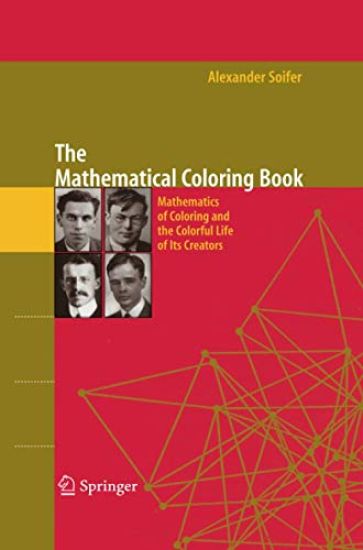
The Mathematical Coloring Book

The Mathematical Coloring Book

Alexander Soifer; Branko Grünbaum; Peter Johnson; Cecil Rousseau

Springer-Verlag New York Inc.
2014
nidottu
This is a unique type of book; at least, I have never encountered a book of this kind. The best description of it I can give is that it is a mystery novel, developing on three levels, and imbued with both educational and philosophical/moral issues. If this summary description does not help understanding the particular character and allure of the book, possibly a more detailed explanation will be found useful. One of the primary goals of the author is to interest readers—in particular, young mathematiciansorpossiblypre-mathematicians—inthefascinatingworldofelegant and easily understandable problems, for which no particular mathematical kno- edge is necessary, but which are very far from being easily solved. In fact, the prototype of such problems is the following: If each point of the plane is to be given a color, how many colors do we need if every two points at unit distance are to receive distinct colors? More than half a century ago it was established that the least number of colorsneeded for such a coloring is either 4, or 5, or 6 or 7. Well, which is it? Despite efforts by a legion of very bright people—many of whom developed whole branches of mathematics and solved problems that seemed much harder—not a single advance towards the answer has been made. This mystery, and scores of other similarly simple questions, form one level of mysteries explored. In doing this, the author presents a whole lot of attractive results in an engaging way, and with increasing level of depth.
USA and International Mathematical Olympiads 2005

USA and International Mathematical Olympiads 2005

Zuming Feng; Melanie Matchett Wood; Cecil Rousseau

Mathematical Association of America
2006
nidottu
The Mathematical Olypiad books, covering the USA Mathematical Olypiad (USAMO) and the International Mathematical Olypiad (IMO), have been published annually by the MAA American Mathematics Competitions since 1976. This is the sixth volume in that series published by the MAA in its Problem Book series. The IMO is the work mathematics championship for high school students. It takes place annually in a different country each year. The aims of the IMO are (1) to discover, encourage and challenge mathematically gifted young people in all countries; (2) to foster friendships between mathematicians around the world; (3) to create an opportunity for the exchange of information on school syllabi and practice throughout the world. The USAMO and the Team Selection Test (TST) are the last two stages of the selection process for the United states of America IMO team. The preceding examinations are the AMC 10 or AMC12 and the American Invitational Mathematics Examination (AIME). Participation in the AIME, USAMO, and the TST is by invitation only, based on performance in the preceding exams of the sequence. Through the AMC contests and the IMO, young gifted mathematicians are identified and recognized while they are still in secondary school. Participation in the competitions provides them with the chance to measure themselves against other exceptional students from all over the world. This work was prepared by Zuming Feng, Melanie Matchett Wood, the Leader and Deputy Leader of the 2004 USA IMO team, and by Cecil Rousseau, the chair of the USAMO Committee. In addition to presenting their own carefully written solutions to the problems, Zuming and Melanie provide remarkable solutions developed by the examination committees, contestants, and experts, during or after the contests. They also provide a detailed report of the 2000 2004 USAMO/IMO results and a comprehensive guide to other material that emphasize advances problem-solving.This collection of excellent problems and beautiful solutions is a valuable companion for students who wish to develop their interest in mathematics outside the school curriculum and to deepen their knowledge of mathematics.
Winning Solutions

Winning Solutions

Edward Lozansky; Cecil Rousseau

Springer-Verlag New York Inc.
1996
nidottu
Problem-solving competitions for mathematically talented sec­ ondary school students have burgeoned in recent years. The number of countries taking part in the International Mathematical Olympiad (IMO) has increased dramatically. In the United States, potential IMO team members are identified through the USA Mathematical Olympiad (USAMO), and most other participating countries use a similar selection procedure. Thus the number of such competitions has grown, and this growth has been accompanied by increased public interest in the accomplishments of mathematically talented young people. There is a significant gap between what most high school math­ ematics programs teach and what is expected of an IMO participant. This book is part of an effort to bridge that gap. It is written for students who have shown talent in mathematics but lack the back­ ground and experience necessary to solve olympiad-level problems. We try to provide some of that background and experience by point­ out useful theorems and techniques and by providing a suitable ing collection of examples and exercises. This book covers only a fraction of the topics normally rep­ resented in competitions such as the USAMO and IMO. Another volume would be necessary to cover geometry, and there are other v VI Preface special topics that need to be studied as part of preparation for olympiad-level competitions. At the end of the book we provide a list of resources for further study.