Kirjojen hintavertailu. Mukana 12 595 353 kirjaa ja 12 kauppaa.

Kirjailija

Cees W. Passchier

Kirjat ja teokset yhdessä paikassa: 5 kirjaa, julkaisuja vuosilta 1990-2016, suosituimpien joukossa Atlas of Mylonites - and related microstructures. Vertaile teosten hintoja ja tarkista saatavuus suomalaisista kirjakaupoista.

5 kirjaa

Kirjojen julkaisuhaarukka 1990-2016.

Atlas of Mylonites - and related microstructures

Atlas of Mylonites - and related microstructures

Rudolph A. J. Trouw; Cees W. Passchier; Dirk J. Wiersma

Springer-Verlag Berlin and Heidelberg GmbH Co. K
2016
nidottu
Mylonites form in response to high rates of strain within deep ductile shear zones, which are the extensions at depth of surface faults, thrusts and fault breccias, They can have many different mineralogical compositions and are therefore defined on their textural appearance. This atlas provides high definition images of a large number of different mylonites allowing students and geologists to correctly classify them with greater ease. It also provides insights into the interpretation of mylonitic fabrics to answer questions such as; from what type of rock did this mylonite derive? What were the metamorphic circumstances during mylonitization? What was the intensity of deformation?, and What was the sense of shear? This book will complement the very successful textbook "Microtectonics" by Passchier and Trouw.

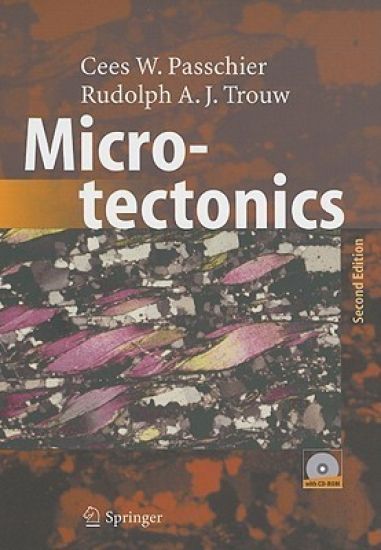
Microtectonics

Microtectonics

Cees W. Passchier; Rudolph A. J. Trouw

Springer-Verlag Berlin and Heidelberg GmbH Co. K
2014
nidottu
Microtectonics deals with the interpretation of microstructures, small-scale deformation structures in rocks that yield abundant information on the history and type of deformation and metamorphism. The results are used by geologists to obtain data for large-scale geological interpretations. This advanced textbook treats common microstructures such as foliations, porphyroblasts, veins, fringes and shear sense indicators. The book mainly focusses on optical microscopy as a tool to study microstructures, but also describes other techniques such as EBSD and tomography. Many photographs and explanatory drawings clarify the text. The new edition, substantially revised throughout and extended, features two new chapters (primary structures and experimental microstructures), 68 new figures, more than 800 new references. Microtectonics has proven useful for self study of microstructures and as a manual for short- and one-semester courses.
Atlas of Mylonites - and related microstructures

Atlas of Mylonites - and related microstructures

Rudolph A. J. Trouw; Cees W. Passchier; Dirk J. Wiersma

Springer-Verlag Berlin and Heidelberg GmbH Co. K
2010
sidottu
Mylonites form in response to high rates of strain within deep ductile shear zones, which are the extensions at depth of surface faults, thrusts and fault breccias, They can have many different mineralogical compositions and are therefore defined on their textural appearance. This atlas provides high definition images of a large number of different mylonites allowing students and geologists to correctly classify them with greater ease. It also provides insights into the interpretation of mylonitic fabrics to answer questions such as; from what type of rock did this mylonite derive? What were the metamorphic circumstances during mylonitization? What was the intensity of deformation?, and What was the sense of shear? This book will complement the very successful textbook "Microtectonics" by Passchier and Trouw.
Microtectonics

Microtectonics

Cees W. Passchier; Rudolph A. J. Trouw

Springer-Verlag Berlin and Heidelberg GmbH Co. K
2005
sidottu
Microtectonics deals with the interpretation of microstructures, small-scale deformation structures in rocks that yield abundant information on the history and type of deformation and metamorphism. The results are used by geologists to obtain data for large-scale geological interpretations. This advanced textbook treats common microstructures such as foliations, porphyroblasts, veins, fringes and shear sense indicators. The book mainly focusses on optical microscopy as a tool to study microstructures, but also describes other techniques such as EBSD and tomography. Many photographs and explanatory drawings clarify the text. The new edition, substantially revised throughout and extended, features two new chapters (primary structures and experimental microstructures), 68 new figures, more than 800 new references. Microtectonics has proven useful for self study of microstructures and as a manual for short- and one-semester courses.
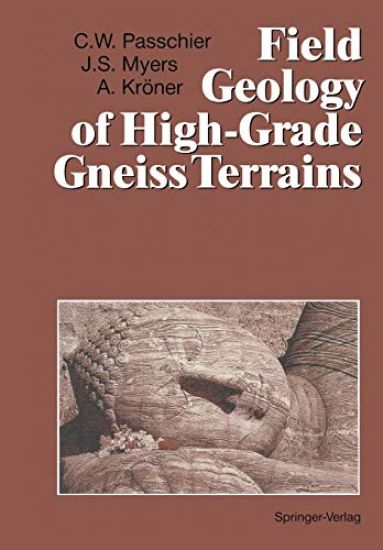
Field Geology of High-Grade Gneiss Terrains

Field Geology of High-Grade Gneiss Terrains

Cees W. Passchier; John S. Myers; Alfred Kröner

Springer-Verlag Berlin and Heidelberg GmbH Co. K
1990
nidottu
Although there are numerous publications on the geology of high-grade gneiss terrains, few descriptions exist of how to map and carry out structural analysis in these terrains. Textbooks on structural geology concentrate on technIques appli­ cable to low-grade terrains. Geologists who have no experience of mapping high-grade gneisses are often at a loss as to how to apply techniques to high­ grade rocks that were developed for low to medium grade metamorphic terrains. Any study of deep crustal processes and their development through time should begin with examination of the primary data source - outcrops of high­ grade metamorphic terrains. We feel that the urge to apply advanced techniques of fabric analysis, petrology, geochemistry, isotope geochemistry and age deter­ mination to these rocks often results in brief sampling trips in which there is little, if any analysis of the structural and metamorphic history revealed by outcrop patterns. Many studies of the metamorphic petrology and geochemistry of high-grade gneiss terrains make ineffective use of available field data, often because the authors are unaware of structural complexities and of the ways to recognise and use them. This is unfortunate, because much data can be collected in the field at minimal cost that cannot easily, if at all, be obtained from material in the laboratory. The primary igneous or sedimentary nature of a rock, the relative age of intrusive veins, and the sequence of deformation that they under­ went, can usually best be determined by straightforward observation in the field.