Kirjojen hintavertailu. Mukana 12 254 398 kirjaa ja 12 kauppaa.
Kirjailija
Central Intelligence Agency
Kirjat ja teokset yhdessä paikassa: 831 kirjaa, julkaisuja vuosilta 2009-2024, suosituimpien joukossa Letter to Mr. Lawrence R. Houston from Matthew Baird. Vertaile teosten hintoja ja tarkista saatavuus suomalaisista kirjakaupoista.
THE COMPREHENSIVE, RELIABLE, INDISPENSABLE GLOBAL REFERENCE WORK VOLUME 1 OF 3 - CONTAINS: Introduction: History of the Factbook, Definitions and Notes, Guide to Country Profiles, 31 Pages of Regional and World Reference Maps. Countries: Afghanistan to Gabon. For Volume 2, search for "1981957561". For Volume 3, search for "1981957588". Unique three-volume large-format, large-print edition Giant 8.5"x11" size - easy to read and navigate Complete & unabridged - 1,800+ pages total, 600+ pages per volume "Batteries last hours, books last decades. Get the print edition " Looks AMAZING on any professional or home bookshelf The World Factbook provides up-to-date information on the history, people, government, economy, geography, communications, transportation, military, and transnational issues for 267 world entities. This almanac-style reference work is created with input and data from numerous government departments and other public and private entities, and is the single most accurate source of intelligence on the nations and peoples of our world. CREATED BY THE CIA, TRUSTED BY INTELLIGENCE OFFICERS, DIPLOMATS, ACADEMICS, JOURNALISTS AND OTHER PROFESSIONALS AROUND THE GLOBE. Sources include: Antarctic Information Program (National Science Foundation) - Armed Forces Medical Intelligence Center (Department of Defense) - Bureau of the Census (Department of Commerce) - Bureau of Labor Statistics (Department of Labor) - Council of Managers of National Antarctic Programs - Defense Intelligence Agency (Department of Defense) - Department of Energy - Department of State - Fish and Wildlife Service (Department of the Interior) - Maritime Administration (Department of Transportation) - National Geospatial-Intelligence Agency (Department of Defense) - Naval Facilities Engineering Command (Department of Defense) - Office of Insular Affairs (Department of the Interior) - Office of Naval Intelligence (Department of Defense) - Oil & Gas Journal - United States Board on Geographic Names (Department of the Interior) - United States Transportation Command (Department of Defense) - and more... Proudly Published in the U.S.A. by CARLILE MEDIA.
THE COMPREHENSIVE, RELIABLE, INDISPENSABLE GLOBAL REFERENCE WORK VOLUME 2 OF 3 - CONTAINS: Countries: The Gambia to Poland. For Volume 1, search for "1981957413". For Volume 3, search for "1981957588". Unique three-volume large-format, large-print edition Giant 8.5"x11" size - easy to read and navigate Complete & unabridged - 1,800+ pages total, 600+ pages per volume "Batteries last hours, books last decades. Get the print edition " Looks AMAZING on any professional or home bookshelf The World Factbook provides up-to-date information on the history, people, government, economy, geography, communications, transportation, military, and transnational issues for 267 world entities. This almanac-style reference work is created with input and data from numerous government departments and other public and private entities, and is the single most accurate source of intelligence on the nations and peoples of our world. CREATED BY THE CIA, TRUSTED BY INTELLIGENCE OFFICERS, DIPLOMATS, ACADEMICS, JOURNALISTS AND OTHER PROFESSIONALS AROUND THE GLOBE. Sources include: Antarctic Information Program (National Science Foundation) - Armed Forces Medical Intelligence Center (Department of Defense) - Bureau of the Census (Department of Commerce) - Bureau of Labor Statistics (Department of Labor) - Council of Managers of National Antarctic Programs - Defense Intelligence Agency (Department of Defense) - Department of Energy - Department of State - Fish and Wildlife Service (Department of the Interior) - Maritime Administration (Department of Transportation) - National Geospatial-Intelligence Agency (Department of Defense) - Naval Facilities Engineering Command (Department of Defense) - Office of Insular Affairs (Department of the Interior) - Office of Naval Intelligence (Department of Defense) - Oil & Gas Journal - United States Board on Geographic Names (Department of the Interior) - United States Transportation Command (Department of Defense) - and more... Proudly Published in the U.S.A. by CARLILE MEDIA.
This is a 760 page reproduction of preserved, declassified reference documents, from archives, created by the Central Intelligence Agency and published in the Second Release of Name Files Under the Nazi War Crimes and Japanese Imperial Government Disclosure Acts, ca. 1981 - ca. 2002. The documents in this volume are focused on the CIA's investigation of Adolf Hitler and include analysis of his behavior, speech patterns, education, historical background, medical reports, and various activities that were conducted. This series consists of biographies, correspondence, reports, memorandums, messages, telegrams, routing slips, publications, dispatches, translations, transcripts, legislative records, legal documents, statements, lists, abstracts, excerpts, clippings, medical records, vouchers, outlines, and other records. Most of the materials relate to people in one, or both, of two categories: Axis personnel accused of committing war crimes, or of belonging to criminal organizations, during World War II; and former Axis personnel who were used by the U.S. or West Germany as intelligence sources during the Cold War. The series also includes files relating to people who were never accused of war crimes or of belonging to criminal organizations, but who may have been associated with war crimes as victims, witnesses, investigators, sources, or officials. Most of the records relate to the activities that brought the people to the attention or employ of the Central Intelligence Agency (CIA) or the West German Federal Intelligence Service (the Bundesnachrichtendienst or BND). The records provide details about the relationship between the CIA and the BND; Nazi and Soviet Union intelligence operations; CIA and BND intelligence operations aimed at Albania, Austria, Czechoslovakia, East Germany, Latvia, Slovakia, and the Soviet Union; Communist, anti-Communist, and nationalist movements in Albania, Byelorussia, Estonia, Latvia, and Slovakia; the activities of Bulgarian, Byelorussian, Czechoslovakian, Estonian, Hungarian, Latvian, Romanian, Russian, Ukrainian, and Yugoslavian migr communities in the U.S. and other countries; political and economic developments in Austria and West Germany; political developments in the Middle East; policies and personnel of the Vatican; prisoner exchanges between East Germany and West Germany; inter-party rivalries, ultranationalist movements, and public debates about rearmament and civilian use of atomic energy in Japan; CIA policies for recruiting, paying, debriefing, evaluating, dismissing, and compensating the heirs of, foreign personnel used as intelligence sources; and how the CIA responded when it learned of, or was forced to confront, the criminal pasts of some of its agents and sources.
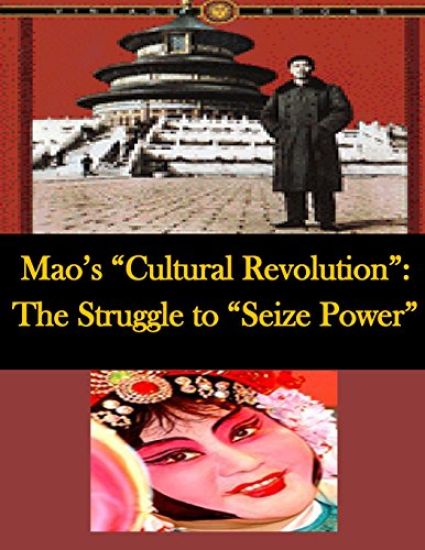
This Intelligence Report develops in broad outline the course of the "Cultural Revolution" in Communist China during 1967. It is written from the point of view that Mao either initiated or approved policies which shifted the direction and intensity of the "Cultural Revolution" during the year, and that he ordered the sharp reversal of policy from revolutionary action to moderation following the high level of economic disorder and violence of August.Mao was not forced, this work argues, to reverse his revolutionary policy by pressure from a "moderate" faction, nor did the period of moderation which followed his August decisions mean that the "Cultural Revolution" was over; rather, it was a pause, a temporary shift in emphasis from revolution from below to revolution from above.Nevertheless, the net effects of events in 1967 were to diminish Mao's power to control developments and to create major, probably long term, political, social and administrative dislocations.This is one of a series of SRS staff studies based on continuing surveillance of the China scene.
A half-century has passed since Sherman Kent lamented the lack of an "intelligence literature" and decided to do something about it a bold step, even for as nimble a bureaucracy as the CIA was alleged to be. Today, looking back upon the more than 1,200 article-length contributions that com-prise five decades of Studies in Intelligence, we see that Kent indeed established something enduring. Somewhere along the way, Studies went from being Kent's revolutionary idea to becoming an institution. And yet, Studies continues to be revolutionary in its insistence on remaining an unofficial publication for the best thinking on intelligence from the entire profession thinking that is often provocative, always cogent, and inevitably adds to the corpus of intelligence literature.This reflection on the past 50 years of Studies in Intelligence is based on my experience as a long-time reader, a sometime contributor, and a current member of its editorial board. In addition, I spent much of the summer of 2005 going through all the issues of Studies since it appeared in 1955" a fascinating journey in itself. In keeping with a tradition unbroken since the first issue, the thoughts expressed here are my own, reflect no official views what-soever, and are intended as much to provoke discussion as to
Analysts used subsource development and document exploitation to crosscheck detainee testimony, leverage detainees in debriefs, and to fill gaps in information. For example, analysts interviewing Huwaysh gained insights into his personality from subsources, while translated technical and procurement-related documentswere critical to verifying the accuracy of his testimony. Likewise, we confronted Vice President Taha Yasin Ramadan Al Jizrawi with a captured document indicating his major role in allocating oil contracts and he divulged details on corruption stemming from the UN's OFF program.Nonetheless, the interview process had several shortcomings. Detainees were very concerned about their fate and therefore would not be willing to implicate themselves in sensitive matters of interest such as WMD, in light of looming prosecutions. Debriefers noted the use of passive interrogation resistance techniques collectivelyby a large number of detainees to avoid their involvement or knowledge of sensitive issues; place blame or knowledge with individuals who were not in a position to contradict the detainee's statements, such as deceased individuals or individuals who were not in custody or who had fled the country; and provide debriefers with previously known information. However, the reader should keep in mind the Arab proverb: "Even a liar tells many truths."
Though much has been written about the Civil War itself, little has been written about the spy war that went on within.The chronicling of Civil War intelligence activities challenges historians because of the lack of records, the lack of access to records, and the questionable truth of other records. Judah P. Benjamin, the Confederacy's Secretary of State, burned all the intelligence records he could find as federal troops entered Richmond. Union intelligence records were kept sealed in the National Archives until 1953. A few individuals involved in intelligence gathering burned their personal papers while others chose to publish their memoirs, though greatly embellishing their exploits. Even today, the identities of many spies remain secret. Henry Thomas Harrison, for example, was a Confederate spy whose intelligence set in motion the events that produced the battle of Gettysburg. But neither his first name nor details of his long career as a spy were known until 1986, when historian James O. Hall published an article about him. Though the idea of centralized intelligence gathering was decades away, the age-old resistance to the idea was present even then. Neither side saw the need to create such intelligence organizations, but each side approached the idea of effectively acquiring intelligence in their own way. The Confederacy's Signal Corps, devoted primarily to communications and intercepts, included a covert agency, the Secret Service Bureau. This unit ran espionage and counter-espionage operations in the North. Late in the war, the bureau set up a secret headquarters in Canada and sent out operatives on covert missions in Northern states. The Union's Bureau of Military Information, unlike the Confederacy's Secret Service Bureau, operated for specific gener-als rather than for the Union Army itself. But here was born the idea of what would eventually become a centralized military intelligence division. Each side still used age-old intelligence techniques, such as code-breaking, deception, and covert surveil-lance. However, into this modern war came two innovations that would endure as tools of espionage: wire-tapping and overhead reconnaissance. What follows is a look at some of the highlights of how the North and the South gathered and used their information, the important missions, and the personalities. From this special view, the focus is not on the battlefield, but on a battle of wits.
While the Committee of Secret Correspondence was meeting secretly in Philadelphia with agents of France, Arthur Lee was meeting in London with Pierre-Augustin Caron de Beaumarchais, the successful author of The Barber of Seville (and later The Marriage of Figaro)-who was a French agent. Lee's inflated reports of patriot strength, which either he fabricated for Beaumarchais' benefit or were provided by Lee's regular correspondent, Sam Adams, won the Frenchman to the American cause. Beaumarchais repeatedly urged the French Court to give immediate assistance to the Americans, and on February 29, 1776 addressed a memorial to Louis XVI quoting Lee's offer of a secret long-term treaty of commerce in exchange for secret aid to the war of independence. Beaumarchais explained that France could grant such aid without compromising itself, but urged that "success of the plan depends wholly upon rapidity as well as secrecy: Your Majesty knows better than any one that secrecy is the soul of business, and that in politics a project once disclosed is a project doomed to failure."With the memorial, Beaumarchais submitted a plan proposing that he set up a commercial trading firm as a cover for the secret French aid; he requested and was granted one million livres to establish a firm to be known as Roderigue Hortalez et Cie for that purpose. Beaumarchais' memorial was followed by one of March 12, 1776, by the French Minister of Foreign Affairs, the Comte de Vergennes. Royal assent was granted, and by the time Silas Deane arrived in Paris, French aid was on its way to the patriots. Deane expanded the Franco-American relationship, working with Beaumarchais and other French merchants to procure ships, commission privateers, recruit French officers, and purchase French military supplies declared "surplus" for that purpose.On September 26, 1776, the Continental Congress elected three commissioners to the Court of France, Benjamin Franklin, Thomas Jefferson and Silas Deane, resolving that "secrecy shall be observed until further Order of Congress; and that until permission be obtained from Congress to disclose the particulars of this business, no member be permitted to say anything more upon this subject, than that Congress have taken such steps as they judged necessary for the purpose of obtaining foreign alliance." Because of his wife's illness, Jefferson could not serve, and Arthur Lee was appointed in his stead.With Franklin's arrival in France on November 29, 1776-the first anniversary of the founding of the Committee of Secret Correspondence-the vital French mission became an intelligence and propaganda center for Europe, an unofficial diplomatic representation, a coordinating facility for aid from America's secret allies, and a recruiting station for such French officers as Lafayette and Kalb. In October 1777 the Continental Army won a crucial victory over the British at Saratoga, and on February 6, 1778, the French-American treaty of alliance was signed. On March 30, 1778, Franklin, Lee, and Deane were received at the French Court as representatives of the United States of America, and on July 7 of that year Comte d'Estaing's French fleet cast anchor in the Delaware River. France was in the war; the mission to Paris had succeeded.Spain, at the urging of French Foreign Minister Vergennes, matched France's one million livres for the operation of Hortalez et Cie. But that was not the beginning of secret Spanish aid to the Patriots. During the summer of 1776 Luis de Unzaga y Amezaga, the governor of New Spain at New Orleans, had privately delivered some ten thousand pounds of gunpowder, out of the King's stores, to Captain George Gibson and Lieutenant Linn of the Virginia Council of Defense. The gunpowder, moved up the Mississippi under the protection of the Spanish flag, made it possible to thwart British plans to capture Fort Pitt.