

Kirjailija
César A. Hidalgo
Kirjat ja teokset yhdessä paikassa: 4 kirjaa, julkaisuja vuosilta 2014-2026, suosituimpien joukossa The Infinite Alphabet. Vertaile teosten hintoja ja tarkista saatavuus suomalaisista kirjakaupoista.
Mukana myös kirjoitusasut: Cesar A. Hidalgo
4 kirjaa
Kirjojen julkaisuhaarukka 2014-2026.

We all understand that knowledge shapes the fate of business and the growth of nations, but few of us are aware of the principles that govern its motion. The Infinite Alphabet unravels the laws describing the growth and diffusion of knowledge by taking you from a failed attempt to build a city of knowledge in Ecuador to the growth of China’s innovation economy. Through dozens of stories, you will learn why aircraft manufacturers in Italy began manufacturing scooters after the Second World War and how migrants like Samuel Slater shaped the industrial fabric of the United States.Knowledge is the secret to the wealth of nations. But to understand it, we must accept that it is not a single thing, but an ever-growing tapestry of unique ideas, experiences and received wisdom. An Infinite Alphabet that we are only beginning to fathom.César A. Hidalgo, a world-renowned scholar for his work on economic complexity, will walk you through the “three laws” and the many principles that govern how knowledge grows, moves, and decays. By the end of this journey, you will understand why knowledge grows exponentially in the electronics industry and what mechanisms govern its diffusion across geographic borders, social networks, and professional boundaries.Together these principles will teach you how knowledge shapes the world.
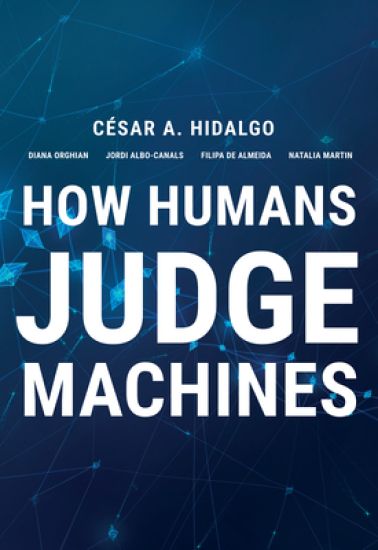
How people judge humans and machines differently, in scenarios involving natural disasters, labor displacement, policing, privacy, algorithmic bias, and more.How would you feel about losing your job to a machine? How about a tsunami alert system that fails? Would you react differently to acts of discrimination depending on whether they were carried out by a machine or by a human? What about public surveillance? How Humans Judge Machines compares people's reactions to actions performed by humans and machines. Using data collected in dozens of experiments, this book reveals the biases that permeate human-machine interactions. Are there conditions in which we judge machines unfairly? Is our judgment of machines affected by the moral dimensions of a scenario? Is our judgment of machine correlated with demographic factors such as education or gender? Cesar Hidalgo and colleagues use hard science to take on these pressing technological questions. Using randomized experiments, they create revealing counterfactuals and build statistical models to explain how people judge artificial intelligence and whether they do it fairly. Through original research, How Humans Judge Machines bring us one step closer tounderstanding the ethical consequences of AI.
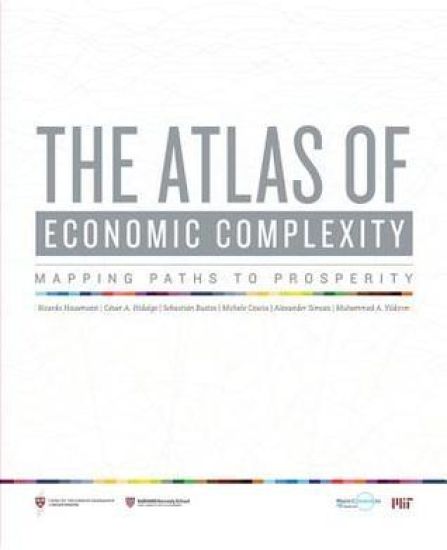
The Atlas of Economic Complexity
Ricardo Hausmann; César A. Hidalgo; Sebastián Bustos; Michele Coscia; Alexander Simoes; Muhammed A. Yildirim
MIT Press
2014
pokkari
Maps capture data expressing the economic complexity of countries from Albania to Zimbabwe, offering current economic measures and as well as a guide to achieving prosperityWhy do some countries grow and others do not? The authors of The Atlas of Economic Complexity offer readers an explanation based on "Economic Complexity," a measure of a society's productive knowledge. Prosperous societies are those that have the knowledge to make a larger variety of more complex products. The Atlas of Economic Complexity attempts to measure the amount of productive knowledge countries hold and how they can move to accumulate more of it by making more complex products.Through the graphical representation of the "Product Space," the authors are able to identify each country's "adjacent possible," or potential new products, making it easier to find paths to economic diversification and growth. In addition, they argue that a country's economic complexity and its position in the product space are better predictors of economic growth than many other well-known development indicators, including measures of competitiveness, governance, finance, and schooling.Using innovative visualizations, the book locates each country in the product space, provides complexity and growth potential rankings for 128 countries, and offers individual country pages with detailed information about a country's current capabilities and its diversification options. The maps and visualizations included in the Atlas can be used to find more viable paths to greater productive knowledge and prosperity.