Kirjojen hintavertailu. Mukana 12 595 353 kirjaa ja 12 kauppaa.

Kirjailija

Chamseddine Talhi

Kirjat ja teokset yhdessä paikassa: 5 kirjaa, julkaisuja vuosilta 2006-2016, suosituimpien joukossa Memory-Constrained Security Enforcement. Vertaile teosten hintoja ja tarkista saatavuus suomalaisista kirjakaupoista.

5 kirjaa

Kirjojen julkaisuhaarukka 2006-2016.

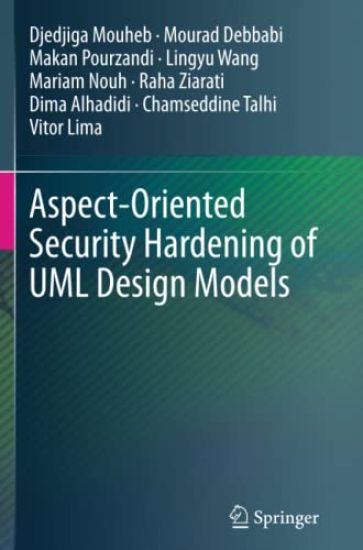
Aspect-Oriented Security Hardening of UML Design Models

Aspect-Oriented Security Hardening of UML Design Models

Djedjiga Mouheb; Mourad Debbabi; Makan Pourzandi; Lingyu Wang; Mariam Nouh; Raha Ziarati; Dima Alhadidi; Chamseddine Talhi; Vitor Lima

Springer International Publishing AG
2016
nidottu
This book comprehensively presents a novel approach to the systematic security hardening of software design models expressed in the standard UML language. It combines model-driven engineering and the aspect-oriented paradigm to integrate security practices into the early phases of the software development process. To this end, a UML profile has been developed for the specification of security hardening aspects on UML diagrams. In addition, a weaving framework, with the underlying theoretical foundations, has been designed for the systematic injection of security aspects into UML models.The work is organized as follows: chapter 1 presents an introduction to software security, model-driven engineering, UML and aspect-oriented technologies. Chapters 2 and 3 provide an overview of UML language and the main concepts of aspect-oriented modeling (AOM) respectively. Chapter 4 explores the area of model-driven architecture with a focus on model transformations. The main approaches that are adopted in the literature for security specification and hardening are presented in chapter 5. After these more general presentations, chapter 6 introduces the AOM profile for security aspects specification. Afterwards, chapter 7 details the design and the implementation of the security weaving framework, including several real-life case studies to illustrate its applicability. Chapter 8 elaborates an operational semantics for the matching/weaving processes in activity diagrams, while chapters 9 and 10 present a denotational semantics for aspect matching and weaving in executable models following a continuation-passing style. Finally, a summary and evaluation of the work presented are provided in chapter 11.The book will benefit researchers in academia and industry as well as students interested in learning about recent research advances in the field of software security engineering.
Aspect-Oriented Security Hardening of UML Design Models

Aspect-Oriented Security Hardening of UML Design Models

Djedjiga Mouheb; Mourad Debbabi; Makan Pourzandi; Lingyu Wang; Mariam Nouh; Raha Ziarati; Dima Alhadidi; Chamseddine Talhi; Vitor Lima

Springer International Publishing AG
2015
sidottu
This book comprehensively presents a novel approach to the systematic security hardening of software design models expressed in the standard UML language. It combines model-driven engineering and the aspect-oriented paradigm to integrate security practices into the early phases of the software development process. To this end, a UML profile has been developed for the specification of security hardening aspects on UML diagrams. In addition, a weaving framework, with the underlying theoretical foundations, has been designed for the systematic injection of security aspects into UML models.The work is organized as follows: chapter 1 presents an introduction to software security, model-driven engineering, UML and aspect-oriented technologies. Chapters 2 and 3 provide an overview of UML language and the main concepts of aspect-oriented modeling (AOM) respectively. Chapter 4 explores the area of model-driven architecture with a focus on model transformations. The main approaches that are adopted in the literature for security specification and hardening are presented in chapter 5. After these more general presentations, chapter 6 introduces the AOM profile for security aspects specification. Afterwards, chapter 7 details the design and the implementation of the security weaving framework, including several real-life case studies to illustrate its applicability. Chapter 8 elaborates an operational semantics for the matching/weaving processes in activity diagrams, while chapters 9 and 10 present a denotational semantics for aspect matching and weaving in executable models following a continuation-passing style. Finally, a summary and evaluation of the work presented are provided in chapter 11.The book will benefit researchers in academia and industry as well as students interested in learning about recent research advances in the field of software security engineering.
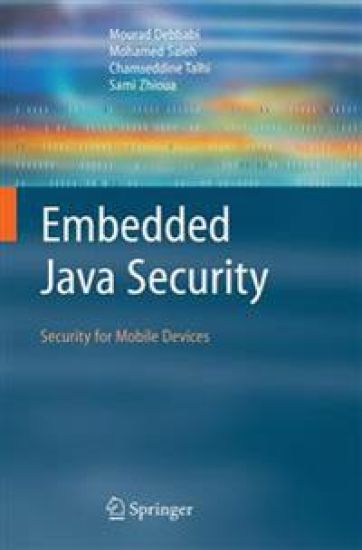
Embedded Java Security

Embedded Java Security

Mourad Debbabi; Mohamed Saleh; Chamseddine Talhi; Sami Zhioua

Springer London Ltd
2010
nidottu
Java brings more functionality and versatility to the world of mobile devices, but it also introduces new security threats. This book is a comprehensive presentation of embedded Java security. It is compared with the security model of the Java 2 Standard Edition in order to view the impact of limited resources on security. The main components of embedded Java are also generally presented to give an idea about the platform architecture. To assess the effectiveness of the security model, an evaluation of the security features is carried out with results presented in the framework of the MEHARI method for risk analysis, and the Common Criteria methodology of security evaluation. The usefulness of this security evaluation is to point out areas that need security hardening. This book provides researchers and practitioners alike with a broader and deeper understanding of the issues involved in embedded Java security, and –as a larger view- mobile devices security.
Embedded Java Security

Embedded Java Security

Mourad Debbabi; Mohamed Saleh; Chamseddine Talhi; Sami Zhioua

Springer London Ltd
2006
nidottu
Java brings more functionality and versatility to the world of mobile devices, but it also introduces new security threats. This book is a comprehensive presentation of embedded Java security. It is compared with the security model of the Java 2 Standard Edition in order to view the impact of limited resources on security. The main components of embedded Java are also generally presented to give an idea about the platform architecture. To assess the effectiveness of the security model, an evaluation of the security features is carried out with results presented in the framework of the MEHARI method for risk analysis, and the Common Criteria methodology of security evaluation. The usefulness of this security evaluation is to point out areas that need security hardening. This book provides researchers and practitioners alike with a broader and deeper understanding of the issues involved in embedded Java security, and –as a larger view- mobile devices security.