Kirjojen hintavertailu. Mukana 12 595 353 kirjaa ja 12 kauppaa.

Kirjailija

Changbao Wu

Kirjat ja teokset yhdessä paikassa: 2 kirjaa, julkaisuja vuosilta 2020-2021, suosituimpien joukossa Sampling Theory and Practice. Vertaile teosten hintoja ja tarkista saatavuus suomalaisista kirjakaupoista.

2 kirjaa

Kirjojen julkaisuhaarukka 2020-2021.

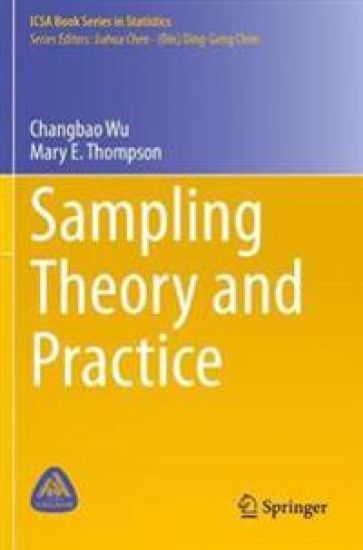
Sampling Theory and Practice

Sampling Theory and Practice

Changbao Wu; Mary E. Thompson

Springer Nature Switzerland AG
2021
nidottu
The three parts of this book on survey methodology combine an introduction to basic sampling theory, engaging presentation of topics that reflect current research trends, and informed discussion of the problems commonly encountered in survey practice. These related aspects of survey methodology rarely appear together under a single connected roof, making this book a unique combination of materials for teaching, research and practice in survey sampling. Basic knowledge of probability theory and statistical inference is assumed, but no prior exposure to survey sampling is required. The first part focuses on the design-based approach to finite population sampling. It contains a rigorous coverage of basic sampling designs, related estimation theory, model-based prediction approach, and model-assisted estimation methods. The second part stems from original research conducted by the authors as well as important methodological advances in the field during the past threedecades. Topics include calibration weighting methods, regression analysis and survey weighted estimating equation (EE) theory, longitudinal surveys and generalized estimating equations (GEE) analysis, variance estimation and resampling techniques, empirical likelihood methods for complex surveys, handling missing data and non-response, and Bayesian inference for survey data. The third part provides guidance and tools on practical aspects of large-scale surveys, such as training and quality control, frame construction, choices of survey designs, strategies for reducing non-response, and weight calculation. These procedures are illustrated through real-world surveys. Several specialized topics are also discussed in detail, including household surveys, telephone and web surveys, natural resource inventory surveys, adaptive and network surveys, dual-frame and multiple frame surveys, and analysis of non-probability survey samples. This book is a self-contained introduction to survey sampling that provides a strong theoretical base with coverage of current research trends and pragmatic guidance and tools for conducting surveys.
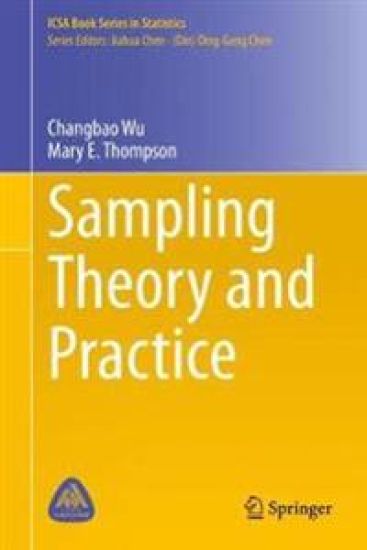
Sampling Theory and Practice

Sampling Theory and Practice

Changbao Wu; Mary E. Thompson

Springer Nature Switzerland AG
2020
sidottu
The three parts of this book on survey methodology combine an introduction to basic sampling theory, engaging presentation of topics that reflect current research trends, and informed discussion of the problems commonly encountered in survey practice. These related aspects of survey methodology rarely appear together under a single connected roof, making this book a unique combination of materials for teaching, research and practice in survey sampling. Basic knowledge of probability theory and statistical inference is assumed, but no prior exposure to survey sampling is required. The first part focuses on the design-based approach to finite population sampling. It contains a rigorous coverage of basic sampling designs, related estimation theory, model-based prediction approach, and model-assisted estimation methods. The second part stems from original research conducted by the authors as well as important methodological advances in the field during the past threedecades. Topics include calibration weighting methods, regression analysis and survey weighted estimating equation (EE) theory, longitudinal surveys and generalized estimating equations (GEE) analysis, variance estimation and resampling techniques, empirical likelihood methods for complex surveys, handling missing data and non-response, and Bayesian inference for survey data. The third part provides guidance and tools on practical aspects of large-scale surveys, such as training and quality control, frame construction, choices of survey designs, strategies for reducing non-response, and weight calculation. These procedures are illustrated through real-world surveys. Several specialized topics are also discussed in detail, including household surveys, telephone and web surveys, natural resource inventory surveys, adaptive and network surveys, dual-frame and multiple frame surveys, and analysis of non-probability survey samples. This book is a self-contained introduction to survey sampling that provides a strong theoretical base with coverage of current research trends and pragmatic guidance and tools for conducting surveys.