Kirjojen hintavertailu. Mukana 12 595 353 kirjaa ja 12 kauppaa.

Kirjailija

Changxing Ma

Kirjat ja teokset yhdessä paikassa: 2 kirjaa, julkaisuja vuosilta 2007-2010, suosituimpien joukossa Statistical Genetics of Quantitative Traits. Vertaile teosten hintoja ja tarkista saatavuus suomalaisista kirjakaupoista.

2 kirjaa

Kirjojen julkaisuhaarukka 2007-2010.

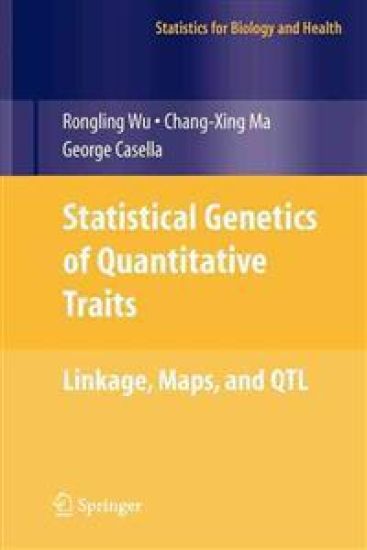
Statistical Genetics of Quantitative Traits

Statistical Genetics of Quantitative Traits

Rongling Wu; Changxing Ma; George Casella

Springer-Verlag New York Inc.
2010
nidottu
Most traits in nature and of importance to agriculture are quantitatively inherited. These traits are di?cult to study due to the complex nature of their inheritance. However, recent developments of genomic technologies provide a revolutionary means for unraveling the secrets of genetic variation in quantitative traits. Genomic te- nologies allow the molecular characterization of polymorphic markers throughout the entire genome that are then used to identify and map the genes or quantitative trait loci (QTLs) underlying a quantitative trait based on linkage analysis. Statistical analysis is a crucial tool for analyzing genome data, which are now becoming increasingly available for a variety of species, and for giving precise exp- nations regarding genetic variation in quantitative traits occurring among species, populations, families, and individuals. In 1989, Lander and Botstein published a ha- mark methodological paper for interval mapping that enables geneticists to detect and estimate individual QTL that control the phenotype of a trait. Today, interval mappingisanimportantstatisticaltoolforstudyingthegeneticsofquantitativetraits at the molecular level, and has led to the discovery of thousands of QTLs responsible for a variety of traits in plants, animals, and humans. In a recent study published in Science, Li, Zhou, and Sang (2006, 311, 1936–1939) were able to characterize the molecular basis of the reduction of grain shattering – a fundamental selection process for rice domestication – at the detected QTL by interval mapping.
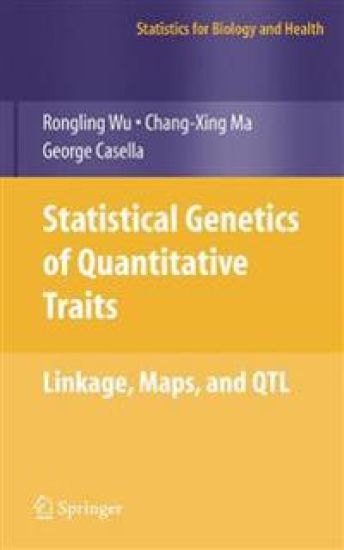
Statistical Genetics of Quantitative Traits

Statistical Genetics of Quantitative Traits

Rongling Wu; Changxing Ma; George Casella

Springer-Verlag New York Inc.
2007
sidottu
Most traits in nature and of importance to agriculture are quantitatively inherited. These traits are di?cult to study due to the complex nature of their inheritance. However, recent developments of genomic technologies provide a revolutionary means for unraveling the secrets of genetic variation in quantitative traits. Genomic te- nologies allow the molecular characterization of polymorphic markers throughout the entire genome that are then used to identify and map the genes or quantitative trait loci (QTLs) underlying a quantitative trait based on linkage analysis. Statistical analysis is a crucial tool for analyzing genome data, which are now becoming increasingly available for a variety of species, and for giving precise exp- nations regarding genetic variation in quantitative traits occurring among species, populations, families, and individuals. In 1989, Lander and Botstein published a ha- mark methodological paper for interval mapping that enables geneticists to detect and estimate individual QTL that control the phenotype of a trait. Today, interval mappingisanimportantstatisticaltoolforstudyingthegeneticsofquantitativetraits at the molecular level, and has led to the discovery of thousands of QTLs responsible for a variety of traits in plants, animals, and humans. In a recent study published in Science, Li, Zhou, and Sang (2006, 311, 1936–1939) were able to characterize the molecular basis of the reduction of grain shattering – a fundamental selection process for rice domestication – at the detected QTL by interval mapping.