Kirjojen hintavertailu. Mukana 12 390 323 kirjaa ja 12 kauppaa.

Kirjailija

Charles A. Stevenson

Kirjat ja teokset yhdessä paikassa: 8 kirjaa, julkaisuja vuosilta 2006-2024, suosituimpien joukossa Warriors and Politicians. Vertaile teosten hintoja ja tarkista saatavuus suomalaisista kirjakaupoista.

Mukana myös kirjoitusasut: Charles A Stevenson

8 kirjaa

Kirjojen julkaisuhaarukka 2006-2024.

Uncle Henry's Hacienda

Uncle Henry's Hacienda

Charles A Stevenson

Aurora House
2024
pokkari
Throughout his life, Henry Anderson, born in 1891, never lost sight of his dream, which was to own a cattle ranch in Mexico with a beautiful hacienda. From a small farm in rural South Texas to a dusty border town in Arizona, Henry then moved to California, his finances affluent. Throughout the 1920s and '30s, he experienced the glitz and glamour of Hollywood. Unfortunately, his fortune was lost in the Great Depression, and afterwards, he pursued the uncertain life of a prospector for gold in the mountains of Northern Mexico.
Scientific Charles Recalls a Poetic Stevenson

Scientific Charles Recalls a Poetic Stevenson

Charles A. Stevenson

GROSVENOR HOUSE PUBLISHING LTD
2023
sidottu
SCRAPS, the full title being Scientific Charles Recalls a Poetic Stevenson, written by Charles Alexander Stevenson, was an idea the author had recalling and correcting some impressions of his cousin Robert Louis Stevenson and of life in Edinburgh and the Scottish Borders, in the 19th century. Much has been published about RLS as a writer, however here we have a first hand account from his cousin, of the young man, his family, within the context of the environment in which he was brought up. Charles Stevenson provides an intimate and authentic description of this Scottish writer in his early years before he became famous. In the latter part of his life, Charles Stevenson, despite his failing health, remained determined that the manuscript of his compiled recollections should be completed as a published book. With the help of his daughter, May (Evelyn Mary Yeoman), he was able to dictate his thoughts, which she would transcribe each day prior to his corrections and amendments. The process ended on Charles' death in 1950 and it is only now that this project has finally come to fruition.
America's Foreign Policy Toolkit

America's Foreign Policy Toolkit

Charles A. Stevenson

CQ Press
2012
nidottu
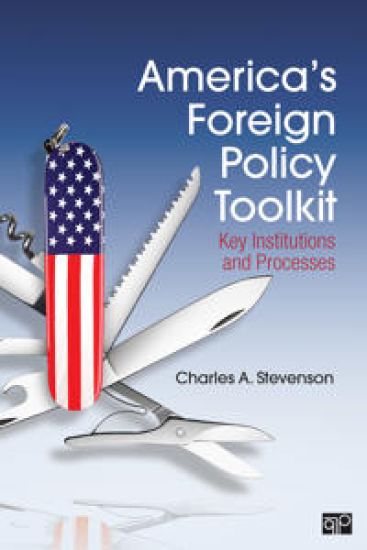
How is foreign policy in the United States really crafted? Who does the work? How are the various activites of the many key participants coordinated and controlled? In America's Foreign Policy Toolkit: Key Institutions and Processes, Charles A. Stevenson identifies for students what the key foreign policy tools are, clarifies which tools are best for which tasks, describes the factors that constrain or push how they're used, and provides fresh insight into the myriad challenges facing national security decisionmakers. Written in an engaging style with case examples drawn from "behind the scenes," Stevenson brings depth and dimension to the sophisticated pathways and instruments of American foreign policy, from the State Department to the intelligence agencies to the Commerce Department and beyond. In this brief text for American foreign policy and national security courses, Stevenson focuses on the institutions and processes of foreign policy, beginning with a look at the historical context and then looking in turn at the tools available to the president, congress, and the shared budgetary tools. The following part, "Using the Tools," looks at the diplomatic, economic, military, intelligence, homeland security, and international institutions instruments. Stevenson concludes with chapters that consider the important constraints and limitation of the U.S. toolkit. Each chapter ends with a case study that allows readers to connect the theory of the toolkit with the realities of decisionmaking. Highlights of the text's coverage include: A sustained analysis of the U.S. Constitution as a response to security threats in the 1780s, providing a strong historical foundation on and springboard for discussion of this basic document in terms of national security powers; Comprehensive coverage of the congressional role overseeing all other policy instruments, showing Congress as an active player in all aspects of foreign policy; Analysis of the full spectrum of agencies and activities involved in foreign economic policy, covering the numerous organizations involved in foreign economic policy, the weak coordinating mechanisms, and the various processes (sanctions, trade, foreign assistance, direct investment) used as policy tools; A consistent framework for analyzing each instrument (authorities, capabilities, personnel, culture, internal factions, and the role of Congress), which makes comparative analyses of U.S. institutions simple and direct; An illuminating overview of the budget process through both the executive and legislative branches, acknowledging the budget process as a shared policy tool, with conflict and feedback, rather than as a linear process; A discussion of homeland security instruments and international organizations used as policy tools, highlighting the relevance of these new and often overlooked instruments; and A survey of recommendations for reform and the difficulties involved, providing possible explanations of foreign policy failures and alternative organizations and processes. This must-have text for courses on American foreign policy will be a crucial reference that students will keep on the shelf long after the last class.
Congress at War

Congress at War

Charles A. Stevenson

Potomac Books Inc
2007
pokkari
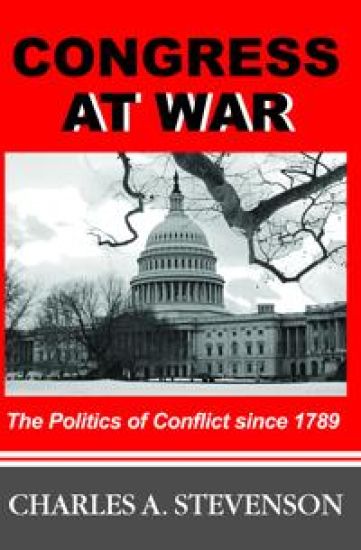
Congress at War reviews the historical record of the U.S. Congress in authorizing, funding, overseeing, and terminating major military operations. Refuting arguments that Congress cannot and should not set limits or conditions on the use of U.S. armed forces, this book catalogs the many times when previous Congresses have enacted restrictions—often with the acceptance and compliance of wartime presidents. While Congress has formally declared war only five times in U.S. history, it has authorized the use of force fifteen other times. In recent decades, however, lawmakers have weakened their Constitutional claims by failing on several occasions to enact measures either supporting or opposing military operations ordered by the president. Concise, dramatically written, and illustrated with several summary tables, this book is a must-read for anyone interested in America's wars—past or present.
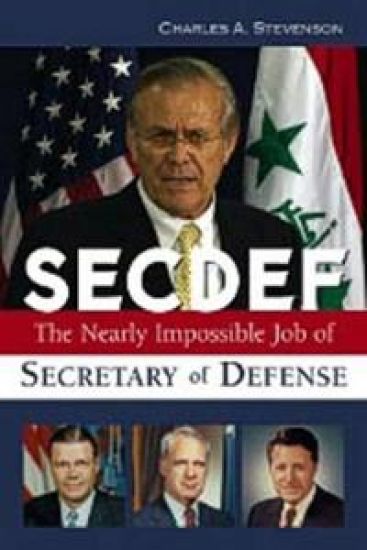
SECDEF

SECDEF

Charles A. Stevenson

Potomac Books Inc
2007
pokkari
SECDEF offers an expert's insights into one of the most difficult jobs in Washington. Of the twenty-one men who have held the post of secretary of defense since it was created in 1947, only half served more than eighteen months. The first, James Forrestal, committed suicide soon after leaving the Pentagon. Seven of his successors were fired or allowed to resign gracefully after losing the confidence of the president. Many left frustrated and disappointed, while few retained the celebrity and esteem they held while in office. One observer has called the job "the graveyard of political ambitions."Charles A. Stevenson, who as a national security adviser to four U.S. senators has seen several defense secretaries in action, examines the unique challenges of this office to learn why the failure rate has been so high. SECDEF focuses on how the secretary performs in the broader world of national security policymaking, how he handles civil-military relations in planning strategy and wars, how he functions on the National Security Council and deals with the president and secretary of state, and how well he performs as a politician, especially in dealing with Congress. In office, Charles Stevenson finds, these men have tended to fall into one of the three general roles for executing such responsibilities: revolutionaries, firefighters, or, the most common role, team players. Stevenson analyzes each type for its defining characteristics and evaluates individual secretaries. This book will appeal to defense professionals and students alike and to readers interested in American defense and foreign policy who want to learn more about the important role often played by the person informally labeled the SECDEF.
Warriors and Politicians

Warriors and Politicians

Charles A. Stevenson

Routledge
2006
nidottu
With historical case studies ranging from the Revolutionary War to the war in Iraq, this new book shows how and why the US military is caught between two civilian masters – the President and Congress – in responding to the challenges of warfighting, rearmament, and transformation. Charles Stevenson skilfully shows how, although the United States has never faced the danger of a military coup, the relations between civilian leaders and the military have not always been easy. Presidents have contended with military leaders who were reluctant to carry out their orders. Generals and Admirals have appealed to Congress for sympathy and support. Congressional leaders have tried to impose their own visions and strategies on the US armed forces. This triangular struggle has recurred time and again, in wartime and in efforts to reshape the military for future wars.Illustrating this dual system of civilian military control in a series of case studies, this new volume starts from the way the Continental Congress ran the Revolutionary War by committee and concludes with the George W. Bush and Donald Rumsfeld efforts to transform the US military into a modern terrorist-fighting force. This detailed coverage shows how warriors and politicians interacted at key points in US history. This book will be of great interest to all students of the US Military, government of the United States and of strategic and military studies in general.
Warriors and Politicians

Warriors and Politicians

Charles A. Stevenson

Routledge
2006
sidottu
With historical case studies ranging from the Revolutionary War to the war in Iraq, this new book shows how and why the US military is caught between two civilian masters – the President and Congress – in responding to the challenges of warfighting, rearmament, and transformation. Charles Stevenson skilfully shows how, although the United States has never faced the danger of a military coup, the relations between civilian leaders and the military have not always been easy. Presidents have contended with military leaders who were reluctant to carry out their orders. Generals and Admirals have appealed to Congress for sympathy and support. Congressional leaders have tried to impose their own visions and strategies on the US armed forces. This triangular struggle has recurred time and again, in wartime and in efforts to reshape the military for future wars.Illustrating this dual system of civilian military control in a series of case studies, this new volume starts from the way the Continental Congress ran the Revolutionary War by committee and concludes with the George W. Bush and Donald Rumsfeld efforts to transform the US military into a modern terrorist-fighting force. This detailed coverage shows how warriors and politicians interacted at key points in US history. This book will be of great interest to all students of the US Military, government of the United States and of strategic and military studies in general.
Secdef

Secdef

Charles A. Stevenson

Potomac Books Inc
2006
sidottu
SECDEF offers an expert's insights into one of the most difficult jobs in Washington. Of the twenty-one men who have held the post of secretary of defense since it was created in 1947, only half served more than eighteen months. The first, James Forrestal, committed suicide soon after leaving the Pentagon. Seven of his successors were fired or allowed to resign gracefully after losing the confidence of the president. Many left frustrated and disappointed, while few retained the celebrity and esteem they held while in office. One observer has called the job "the graveyard of political ambitions."Charles A. Stevenson, who as a national security adviser to four U.S. senators has seen several defense secretaries in action, examines the unique challenges of this office to learn why the failure rate has been so high. SECDEF focuses on how the secretary performs in the broader world of national security policymaking, how he handles civil-military relations in planning strategy and wars, how he functions on the National Security Council and deals with the president and secretary of state, and how well he performs as a politician, especially in dealing with Congress. In office, Charles Stevenson finds, these men have tended to fall into one of the three general roles for executing such responsibilities: revolutionaries, firefighters, or, the most common role, team players. Stevenson analyzes each type for its defining characteristics and evaluates individual secretaries. This book will appeal to defense professionals and students alike and to readers interested in American defense and foreign policy who want to learn more about the important role often played by the person informally labeled the SECDEF.