Kirjojen hintavertailu. Mukana 12 390 323 kirjaa ja 12 kauppaa.

Kirjailija

Charles A. Weibel

Kirjat ja teokset yhdessä paikassa: 5 kirjaa, julkaisuja vuosilta 1995-2019, suosituimpien joukossa The $K$-book. Vertaile teosten hintoja ja tarkista saatavuus suomalaisista kirjakaupoista.

5 kirjaa

Kirjojen julkaisuhaarukka 1995-2019.

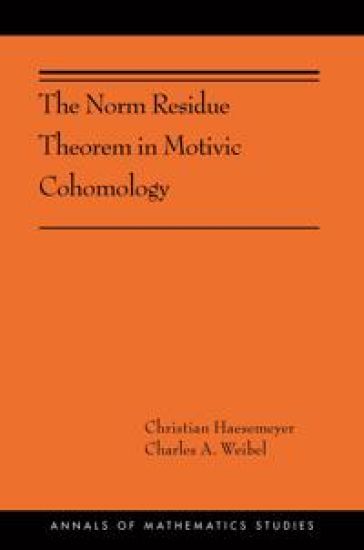
The Norm Residue Theorem in Motivic Cohomology

The Norm Residue Theorem in Motivic Cohomology

Christian Haesemeyer; Charles A. Weibel

PRINCETON UNIVERSITY PRESS
2019
sidottu
This book presents the complete proof of the Bloch-Kato conjecture and several related conjectures of Beilinson and Lichtenbaum in algebraic geometry. Brought together here for the first time, these conjectures describe the structure of étale cohomology and its relation to motivic cohomology and Chow groups.Although the proof relies on the work of several people, it is credited primarily to Vladimir Voevodsky. The authors draw on a multitude of published and unpublished sources to explain the large-scale structure of Voevodsky’s proof and introduce the key figures behind its development. They proceed to describe the highly innovative geometric constructions of Markus Rost, including the construction of norm varieties, which play a crucial role in the proof. The book then addresses symmetric powers of motives and motivic cohomology operations.Comprehensive and self-contained, The Norm Residue Theorem in Motivic Cohomology unites various components of the proof that until now were scattered across many sources of varying accessibility, often with differing hypotheses, definitions, and language.
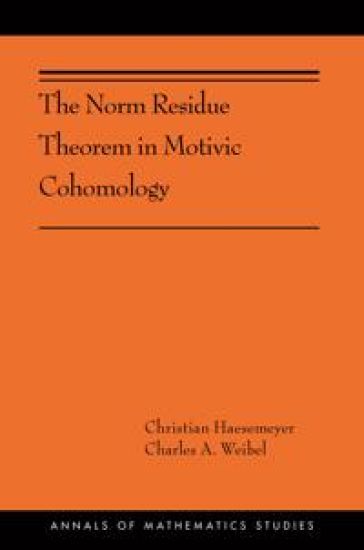
The Norm Residue Theorem in Motivic Cohomology

The Norm Residue Theorem in Motivic Cohomology

Christian Haesemeyer; Charles A. Weibel

Princeton University Press
2019
pokkari
This book presents the complete proof of the Bloch-Kato conjecture and several related conjectures of Beilinson and Lichtenbaum in algebraic geometry. Brought together here for the first time, these conjectures describe the structure of étale cohomology and its relation to motivic cohomology and Chow groups.Although the proof relies on the work of several people, it is credited primarily to Vladimir Voevodsky. The authors draw on a multitude of published and unpublished sources to explain the large-scale structure of Voevodsky’s proof and introduce the key figures behind its development. They proceed to describe the highly innovative geometric constructions of Markus Rost, including the construction of norm varieties, which play a crucial role in the proof. The book then addresses symmetric powers of motives and motivic cohomology operations.Comprehensive and self-contained, The Norm Residue Theorem in Motivic Cohomology unites various components of the proof that until now were scattered across many sources of varying accessibility, often with differing hypotheses, definitions, and language.
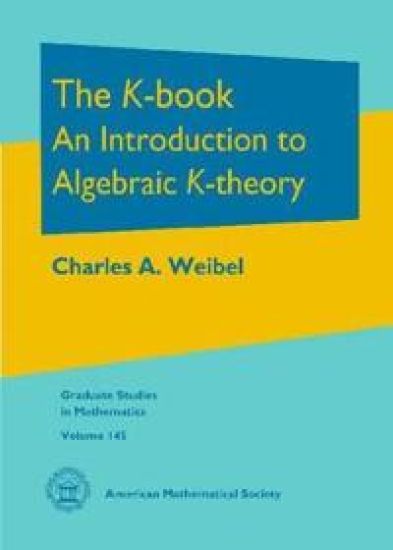
The K-book

The K-book

Charles A. Weibel

American Mathematical Society
2013
sidottu
Informally, $K$-theory is a tool for probing the structure of a mathematical object such as a ring or a topological space in terms of suitably parameterized vector spaces and producing important intrinsic invariants which are useful in the study of algebraic and geometric questions. Algebraic $K$-theory, which is the main character of this book, deals mainly with studying the structure of rings. However, it turns out that even working in a purely algebraic context, one requires techniques from homotopy theory to construct the higher $K$-groups and to perform computations. The resulting interplay of algebra, geometry, and topology in $K$-theory provides a fascinating glimpse of the unity of mathematics. This book is a comprehensive introduction to the subject of algebraic $K$-theory. It blends classical algebraic techniques for $K_0$ and $K_1$ with newer topological techniques for higher $K$-theory such as homotopy theory, spectra, and cohomological descent. The book takes the reader from the basics of the subject to the state of the art, including the calculation of the higher $K$-theory of number fields and the relation to the Riemann zeta function.
The $K$-book

The $K$-book

Charles A. Weibel

AMERICAN MATHEMATICAL SOCIETY
2013
nidottu
Informally, $K$-theory is a tool for probing the structure of a mathematical object such as a ring or a topological space in terms of suitably parameterized vector spaces and producing important intrinsic invariants which are useful in the study of algebraic and geometric questions. Algebraic $K$-theory, which is the main character of this book, deals mainly with studying the structure of rings. However, it turns out that even working in a purely algebraic context, one requires techniques from homotopy theory to construct the higher $K$-groups and to perform computations. The resulting interplay of algebra, geometry, and topology in $K$-theory provides a fascinating glimpse of the unity of mathematics. This book is a comprehensive introduction to the subject of algebraic $K$-theory. It blends classical algebraic techniques for $K_0$ and $K_1$ with newer topological techniques for higher $K$-theory such as homotopy theory, spectra, and cohomological descent. The book takes the reader from the basics of the subject to the state of the art, including the calculation of the higher $K$-theory of number fields and the relation to the Riemann zeta function.
An Introduction to Homological Algebra

An Introduction to Homological Algebra

Charles A. Weibel

Cambridge University Press
1995
pokkari
The landscape of homological algebra has evolved over the last half-century into a fundamental tool for the working mathematician. This book provides a unified account of homological algebra as it exists today. The historical connection with topology, regular local rings, and semi-simple Lie algebras are also described. This book is suitable for second or third year graduate students. The first half of the book takes as its subject the canonical topics in homological algebra: derived functors, Tor and Ext, projective dimensions and spectral sequences. Homology of group and Lie algebras illustrate these topics. Intermingled are less canonical topics, such as the derived inverse limit functor lim1, local cohomology, Galois cohomology, and affine Lie algebras. The last part of the book covers less traditional topics that are a vital part of the modern homological toolkit: simplicial methods, Hochschild and cyclic homology, derived categories and total derived functors. By making these tools more accessible, the book helps to break down the technological barrier between experts and casual users of homological algebra.