Kirjojen hintavertailu. Mukana 12 657 676 kirjaa ja 12 kauppaa.
Kirjailija
Charles C. Lemert
Kirjat ja teokset yhdessä paikassa: 24 kirjaa, julkaisuja vuosilta 2004-2022, suosituimpien joukossa Michel Foucault. Social Theory and Transgression. Vertaile teosten hintoja ja tarkista saatavuus suomalaisista kirjakaupoista.
This work marks the recent passing of the 100th Anniversary of Du Bois' classic of African American literature. More than fifty events and celebrations were held in cities and universities around the country. It poignantly explores the relationship of Du Bois, the man, to his writings. It is written by expert team of authors including the prominent Manning Marable. "The Souls of W. E. B. Du Bois" explores the relationship of W. E. B. Du Bois' seminal book, "The Souls of Black Folk", to other works in his scholarly portfolio and to his larger project concerning race, racial identity, and the social objectives of scholarly engagement. Prominent authors consider why the classic book remains so relevant today.
"Globalization: An Introduction to the End of the Known World" surveys the history of globalization from the earliest of ancient texts through contemporary debates and the prospects for anticipating the new worlds to come. At the end of the twentieth century, debates over the nature of globalization were unable to agree on a simple resolution, except to say that globalization is economic, political, and cultural all at once. Cultural globalization affects everyone with a smartphone, on which global youth from Los Angeles to Jakarta listen to Jay-Z and Beyonce. States are torn in several directions at once by unsettling economic, political, and cultural forces. Lemert concludes with a serious outline of the possible ways of imagining what the still-unknown global world will become next ways including optimism, caution, and skepticism."
"Globalization: An Introduction to the End of the Known World" surveys the history of globalization from the earliest of ancient texts through contemporary debates and the prospects for anticipating the new worlds to come. At the end of the twentieth century, debates over the nature of globalization were unable to agree on a simple resolution, except to say that globalization is economic, political, and cultural all at once. Cultural globalization affects everyone with a smartphone, on which global youth from Los Angeles to Jakarta listen to Jay-Z and Beyonce. States are torn in several directions at once by unsettling economic, political, and cultural forces. Lemert concludes with a serious outline of the possible ways of imagining what the still-unknown global world will become next ways including optimism, caution, and skepticism."
Uncertain Worlds is the definitive presentation of the evolution of world-systems analysis from the point of view of its founder, Immanuel Wallerstein. Few theorists have offered a more systematic theory of what has become known as 'globalisation' than Wallerstein. The book includes a one-of-kind interview with Wallerstein by Carlos Rojas, a conversation between Wallerstein and Lemert about the history of the field as it has come down to the present time, a long essay by Lemert on the uncertainties of the modern world-system, as well as a preface by Rojas and a concluding essay by Wallerstein. No other book lends such biographical, historical, and personal nuance to the biography of world-systems analysis and, thus, to the history of our times. The will be a key reference book for students of global politics, economics and international relations.
Uncertain Worlds is the definitive presentation of the evolution of world-systems analysis from the point of view of its founder, Immanuel Wallerstein. Few theorists have offered a more systematic theory of what has become known as 'globalisation' than Wallerstein. The book includes a one-of-kind interview with Wallerstein by Carlos Rojas, a conversation between Wallerstein and Lemert about the history of the field as it has come down to the present time, a long essay by Lemert on the uncertainties of the modern world-system, as well as a preface by Rojas and a concluding essay by Wallerstein. No other book lends such biographical, historical, and personal nuance to the biography of world-systems analysis and, thus, to the history of our times. The will be a key reference book for students of global politics, economics and international relations.
The Structural Lie tackles one of social science's most mysterious problems. How is it possible to derive statements about the grand structures of social life from their effects in the small movements of everyday life? Prominent sociologist Charles Lemert shows how Marx and Freud provide some answers to this question. Marx derived from the commodity his picture of the capitalist system, Freud diagnosed the character of psyches from the details of dreams, slips and jokes. This wonderfully readable and engaging book lays the foundation for a new social science in an age where a microchip can convey a world of information.
In this book, the presidential debates of 2000, 2004, and 2008 are analyzed in terms of linguistics, rhetoric, and religious context to offer a unique perspective on the styles, beliefs, and strategies of the two major parties and their candidates.In The Podium, the Pulpit, and the Republicans: How Presidential Candidates Use Religious Language in American Political Debate, a veteran minister analyzes the religious metaphors Republicans use at the podium and alleges that the party deliberately employs blaming tactics, fear metaphors, and coded references to apocalyptic judgment to sway undecided voters.Over the past 40 years, Frederick Stecker charges, the Republican Party has created fear for political expediency. Stecker's book traces the development of the Republican rhetoric of polarization and applies the linguistics-based "nation-as-a-family" political typology of George Lakoff to an analysis of the presidential debates of 2000, 2004, and 2008. He demonstrates how Republican candidates select their language and metaphors to signal adherence to rigid belief systems and simple, black-and-white choices in domestic and foreign policy.
In this book, the presidential debates of 2000, 2004, and 2008 are analyzed in terms of linguistics, rhetoric, and religious context to offer a unique perspective on the styles, beliefs, and strategies of the two major parties and their candidates.In The Podium, the Pulpit, and the Republicans: How Presidential Candidates Use Religious Language in American Political Debate, a veteran minister analyzes the religious metaphors Republicans use at the podium and alleges that the party deliberately employs blaming tactics, fear metaphors, and coded references to apocalyptic judgment to sway undecided voters.Over the past 40 years, Frederick Stecker charges, the Republican Party has created fear for political expediency. Stecker's book traces the development of the Republican rhetoric of polarization and applies the linguistics-based "nation-as-a-family" political typology of George Lakoff to an analysis of the presidential debates of 2000, 2004, and 2008. He demonstrates how Republican candidates select their language and metaphors to signal adherence to rigid belief systems and simple, black-and-white choices in domestic and foreign policy.
The Structural Lie tackles one of social science's most mysterious problems. How is it possible to derive statements about the grand structures of social life from their effects in the small movements of everyday life? Prominent sociologist Charles Lemert shows how Marx and Freud provide some answers to this question. Marx derived from the commodity his picture of the capitalist system, Freud diagnosed the character of psyches from the details of dreams, slips and jokes. This wonderfully readable and engaging book lays the foundation for a new social science in an age where a microchip can convey a world of information.
The voices of famous and lesser known figures in America's quest to reduce poverty are collected for the first time in this comprehensive historical anthology. The book traces the most important ideas and contributions of citizens, activists, labour leaders, scholars, politicians, and governmental agencies to ensure American citizens the basics of food, housing, employment, education, and health care. The book follows the idea of poverty reduction from Thomas Paine's agrarian justice to Josiah Quincy's proposal for the construction of poorhouses; from the Freedmen's Bureau to Sitting Bull's demand for money and supplies; from Coxey's army of the unemployed to Jane Addams's Hull House; from the Civil Works Administration to Dr. Martin Luther King, Jr.'s call for an Economic Bill of Rights; and from William Julius Wilson's universal programme of reform to George W. Bush's armies of compassion.
In the eloquent style for which he has become famous, Charles Lemert writes of social theory as no one else. Thinking the Unthinkable is offered as text for instruction, yet it defies the prevailing assumption that social theory is a method for clarifying the facts of social life. Lemert shows how social theory began late in the 19th century as a struggle to come to terms with the failure of modern reason to solve the social problems created by the capitalist world-system. Since then, social theory has developed through twists and turns to think and rethink this Unthinkable. Hence the surprising innovations of recent years-postmodern, queer, postcolonial, third-wave feminist, risk theories, among others arising in the wake of globalization. Once again, Lemert has made the difficult clear in a book that students and other readers will treasure and keep.
In the eloquent style for which he has become famous, Charles Lemert writes of social theory as no one else. Thinking the Unthinkable is offered as text for instruction, yet it defies the prevailing assumption that social theory is a method for clarifying the facts of social life. Lemert shows how social theory began late in the 19th century as a struggle to come to terms with the failure of modern reason to solve the social problems created by the capitalist world-system. Since then, social theory has developed through twists and turns to think and rethink this Unthinkable. Hence the surprising innovations of recent years-postmodern, queer, postcolonial, third-wave feminist, risk theories, among others arising in the wake of globalization. Once again, Lemert has made the difficult clear in a book that students and other readers will treasure and keep.
The voices of famous and lesser known figures in America's quest to reduce poverty are collected for the first time in this comprehensive historical anthology. The book traces the most important ideas and contributions of citizens, activists, labour leaders, scholars, politicians, and governmental agencies to ensure American citizens the basics of food, housing, employment, education, and health care. The book follows the idea of poverty reduction from Thomas Paine's agrarian justice to Josiah Quincy's proposal for the construction of poorhouses; from the Freedmen's Bureau to Sitting Bull's demand for money and supplies; from Coxey's army of the unemployed to Jane Addams's Hull House; from the Civil Works Administration to Dr. Martin Luther King, Jr.'s call for an Economic Bill of Rights; and from William Julius Wilson's universal programme of reform to George W. Bush's armies of compassion.
This work marks the recent passing of the 100th Anniversary of Du Bois' classic of African American literature. More than fifty events and celebrations were held in cities and universities around the country. It poignantly explores the relationship of Du Bois, the man, to his writings. It is written by expert team of authors including the prominent Manning Marable. "The Souls of W. E. B. Du Bois" explores the relationship of W. E. B. Du Bois' seminal book, "The Souls of Black Folk", to other works in his scholarly portfolio and to his larger project concerning race, racial identity, and the social objectives of scholarly engagement. Prominent authors consider why the classic book remains so relevant today.
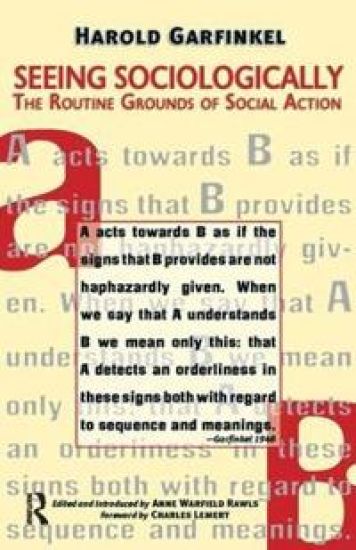
This book-never before published-is eminent sociologist Harold Garfinkel's earliest attempt, while at Harvard in 1948, to bridge the growing gap in American sociology. This gap was generated by a Parsonian paradigm that emphasised a scientific approach to sociological description, one that increasingly distanced itself from social phenomena in the increasingly influential ways studied by phenomenologists. It was Garfinkel's idea that phenomenological description, rendered in more empirical and interactive terms, might remedy shortcomings in the reigning Parsonian view. Garfinkel soon gave up the attempt to repair scientific description, and his focus became increasingly empirical until, in 1954, he famously coined the term "Ethnomethodology." However, in this early manuscript can be seen more clearly than in some of his later work the struggle with a conceptual and positivist rendering of social relations that ultimately informed Garfinkel's position. Here we find the sources of his turn toward ethnomethodology, which would influence subsequent generations of sociologists. Essential reading for all social theory scholars and graduate students and for a wider range of social scientists in anthropology, ethnomethodology, and other fields.
This book-never before published-is eminent sociologist Harold Garfinkel's earliest attempt, while at Harvard in 1948, to bridge the growing gap in American sociology. This gap was generated by a Parsonian paradigm that emphasised a scientific approach to sociological description, one that increasingly distanced itself from social phenomena in the increasingly influential ways studied by phenomenologists. It was Garfinkel's idea that phenomenological description, rendered in more empirical and interactive terms, might remedy shortcomings in the reigning Parsonian view. Garfinkel soon gave up the attempt to repair scientific description, and his focus became increasingly empirical until, in 1954, he famously coined the term "Ethnomethodology." However, in this early manuscript can be seen more clearly than in some of his later work the struggle with a conceptual and positivist rendering of social relations that ultimately informed Garfinkel's position. Here we find the sources of his turn toward ethnomethodology, which would influence subsequent generations of sociologists. Essential reading for all social theory scholars and graduate students and for a wider range of social scientists in anthropology, ethnomethodology, and other fields.
'Charles Lemert is one of the most thoughtful and interesting of sociology's postmodernists. He recurrently finds new angles of vision and is especially helpful for overcoming the pernicious opposition of 'micro' and 'macro' perspectives.' -Craig Calhoun, New York University (on the first edition) Highly readable, the second edition of Postmodernism Is Not What You Think responds to the widespread claim that postmodernism is over. It explains the historical connections between the postmodern and globalization. Those who wish to kill the term postmodernism still must face the facts that the former nationalistic world-system has collapsed and is slowly being replaced by a more global set of structures. The book is completely revised and updated with an entirely new section on globalization. The media and popular culture, identity politics, the science wars, politics and cultural studies, structuralism and poststructuralism, and the new sociologies are also put in perspective as signs of the new social formations dawning at the end of the modern age. Lemert shows that the postmodern is less a theory than a condition of social life brought about by the trouble modernity has gotten itself into.
'Charles Lemert is one of the most thoughtful and interesting of sociology's postmodernists. He recurrently finds new angles of vision and is especially helpful for overcoming the pernicious opposition of 'micro' and 'macro' perspectives.' -Craig Calhoun, New York University (on the first edition) Highly readable, the second edition of Postmodernism Is Not What You Think responds to the widespread claim that postmodernism is over. It explains the historical connections between the postmodern and globalization. Those who wish to kill the term postmodernism still must face the facts that the former nationalistic world-system has collapsed and is slowly being replaced by a more global set of structures. The book is completely revised and updated with an entirely new section on globalization. The media and popular culture, identity politics, the science wars, politics and cultural studies, structuralism and poststructuralism, and the new sociologies are also put in perspective as signs of the new social formations dawning at the end of the modern age. Lemert shows that the postmodern is less a theory than a condition of social life brought about by the trouble modernity has gotten itself into.