Kirjojen hintavertailu. Mukana 12 595 353 kirjaa ja 12 kauppaa.

Kirjailija

Charles E. Burkhardt

Kirjat ja teokset yhdessä paikassa: 4 kirjaa, julkaisuja vuosilta 2005-2010, suosituimpien joukossa Foundations of Quantum Physics. Vertaile teosten hintoja ja tarkista saatavuus suomalaisista kirjakaupoista.

4 kirjaa

Kirjojen julkaisuhaarukka 2005-2010.

Foundations of Quantum Physics

Foundations of Quantum Physics

Charles E. Burkhardt; Jacob J. Leventhal

Springer-Verlag New York Inc.
2010
nidottu
This book is meant to be a text for a ?rst course in quantum physics. It is assumed that the student has had courses in Modern Physics and in mathematics through differential equations. The book is otherwise self-contained and does not rely on outside resources such as the internet to supplement the material. SI units are used throughoutexcept for those topics for which atomic units are especially convenient. It is our belief that for a physics major a quantum physics textbook should be more than a one- or two-semester acquaintance. Consequently, this book contains material that, while germane to the subject, the instructor might choose to omit because of time limitations. There are topics and examples included that are not normally covered in introductory textbooks. These topics are not necessarily too advanced, they are simply not usually covered. We have not, however, presumed to tell the instructor which topics must be included and which may be omitted. It is our intention that omitted subjects are available for future reference in a book that is already familiar to its owner. In short, it is our hope that the student will use the book as a reference after having completed the course. We have included at the end of most chapters a “Retrospective” of the chapter. Thisis notmeanttobemerelya summary,but,rather,anoverviewoftheimportance ofthe material andits placein the contextofpreviousandforthcomingchapters.
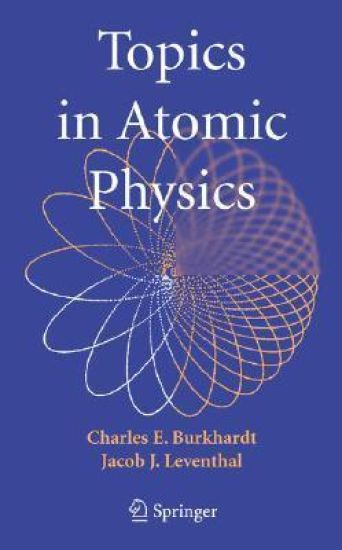
Topics in Atomic Physics

Topics in Atomic Physics

Charles E. Burkhardt; Jacob J. Leventhal

Springer-Verlag New York Inc.
2010
nidottu
The importance of the ?eld of atomic physics to modern technology cannot be overemphasized. Atomic physics served as a major impetus to the development of the quantum theory of matter in the early part of the twentieth century and, due to the availability of the laser as a laboratory tool, it has taken us into the twen- ?rst century with an abundance of new and exciting phenomena to understand. Our intention in writing this book is to provide a foundation for students to begin researchinmodernatomicphysics. Asthetitleimplies,itisnot,norwasitintended to be, an all-inclusive tome covering every aspect of atomic physics. Any specialized textbook necessarily re?ects the predilection of the authors toward certain aspects of the subject. This one is no exception. It re?ects our - lief that a thorough understanding of the unique properties of the hydrogen atom is essential to an understanding of atomic physics. It also re?ects our fasci- tion with the distinguished position that Mother Nature has bestowed on the pure Coulomb and Newtonian potentials, and thus hydrogen atoms and Keplerian - bits. Therefore, we have devoted a large portion of this book to the hydrogen atom toemphasizethisdistinctiveness. Weattempttostresstheuniquenessoftheattr- tive 1/r potential without delving into group theory. It is our belief that, once an understanding of the hydrogen atom is achieved, the properties of multielectron atoms can be understood as departures from hydrogenic properties.
Foundations of Quantum Physics

Foundations of Quantum Physics

Charles E. Burkhardt; Jacob J. Leventhal

Springer-Verlag New York Inc.
2008
sidottu
This book is meant to be a text for a ?rst course in quantum physics. It is assumed that the student has had courses in Modern Physics and in mathematics through differential equations. The book is otherwise self-contained and does not rely on outside resources such as the internet to supplement the material. SI units are used throughoutexcept for those topics for which atomic units are especially convenient. It is our belief that for a physics major a quantum physics textbook should be more than a one- or two-semester acquaintance. Consequently, this book contains material that, while germane to the subject, the instructor might choose to omit because of time limitations. There are topics and examples included that are not normally covered in introductory textbooks. These topics are not necessarily too advanced, they are simply not usually covered. We have not, however, presumed to tell the instructor which topics must be included and which may be omitted. It is our intention that omitted subjects are available for future reference in a book that is already familiar to its owner. In short, it is our hope that the student will use the book as a reference after having completed the course. We have included at the end of most chapters a “Retrospective” of the chapter. Thisis notmeanttobemerelya summary,but,rather,anoverviewoftheimportance ofthe material andits placein the contextofpreviousandforthcomingchapters.
Topics in Atomic Physics

Topics in Atomic Physics

Charles E. Burkhardt; Jacob J. Leventhal

Springer-Verlag New York Inc.
2005
sidottu
The importance of the ?eld of atomic physics to modern technology cannot be overemphasized. Atomic physics served as a major impetus to the development of the quantum theory of matter in the early part of the twentieth century and, due to the availability of the laser as a laboratory tool, it has taken us into the twen- ?rst century with an abundance of new and exciting phenomena to understand. Our intention in writing this book is to provide a foundation for students to begin researchinmodernatomicphysics. Asthetitleimplies,itisnot,norwasitintended to be, an all-inclusive tome covering every aspect of atomic physics. Any specialized textbook necessarily re?ects the predilection of the authors toward certain aspects of the subject. This one is no exception. It re?ects our - lief that a thorough understanding of the unique properties of the hydrogen atom is essential to an understanding of atomic physics. It also re?ects our fasci- tion with the distinguished position that Mother Nature has bestowed on the pure Coulomb and Newtonian potentials, and thus hydrogen atoms and Keplerian - bits. Therefore, we have devoted a large portion of this book to the hydrogen atom toemphasizethisdistinctiveness. Weattempttostresstheuniquenessoftheattr- tive 1/r potential without delving into group theory. It is our belief that, once an understanding of the hydrogen atom is achieved, the properties of multielectron atoms can be understood as departures from hydrogenic properties.