Kirjojen hintavertailu. Mukana 12 182 722 kirjaa ja 12 kauppaa.

Kirjailija

Charles E. Lyman

Kirjat ja teokset yhdessä paikassa: 4 kirjaa, julkaisuja vuosilta 1990-2013, suosituimpien joukossa Scanning Electron Microscopy and X-Ray Microanalysis. Vertaile teosten hintoja ja tarkista saatavuus suomalaisista kirjakaupoista.

4 kirjaa

Kirjojen julkaisuhaarukka 1990-2013.

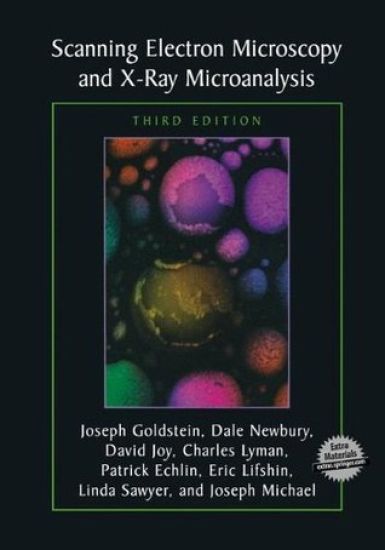
Scanning Electron Microscopy and X-Ray Microanalysis

Scanning Electron Microscopy and X-Ray Microanalysis

Joseph Goldstein; Dale E. Newbury; David C. Joy; Charles E. Lyman; Patrick Echlin; Eric Lifshin; Linda Sawyer; J.R. Michael

Springer-Verlag New York Inc.
2013
nidottu
In the decade since the publication of the second edition of Scanning Electron Microscopy and X-Ray Microanalysis, there has been a great expansion in the capabilities of the basic scanning electron microscope (SEM) and the x-ray spectrometers. The emergence of the variab- pressure/environmental SEM has enabled the observation of samples c- taining water or other liquids or vapor and has allowed for an entirely new class of dynamic experiments, that of direct observation of che- cal reactions in situ. Critical advances in electron detector technology and computer-aided analysis have enabled structural (crystallographic) analysis of specimens at the micrometer scale through electron backscatter diffr- tion (EBSD). Low-voltage operation below 5 kV has improved x-ray spatial resolution by more than an order of magnitude and provided an effective route to minimizing sample charging. High-resolution imaging has cont- ued to develop with a more thorough understanding of how secondary el- trons are generated. The ?eld emission gun SEM, with its high brightness, advanced electron optics, which minimizes lens aberrations to yield an - fective nanometer-scale beam, and “through-the-lens” detector to enhance the measurement of primary-beam-excited secondary electrons, has made high-resolution imaging the rule rather than the exception. Methods of x-ray analysis have evolved allowing for better measurement of specimens with complex morphology: multiple thin layers of different compositions, and rough specimens and particles. Digital mapping has transformed classic x-ray area scanning, a purely qualitative technique, into fully quantitative compositional mapping.
Scanning Electron Microscopy, X-Ray Microanalysis, and Analytical Electron Microscopy

Scanning Electron Microscopy, X-Ray Microanalysis, and Analytical Electron Microscopy

Charles E. Lyman; Dale E. Newbury; Joseph Goldstein; David B. Williams; Alton D. Romig Jr.; John Armstrong; Patrick Echlin; Charles Fiori; David C. Joy; Eric Lifshin; Klaus-Rüdiger Peters

Kluwer Academic/Plenum Publishers
1990
nidottu
During the last four decades remarkable developments have taken place in instrumentation and techniques for characterizing the microstructure and microcomposition of materials. Some of the most important of these instruments involve the use of electron beams because of the wealth of information that can be obtained from the interaction of electron beams with matter. The principal instruments include the scanning electron microscope, electron probe x-ray microanalyzer, and the analytical transmission electron microscope. The training of students to use these instruments and to apply the new techniques that are possible with them is an important function, which. has been carried out by formal classes in universities and colleges and by special summer courses such as the ones offered for the past 19 years at Lehigh University. Laboratory work, which should be an integral part of such courses, is often hindered by the lack of a suitable laboratory workbook. While laboratory workbooks for transmission electron microscopy have-been in existence for many years, the broad range of topics that must be dealt with in scanning electron microscopy and microanalysis has made it difficult for instructors to devise meaningful experiments. The present workbook provides a series of fundamental experiments to aid in "hands-on" learning of the use of the instrumentation and the techniques. It is written by a group of eminently qualified scientists and educators. The importance of hands-on learning cannot be overemphasized.
Scanning Electron Microscopy and X-Ray Microanalysis

Scanning Electron Microscopy and X-Ray Microanalysis

Joseph Goldstein; Dale E. Newbury; Patrick Echlin; David C. Joy; Alton D. Romig Jr.; Charles E. Lyman; Charles Fiori; Eric Lifshin

Springer-Verlag New York Inc.
2011
nidottu
In the last decade, since the publication of the first edition of Scanning Electron Microscopy and X-ray Microanalysis, there has been a great expansion in the capabilities of the basic SEM and EPMA. High­ resolution imaging has been developed with the aid of an extensive range of field emission gun (FEG) microscopes. The magnification ranges of these instruments now overlap those of the transmission electron microscope. Low-voltage microscopy using the FEG now allows for the observation of noncoated samples. In addition, advances in the develop­ ment of x-ray wavelength and energy dispersive spectrometers allow for the measurement of low-energy x-rays, particularly from the light elements (B, C, N, 0). In the area of x-ray microanalysis, great advances have been made, particularly with the "phi rho z" [Ij)(pz)] technique for solid samples, and with other quantitation methods for thin films, particles, rough surfaces, and the light elements. In addition, x-ray imaging has advanced from the conventional technique of "dot mapping" to the method of quantitative compositional imaging. Beyond this, new software has allowed the development of much more meaningful displays for both imaging and quantitative analysis results and the capability for integrating the data to obtain specific information such as precipitate size, chemical analysis in designated areas or along specific directions, and local chemical inhomogeneities.
Scanning Electron Microscopy and X-Ray Microanalysis

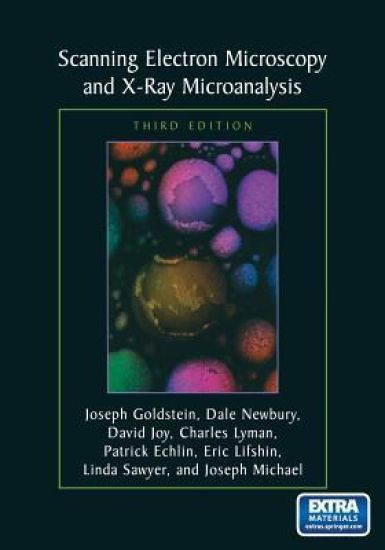
Scanning Electron Microscopy and X-Ray Microanalysis

Joseph Goldstein; Dale E. Newbury; David C. Joy; Charles E. Lyman; Patrick Echlin; Eric Lifshin; Linda Sawyer; J.R. Michael

Kluwer Academic/Plenum Publishers
2003
sidottu
In the decade since the publication of the second edition of Scanning Electron Microscopy and X-Ray Microanalysis, there has been a great expansion in the capabilities of the basic scanning electron microscope (SEM) and the x-ray spectrometers. The emergence of the variab- pressure/environmental SEM has enabled the observation of samples c- taining water or other liquids or vapor and has allowed for an entirely new class of dynamic experiments, that of direct observation of che- cal reactions in situ. Critical advances in electron detector technology and computer-aided analysis have enabled structural (crystallographic) analysis of specimens at the micrometer scale through electron backscatter diffr- tion (EBSD). Low-voltage operation below 5 kV has improved x-ray spatial resolution by more than an order of magnitude and provided an effective route to minimizing sample charging. High-resolution imaging has cont- ued to develop with a more thorough understanding of how secondary el- trons are generated. The ?eld emission gun SEM, with its high brightness, advanced electron optics, which minimizes lens aberrations to yield an - fective nanometer-scale beam, and “through-the-lens” detector to enhance the measurement of primary-beam-excited secondary electrons, has made high-resolution imaging the rule rather than the exception. Methods of x-ray analysis have evolved allowing for better measurement of specimens with complex morphology: multiple thin layers of different compositions, and rough specimens and particles. Digital mapping has transformed classic x-ray area scanning, a purely qualitative technique, into fully quantitative compositional mapping.