Kirjojen hintavertailu. Mukana 12 595 353 kirjaa ja 12 kauppaa.

Kirjailija

Charles E. McCulloch

Kirjat ja teokset yhdessä paikassa: 4 kirjaa, julkaisuja vuosilta 2006-2014, suosituimpien joukossa Regression Methods in Biostatistics. Vertaile teosten hintoja ja tarkista saatavuus suomalaisista kirjakaupoista.

4 kirjaa

Kirjojen julkaisuhaarukka 2006-2014.

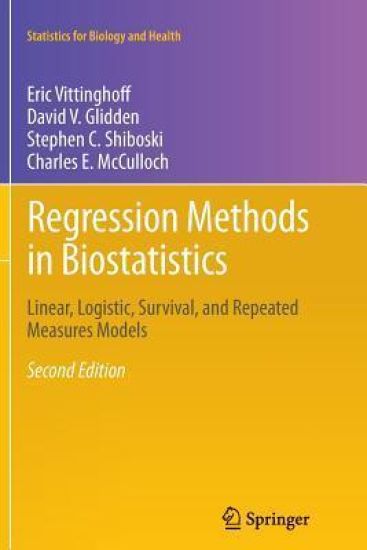
Regression Methods in Biostatistics

Regression Methods in Biostatistics

Eric Vittinghoff; David V. Glidden; Stephen C. Shiboski; Charles E. McCulloch

Springer-Verlag New York Inc.
2014
nidottu
This new book provides a unified, in-depth, readable introduction to the multipredictor regression methods most widely used in biostatistics: linear models for continuous outcomes, logistic models for binary outcomes, the Cox model for right-censored survival times, repeated-measures models for longitudinal and hierarchical outcomes, and generalized linear models for counts and other outcomes. Treating these topics together takes advantage of all they have in common. The authors point out the many-shared elements in the methods they present for selecting, estimating, checking, and interpreting each of these models. They also show that these regression methods deal with confounding, mediation, and interaction of causal effects in essentially the same way. The examples, analyzed using Stata, are drawn from the biomedical context but generalize to other areas of application. While a first course in statistics is assumed, a chapter reviewing basic statistical methods is included. Some advanced topics are covered but the presentation remains intuitive. A brief introduction to regression analysis of complex surveys and notes for further reading are provided.
Regression Methods in Biostatistics

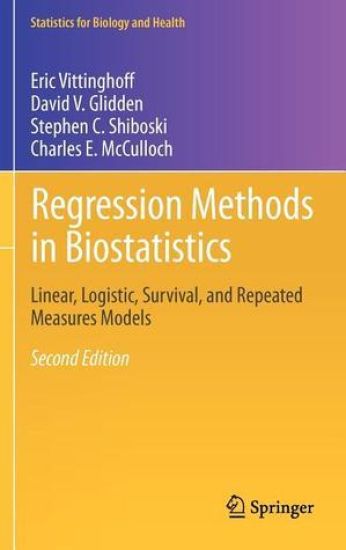
Regression Methods in Biostatistics

Eric Vittinghoff; David V. Glidden; Stephen C. Shiboski; Charles E. McCulloch

Springer-Verlag New York Inc.
2011
sidottu
This new book provides a unified, in-depth, readable introduction to the multipredictor regression methods most widely used in biostatistics: linear models for continuous outcomes, logistic models for binary outcomes, the Cox model for right-censored survival times, repeated-measures models for longitudinal and hierarchical outcomes, and generalized linear models for counts and other outcomes. Treating these topics together takes advantage of all they have in common. The authors point out the many-shared elements in the methods they present for selecting, estimating, checking, and interpreting each of these models. They also show that these regression methods deal with confounding, mediation, and interaction of causal effects in essentially the same way. The examples, analyzed using Stata, are drawn from the biomedical context but generalize to other areas of application. While a first course in statistics is assumed, a chapter reviewing basic statistical methods is included. Some advanced topics are covered but the presentation remains intuitive. A brief introduction to regression analysis of complex surveys and notes for further reading are provided.
Generalized, Linear, and Mixed Models

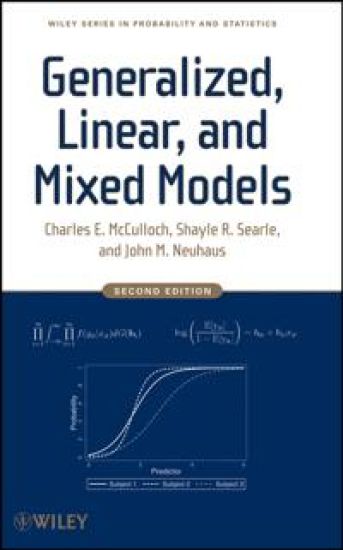
Generalized, Linear, and Mixed Models

Charles E. McCulloch; Shayle R. Searle; John M. Neuhaus

John Wiley Sons Inc
2008
sidottu
An accessible and self-contained introduction to statistical models-now in a modernized new edition Generalized, Linear, and Mixed Models, Second Edition provides an up-to-date treatment of the essential techniques for developing and applying a wide variety of statistical models. The book presents thorough and unified coverage of the theory behind generalized, linear, and mixed models and highlights their similarities and differences in various construction, application, and computational aspects. A clear introduction to the basic ideas of fixed effects models, random effects models, and mixed models is maintained throughout, and each chapter illustrates how these models are applicable in a wide array of contexts. In addition, a discussion of general methods for the analysis of such models is presented with an emphasis on the method of maximum likelihood for the estimation of parameters. The authors also provide comprehensive coverage of the latest statistical models for correlated, non-normally distributed data. Thoroughly updated to reflect the latest developments in the field, the Second Edition features: A new chapter that covers omitted covariates, incorrect random effects distribution, correlation of covariates and random effects, and robust variance estimationA new chapter that treats shared random effects models, latent class models, and properties of modelsA revised chapter on longitudinal data, which now includes a discussion of generalized linear models, modern advances in longitudinal data analysis, and the use between and within covariate decompositionsExpanded coverage of marginal versus conditional modelsNumerous new and updated examples With its accessible style and wealth of illustrative exercises, Generalized, Linear, and Mixed Models, Second Edition is an ideal book for courses on generalized linear and mixed models at the upper-undergraduate and beginning-graduate levels. It also serves as a valuable reference for applied statisticians, industrial practitioners, and researchers.
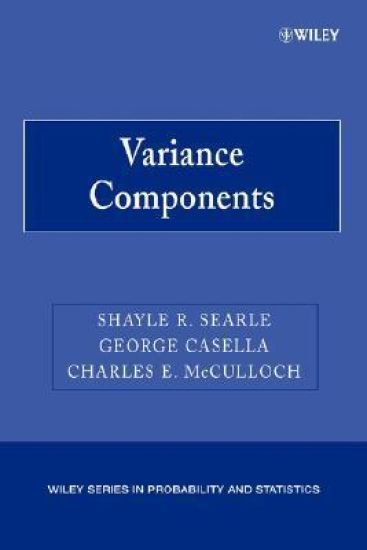
Variance Components

Variance Components

Shayle R. Searle; George Casella; Charles E. McCulloch

John Wiley Sons Inc
2006
nidottu
WILEY-INTERSCIENCE PAPERBACK SERIES The Wiley-Interscience Paperback Series consists of selected books that have been made more accessible to consumers in an effort to increase global appeal and general circulation. With these new unabridged softcover volumes, Wiley hopes to extend the lives of these works by making them available to future generations of statisticians, mathematicians, and scientists. ". . .Variance Components is an excellent book. It is organized and well written, and provides many references to a variety of topics. I recommend it to anyone with interest in linear models." —Journal of the American Statistical Association "This book provides a broad coverage of methods for estimating variance components which appeal to students and research workers . . . The authors make an outstanding contribution to teaching and research in the field of variance component estimation." —Mathematical Reviews "The authors have done an excellent job in collecting materials on a broad range of topics. Readers will indeed gain from using this book . . . I must say that the authors have done a commendable job in their scholarly presentation." —Technometrics This book focuses on summarizing the variability of statistical data known as the analysis of variance table. Penned in a readable style, it provides an up-to-date treatment of research in the area. The book begins with the history of analysis of variance and continues with discussions of balanced data, analysis of variance for unbalanced data, predictions of random variables, hierarchical models and Bayesian estimation, binary and discrete data, and the dispersion mean model.