
Kirjailija
Charles Goodhart
Kirjat ja teokset yhdessä paikassa: 15 kirjaa, julkaisuja vuosilta 1988-2025, suosituimpien joukossa The Interest Rate Conditioning Assumption. Vertaile teosten hintoja ja tarkista saatavuus suomalaisista kirjakaupoista.
15 kirjaa
Kirjojen julkaisuhaarukka 1988-2025.
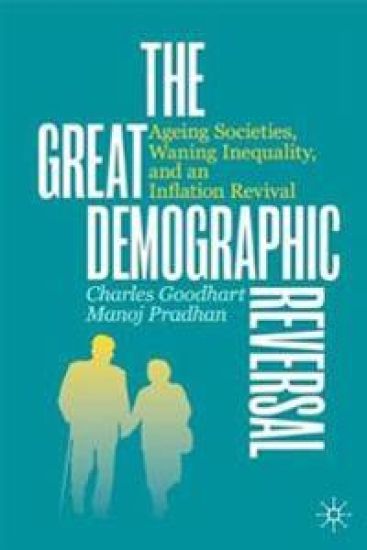
The Great Demographic Reversal
Charles Goodhart; Manoj Pradhan
Springer Nature Switzerland AG
2020
sidottu
This original and panoramic book proposes that the underlying forces of demography and globalisation will shortly reverse three multi-decade global trends – it will raise inflation and interest rates, but lead to a pullback in inequality. “Whatever the future holds”, the authors argue, “it will be nothing like the past”. Deflationary headwinds over the last three decades have been primarily due to an enormous surge in the world’s available labour supply, owing to very favourable demographic trends and the entry of China and Eastern Europe into the world’s trading system. This book demonstrates how these demographic trends are on the point of reversing sharply, coinciding with a retreat from globalisation. The result? Ageing can be expected to raise inflation and interest rates, bringing a slew of problems for an over-indebted world economy, but is also anticipated to increase the share of labour, so that inequality falls. Covering many social and politicalfactors, as well as those that are more purely macroeconomic, the authors address topics including ageing, dementia, inequality, populism, retirement and debt finance, among others. This book will be of interest and understandable to anyone with an interest on where the world’s economy may be going.

Financial Regulation and Stability
Charles Goodhart; Dimitrios P. Tsomocos
Edward Elgar Publishing Ltd
2019
sidottu
'This is a most useful book which nicely combines theory and practice. In it the authors provide a framework which helps us better understand the nature of modern financial crises and how monetary and regulatory policies interact in delivering price and financial stability. Certainly worth reading by academics, policymakers and all those interested in deepening their knowledge of how modern financial systems work in both good and bad times.'- José Viñals, Standard Chartered, UK 'This collection of papers is a remarkable tour de force. Goodhart and Tsomocos have made pioneering steps toward understanding the causes of financial crises and showing how the financial system can be regulated to reduce and mitigate them. A must-read for anyone interested in financial stability.'- Doyne Farmer, University of Oxford, UK'Today almost everyone realizes the crucial importance of liquidity, a painful lesson taught by the global financial crisis. This collection records that Goodhart and Tsomocos were early and persistent voices, initially in the wilderness but now almost mainstream, showing the way forward by clothing old wisdom in new modelling.'- Perry G. Mehrling, Columbia University, US Charles Goodhart and Dimitrios P. Tsomocos examine the interaction of monetary and regulatory policy to achieve the important goals of price and financial stability. Their focus is on the relationship between liquidity and default in the post-crisis context, with special emphasis on macroprudential regulation. Exploring how financial stability can be continually assessed and measured, Financial Regulation and Stability discusses the interrelationships between liquidity and default. Without default there would be no concern about liquidity. But the financial crisis was not just a liquidity problem, it requires a general equilibrium model. The authors' model delineates all the potential interrelationships between the real and financial sectors of the economy, with special emphasis on the interaction between liquidity and default. Economists and central bankers will greatly benefit from the practical advice offered in this book to aid financial stability. Advanced students of financial economics will also find this a vital read to understand the consequences of the 2007-8 financial crisis in more depth and the lessons to be learnt.

A Brief Affectionate History of the Financial Markets Group
Kathleen Tyson; Charles Goodhart
Createspace Independent Publishing Platform
2018
nidottu
This is a history of the first 30 years of the Financial Markets Group of the London School of Economics and Political Science. The FMG has become a leading centre in Europe for policy research into financial markets. It is the focal point of the LSE's research communication with the business, policy making and international finance communities. This history looks back at FMG's founding, development and accomplishments. Appendices list the Members, Associate Members, Researchers and Visitors who have contributed to the FMG's success. Additional appendices list the Discussion Papers and Special Papers published by FMG, many of which were republished in leading journals or as book chapters, gaining wider readership and influence.
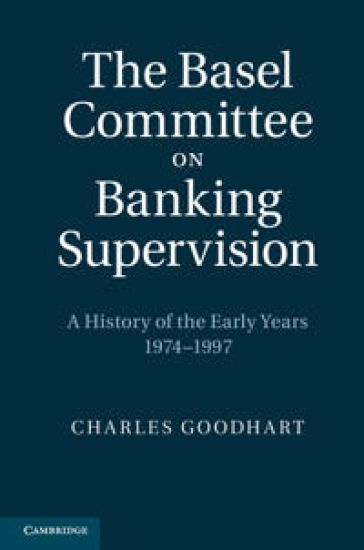
The Basel Committee on Banking Supervision (BCBS) sets the guidelines for world-wide regulation of banks. It is the forum for agreeing international regulation on the conduct of banking. Based on special access to the archives of the BCBS and interviews with many of its key players, this book tells the story of the early years of the Committee from its foundation in 1974/5 right through until 1997 - the year that marks the watershed between the Basel I Accord on Capital Adequacy and the start of work on Basel II. In addition, the book covers the Concordat, the Market Risk Amendment, the Core Principles of Banking and all other facets of the work of the BCBS. While the book is primarily a record of the history of the BCBS, it also provides an assessment of its actions and efficacy. It is a major contribution to the historical record on banking supervision.
The Future of Central Banking
Forrest Capie; Stanley Fischer; Charles Goodhart; Norbert Schnadt
Cambridge University Press
2008
pokkari
This volume contains two major papers prepared for the Bank of England's Tercentenary Symposium in June 1994. The first, by Forrest Capie, Charles Goodhart and Norbert Schnadt, provides an authoritative account of the evolution of central banking. It traces the development of both the monetary and financial stability concerns of central banks, and includes individual sections on the evolution and constitutional positions of 31 central banks from around the world. The second paper, by Stanley Fischer, explores the major policy dilemmas now facing central bankers: the extent to which there is a short-term trade-off between inflation and growth; the choice of inflation targets; and the choice of operating procedures. Important contributions by leading central bankers from around the world, and the related Per Jacobsen lecture by Alexander Lamfalussy, are also included in the volume.

House Prices and the Macroeconomy
Charles Goodhart; Boris Hofmann
Oxford University Press
2006
sidottu
House price bubbles, and their aftermath, have become a focus of macro-economic policy concern in most developed countries. This book elucidates the two-way relationship between house-price fluctuations and economic fundamentals. Housing has many features which make it distinct from other assets, like equity. Real estate is not only an asset but also a durable consumption good for households, providing shelter and other housing services. As a result, a house is often the largest and most important asset of households and therefore accounts for a major share of household wealth. Similarly a large share of bank assets is tied to housing values. House price fluctuations may, therefore, have a major effect on economic activity and the soundness of the financial system. Following an introductory chapter, the book is structured into three parts. The first demonstrates the importance of house prices as determinants or indicators of inflation and economic activity. The second focuses on the inter-relationships between bank credit extension and housing prices, and how bubbles can lead to financial crises. The third discusses resultant public policy issues, such as whether, and how, to include housing prices in a general inflation index, and how to restrain the housing/bank credit cycle.
By August 1998, the Hong Kong economy had become threatened not only by the natural consequences of the Asian crisis (1997/8), but also by waves of speculation, betting that the authorities would be forced to abandon the linked exchange rate (to the US dollar). When facing previous speculative attacks (starting October 1997), the authorities had followed traditional policies of raising interest rates. But, by August 1998, such policies had helped to batter asset markets; property prices and output were falling, and confidence was low. Moreover, the speculators had developed an ingenious 'double-play', simultaneously selling both the foreign exchange market and the Hang Seng equity market short; whether the authorities used an interest rate defence, or abandoned the 'link', the speculators would gain either way. So, the authorities decided on a bold, unexpected and unconventional response to reports of a further attack. They would undertake counter-intervention, again both in the equity and foreign exchange markets. This was the largest, and most successful, counter-speculative intervention ever undertaken. In comparison to the size of Hong Kong's economy, it was massive. On one day -- Friday, 28 August, 1998 -- the authorities bought up around five per cent of the total capitalization of the Hang Seng. Despite the eventual success of the exercise, the authorities have been quite reticent about their actions, revealing only the aggregate amounts of purchases of each stock intervened. This book uses publicly available market data to trace out the authorities' actions on a blow-by-blow basis, primarily in the Hang Seng equity market, but also in the futures and foreign exchange market. The authors set the intervention in its economic context, describe its development, and assess its results. The book provides a fascinating story and insights into what lessons academics and practitioners can learn from the turbulent events of the time.

Financial Regulation
Charles Goodhart; Philipp Hartmann; David T. Llewellyn; Liliana Rojas-Suarez; Steven Weisbrod
Routledge
1998
sidottu
Financial Regulation presents an important restatement of the purposes and objectives of financial regulation. The authors provide details and data on the scale, nature and costs of regulatory problems around the world, and look at what sort of countries and sectors require special attention and policies. Key topics covered include:* the need to recast the form of regulation* incentive structures for financial regulation* proportionality* new techniques for risk management* regulation in emerging countries* crisis management* prospects for financial regulation in the future.
Financial Regulation
Charles Goodhart; Philipp Hartmann; David T. Llewellyn; Liliana Rojas-Suarez; Steven Weisbrod
Routledge
1998
nidottu
Financial Regulation presents an important restatement of the purposes and objectives of financial regulation. The authors provide details and data on the scale, nature and costs of regulatory problems around the world, and look at what sort of countries and sectors require special attention and policies. Key topics covered include:* the need to recast the form of regulation* incentive structures for financial regulation* proportionality* new techniques for risk management* regulation in emerging countries* crisis management* prospects for financial regulation in the future.
Central Banking in Developing Countries
Álvaro Almeida; Maxwell J. Fry; Charles Goodhart
Routledge
1996
sidottu
This book examines the current state of central banking in 44 developing countries. The authors analyse the banks' achievement in their primary objective of price stability and discuss the reasons behind the general lack of success. The book covers: * government financing * foreign exchange systems * domestic banking systems. Rich in data, the book contains original financial information from Africa, Asia, the Middle East, Europe, Latin America and the Caribbean. The lay-out is user-friendly and generously illustrated with tables, figures, boxed material and useful appendices. The book is published in association with the Bank of England and presents the definitive account of the role of central banks in developing countries.
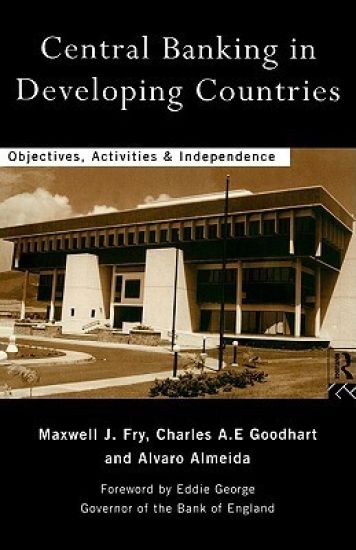
Central Banking in Developing Countries
Álvaro Almeida; Maxwell J. Fry; Charles Goodhart
Routledge
1996
nidottu
This book examines the current state of central banking in 44 developing countries. The authors analyse the banks' achievement in their primary objective of price stability and discuss the reasons behind the general lack of success. The book covers: * government financing * foreign exchange systems * domestic banking systems. Rich in data, the book contains original financial information from Africa, Asia, the Middle East, Europe, Latin America and the Caribbean. The lay-out is user-friendly and generously illustrated with tables, figures, boxed material and useful appendices. The book is published in association with the Bank of England and presents the definitive account of the role of central banks in developing countries.

The Future of Central Banking
Forrest Capie; Stanley Fischer; Charles Goodhart; Norbert Schnadt
Cambridge University Press
1995
sidottu
This volume contains two major papers prepared for the Bank of England’s Tercentenary Symposium in June 1994. The first, by Forrest Capie, Charles Goodhart and Norbert Schnadt, provides an authoritative account of the evolution of central banking. It traces the development of both the monetary and financial stability concerns of central banks, and includes individual sections on the evolution and constitutional positions of 31 central banks from around the world. The second paper, by Stanley Fischer, explores the major policy dilemmas now facing central bankers: the extent to which there is a short-term trade-off between inflation and growth; the choice of inflation targets; and the choice of operating procedures. Important contributions by leading central bankers from around the world, and the related Per Jacobsen lecture by Alexander Lamfalussy, are also included in the volume.

The Evolution of Central Banks employs a wide range of historical evidence and reassesses current monetary analysis to argue that the development of non-profit-maximizing and noncompetitive central banks to supervise and regulate the commercial banking system fulfils a necessary and natural function. Goodhart surveys the case for free banking, examines the key role of the clearing house in the evolution of the central bank, and investigates bank expansion and fluctuation in the context of the clearing house mechanism. He concludes that it is the noncompetitive aspect of the central bank that is crucial to the performance of its role. Goodhart addresses the questions of deposit insurance and takes up the "club theory" approach to the central bank. Included in the historical study of their origins are 8 European central banks, the Bank of Japan, the Bank of England, and the Federal Reserve Board of the United States.