Kirjojen hintavertailu. Mukana 12 387 097 kirjaa ja 12 kauppaa.

Kirjailija

Charles K. Kliment

Kirjat ja teokset yhdessä paikassa: 4 kirjaa, julkaisuja vuosilta 1997-2023, suosituimpien joukossa Magyar Warriors Volume 1. Vertaile teosten hintoja ja tarkista saatavuus suomalaisista kirjakaupoista.

Mukana myös kirjoitusasut: Charles K Kliment

4 kirjaa

Kirjojen julkaisuhaarukka 1997-2023.

Magyar Warriors Vol 2: The History of the Royal Hungarian Armed Forces 1919-1945
The Hungarian armed forces (known as the Honv ds g) were built up from the 1920s, their expansion gaining momentum once Hungary became free of the strict post-First World War Trianon treaty limitations in August 1938. Politically, Hungary was looking for a strong ally, who would help it to recover at least some of the territories containing sizeable Magyar ethnic populations that had been lost after the First World War. Initially, in the mid-1930s, Italy gave political assistance and supplied military materiel; then - on the eve of the Second World War - Germany also lent some support. In November 1938, Hungary managed to peacefully recover a chunk of its former territory from Czechoslovakia, followed by the Sub-Carpathian area during a brief border war in March 1939, and then the northern part of Transylvania from Rumania in August 1940. Later, in April 1941, the Bachka region and parts of Baranya were also taken back from the dismembered Yugoslavia, in a swift military action. The rub is that Hungary was sucked into the cauldron of the Eastern Front, and soon the Honv ds (Hungarian soldiers) found themselves deep in Soviet territory, outgunned and outnumbered by the Red Army. Later on, from August 1944, the beleaguered Honv ds g had to fight in defense of its own territory. Alongside tiny Croatia, Hungary remained the last German ally up to the bitter end, and paid the price accordingly. This comprehensive reference, to be published in three volumes - the fruit of over twenty years of meticulous research - strives to provide a complete picture of the Hungarian armed forces between the years 1919 and 1945. Volume 1 (published in 2015) presents a brief history of the Magyars up until the end of the Second World War, as well as the building of the armed forces, and details the armored formations and their equipment. Volume 2 covers in great details the activity of the air force (Chapter 4), the river flotilla (Chapter 5), as well as the combat operations of the Honv ds g (Chapter 6). The final volume will contain type sheets of every weapon and vehicle used by the Army, as well as all aircraft types in service with the Air Force. The discussed topics are described in great details, and illustrated with over 500 photographs, several maps and many tables.
Magyar Warriors Volume 1

Magyar Warriors Volume 1

Dénes Bernád; Charles K. Kliment

Helion Company
2014
sidottu
The Hungarian armed forces, known as the Honvédség, were built up in the 1930s, their expansion gaining momentum once Hungary became free of the strict post- World War I Trianon treaty limitations in August 1938. Politically, Hungary was looking for a strong ally, who would help it to recover at least some of the territories that had been lost after the First World War. Initially, in the mid-1930s, Italy gave political assistance and supplied military matériel, then, on the eve of World War II, Germany also lent support. In November 1938, Hungary managed to peacefully recover a chunk of its former territory from Czechoslovakia, followed by the Sub-Carpathian area and the northern part of Transylvania from Rumania in August 1940. Later, in April 1941, the Bachka region and parts of Baranya were also taken back from the dismembered Yugoslavia, in a swift military action. The rub was that Hungary was sucked into the cauldron of the Eastern front, and soon the Honvéds found themselves deep in Soviet territory, outgunned and outnumbered. From August 1944, the beleaguered Honvédség had to fight against the mighty Soviet army in defense of its own territory. However, alongside tiny Croatia, Hungary remained the last German ally up to the bitter end. This comprehensive reference, to be published in two volumes, and the fruit of over twenty years of meticulous research by Hungarian historian Dénes Bernád, and AFV expert Charles K. Kliment, strives to provide a complete picture of the Hungarian armed forces between the years 1919–1945. It describes the political situation in Hungary before and during World War II, the building of the armed forces, the growth of domestic arms manufacturers and the organisation of the armed forces units and how they changed during the war. The various campaigns of the war are described in great detail, illustrated with many photographs, colour plates and maps.
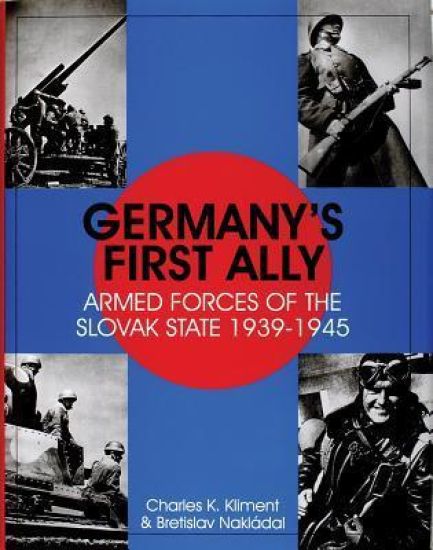
Germany's First Ally

Germany's First Ally

Charles K. Kliment

Schiffer Publishing Ltd
1998
sidottu
Slovakia split from Czechoslovakia and formed its own state on March 14, 1939. The Slovak State was born under the auspices of Hitler’s Third Reich and became its first ally on September 1, 1939, when it took part in the invasion of Poland. The Slovak army inherited its weapons, equipment, training manuals and its doctrine from the defunct Czechoslovak Army. Though hampered by a shortage of specialists in its air force, armored units and artillery, it managed to field several division-sized units and sustain them during the initial three years of combat on the Eastern front. Its Mobile division fought its way all the way from the Carpathian Mountains to the Caucasus. In the last years of the war, the Slovak people became more and more disillusioned with the war and with their own semi-fascist government. These feelings led to mounting desertions in the fighting units, and culminated in the Slovak National Uprising in August 1944. Though the uprising was liquidated after two months of bitter fighting, it gave the Slovak nation the right to join the victorious allies and be accepted back into the restored Czechoslovakia. Though the Slovak army was by far the smallest of the armies of Germany’s allies on the Eastern front, it was part of this grandiose “clash of titans” and deserves thus a place in the history of the Second World War. This book describes in detail the composition, dislocation and equipment of all branches of the Slovak army (infantry, artillery, armored and air force) and its operational history through the war years.