Kirjailija
Charles K Rowley
Kirjat ja teokset yhdessä paikassa: 27 kirjaa, julkaisuja vuosilta 1972-2016, suosituimpien joukossa Economics & Politics of Wealth Distribution. Vertaile teosten hintoja ja tarkista saatavuus suomalaisista kirjakaupoista.
Mukana myös kirjoitusasut: Charles K. Rowley
27 kirjaa
Kirjojen julkaisuhaarukka 1972-2016.
This book offers an analytic history of Britannia (first England and Wales and then Great Britain) over eight hundred years of political turmoil, intermingled with economic stagnation, followed by the engine of the industrial revolution. The book draws on economics, political science, public choice, philosophy and the law to probe in depth into the evolution of Britannia from an impoverished feudal and then post-feudal autocracy into a constitutional monarchy with limited suffrage that provided the fulcrum for industrial and commercial success, making Britannia, by 1884, the richest nation, per capita, on the planet. The book challenges head-on the Whiggist liberal notion of Macaulay and Trevelyan that the path from oppression to freedom was one of unimpeded progress. Among its novel features, the book draws upon the dictator’s handbook, as modeled by Bueno de Mesquita and Alistair Smith to evaluate the period of varying autocracy, 1066-1688. The book draws upon modern public choice theory and legal history to evaluate the fragile, corrupt constitutional monarchy that oversaw the initial phase of post-Glorious Revolution Britannia, 1689-1775. At each stage, the philosophical battle between those who sought order and unity and those who sought individual liberty is meticulously outlined. The book draws on the contributions of the Scottish Enlightenment (Hume, Ferguson and Smith) and of classical liberal philosophy (John Stuart Mill) to explain the final vault of Britannia from a weak and corrupt to a robust and admired constitutional monarchy grounded on the rule of law, over the period 1776-1884.
This book is a key example of the emergence of public choice theory by an economist who was to become one of its major exponents. It combines a detailed, critical study of the Monopolies Commission, with an analysis of the economic issues involved in monopoly supervision and control.
This book offers an analytic history of Britannia (first England and Wales and then Great Britain) over eight hundred years of political turmoil, intermingled with economic stagnation, followed by the engine of the industrial revolution. The book draws on economics, political science, public choice, philosophy and the law to probe in depth into the evolution of Britannia from an impoverished feudal and then post-feudal autocracy into a constitutional monarchy with limited suffrage that provided the fulcrum for industrial and commercial success, making Britannia, by 1884, the richest nation, per capita, on the planet. The book challenges head-on the Whiggist liberal notion of Macaulay and Trevelyan that the path from oppression to freedom was one of unimpeded progress. Among its novel features, the book draws upon the dictator’s handbook, as modeled by Bueno de Mesquita and Alistair Smith to evaluate the period of varying autocracy, 1066-1688. The book draws upon modern public choice theory and legal history to evaluate the fragile, corrupt constitutional monarchy that oversaw the initial phase of post-Glorious Revolution Britannia, 1689-1775. At each stage, the philosophical battle between those who sought order and unity and those who sought individual liberty is meticulously outlined. The book draws on the contributions of the Scottish Enlightenment (Hume, Ferguson and Smith) and of classical liberal philosophy (John Stuart Mill) to explain the final vault of Britannia from a weak and corrupt to a robust and admired constitutional monarchy grounded on the rule of law, over the period 1776-1884.
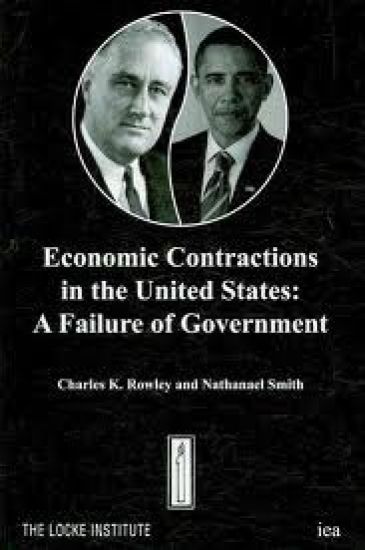
Economic Contractions in the United States
Charles K. Rowley; Nathanael Smith
Institute of Economic Affairs
2009
nidottu
This monograph provides a detailed explanation how the Great Depression and the current financial crisis and economic contraction in the United States were both caused by and exacerbated by government, not by capitalism. The monograph provides a well-reasoned free market alternative to current statist policies with respect to economic recovery in the United States.
Gordon Tullock is among a small group of living legends in the field of political economics. This volume provides an entree to the mind of an original thinker. Professor Rowley provides deliberately sparse contextual introduction to each volume, opting to allow the very able and eloquent Tullock to speak for himself.
This final volume of 'The Selected Works of Gordon Tullock' series, presents an eclectic mix of essays by Gordon Tullock. The first three sections highlight his pioneering application of rational choice theory to fields outside the usual purview of economics, including criminal behaviour, sociobiology, and behaviour in non-human societies. The final four sections, all concerned with more traditional areas of economics, still show Tullock at his innovative best, challenging conventional thinking in such fields as public finance and monetary economics.
Gordon Tullock is among a small group of living legends in the field of political economics. This volume provides an entree to the mind of an original thinker. Professor Rowley provides deliberately sparse contextual introduction to each volume, opting to allow the very able and eloquent Tullock to speak for himself.
Examines the fundamental principles of our legal system from a public choice perspective and compares its efficiency and accuracy with other systems. It presents in full two controversial works by Gordon Tullock, 'The Logic of the Law' and 'The Case against the Common Law', as well as chapters from his 'Trials on Trial' and other innovative articles. Highly critical of the US common law system, Tullock argues for various reforms, even for its replacement with a civil code system.
Volume 8 in "The Selected Works of Gordon Tullock" draws from two highly acclaimed and path-breaking books by Gordon Tullock, The Social Dilemma (1974) and Autocracy (1987). In this work, Tullock explores political market behaviour that is based on conflict rather than on bargaining and thus behaviour that results in wealth reduction rather than in gains from trade. "The Social Dilemma: The Economics of War and Revolution" was written in response to the tumultuous events of the 1960s and 1970s. Specifically, after the constitutional crisis caused by the Watergate scandal, Tullock acknowledged the Hobbesian nature of democracy. He posed that political figures are locked in wealth-reducing circumstances by the nature of the political game and inherent problems found in democracy. In Autocracy, Tullock provides a scientific analysis of dictatorships, using a rational choice model to analyse the behaviour of individuals under autocracy. Whereas most scholars have applied public choice theory only to co-operative, democratic states, Tullock extends the theory into new territory. In addition, his insights contribute to the discussion of pressing current issues, such as the transformation of autocracies into democracies.
Examines the fundamental principles of our legal system from a public choice perspective and compares its efficiency and accuracy with other systems. It presents in full two controversial works by Gordon Tullock, 'The Logic of the Law' and 'The Case against the Common Law', as well as chapters from his 'Trials on Trial' and other innovative articles. Highly critical of the US common law system, Tullock argues for various reforms, even for its replacement with a civil code system.
Gordon Tullock is among a small group of living legends in the field of political economics. This volume provides an entree to the mind of an original thinker. Professor Rowley provides deliberately sparse contextual introduction to each volume, opting to allow the very able and eloquent Tullock to speak for himself.
This is the fourth volume in Liberty Fund's "The Selected Works of Gordon Tullock". This volume includes some of Gordon Tullock's most noteworthy contributions to the theory and application of public choice, which is a relatively new science that links economics and political action. This volume combines the best parts of two of his books, Private Wants: Public Means and On Voting, as well as his famous monograph The Vote Motive. The common thread is the importance of the bond between Homo politicus and Homo economicus: they are the same species, each driven largely by self-interest in vigorous pursuit of such personal objectives as wealth, power, prestige, and income security within the confines of society. "The Economics of Politics" covers such diverse public choice topics as: the nature and origins of public choice, the power of using economic analysis to understand and predict the behaviour of politically influenced markets, and an evaluation of voting rules and political institutions. Equally confident in both the normative and the positive branches of the discipline, and well-versed in the wide variety of institutions and practices of democracy throughout history, Tullock takes the reader on a journey that goes well beyond the conventional horizon of public choice.
This volume consists of six parts, each part expounding on a separate component of the field. Part 1, "Rent Seeking: An Overview", brings together two papers that focus on problems of defining rent-seeking behaviour and outline the nature of the ongoing research program in a historical perspective. Part 2, "More on Efficient Rent Seeking", contains four contributions in which Tullock elaborates on his 1980 article on efficient rent seeking. Part 3, The Environments of Rent Seeking", consists of eight papers that collectively display the breadth of the rent-seeking concept. Part 4, "The Cost of Rent Seeking", comprises seven papers that address several important issues about the cost of rent seeking to society as a whole. Part 5 is Tullock's short monograph Exchanges and Contract's, in which he develops a systematic theory of exchange in political markets. In Part 6, "Future Directions for Rent-Seeking Research", Tullock focuses on the importance of information in the political marketplace. This work has been carefully constructed to build on the inaugural volume in this collection and to ease students through the field in a clear and concise manner.
The fifth volume in "The Selected Works of Gordon Tullock" series consists of six parts, each part expounding on a separate component of the field. Part 1, 'Rent Seeking: An Overview', brings together two papers that focus on problems of defining rent-seeking behaviour and outline the nature of the on-going research program in a historical perspective. Part 2, 'More on Efficient Rent Seeking', contains four contributions in which Tullock elaborates on his 1980 article on efficient rent seeking. Part 3, 'The Environments of Rent Seeking', consists of eight papers that collectively display the breadth of the rent-seeking concept. Part 4, 'The Cost of Rent Seeking', comprises seven papers that address several important issues about the cost of rent seeking to society as a whole. Part 5 is Tullock's short monograph Exchanges and Contracts, in which he develops a systematic theory of exchange in political markets. In Part 6, 'Future Directions for Rent-Seeking Research', Tullock focuses on the importance of information in the political marketplace. This work has been carefully constructed to build on the inaugural volume in this collection and to ease students through the field in a clear and concise manner.
In this book, Tullock focuses attention on the organisation of science, raising important questions about scientific inquiry and specifically about the problems of science as a social system. Tullock poses such questions as: how do scientists engage in apparently co-operative contributions in the absence of hierarchic organisation and why are scientific contributions worthy, for the most part, of the public's trust? Throughout "The Organization of Inquiry", Tullock answers these questions and many more through a pioneering exploration of the interrelationship between economics and the philosophy of science, much of which had defied then-conventional wisdom. Anyone interested in scientific endeavour will find the combination of Tullock's powerful logic, his sharp forensic skills, and his barbed wit elucidating and helpful.