Kirjojen hintavertailu. Mukana 12 657 676 kirjaa ja 12 kauppaa.

Kirjailija

Charles Levenstein

Kirjat ja teokset yhdessä paikassa: 19 kirjaa, julkaisuja vuosilta 2001-2019, suosituimpien joukossa The Cotton Dust Papers. Vertaile teosten hintoja ja tarkista saatavuus suomalaisista kirjakaupoista.

19 kirjaa

Kirjojen julkaisuhaarukka 2001-2019.

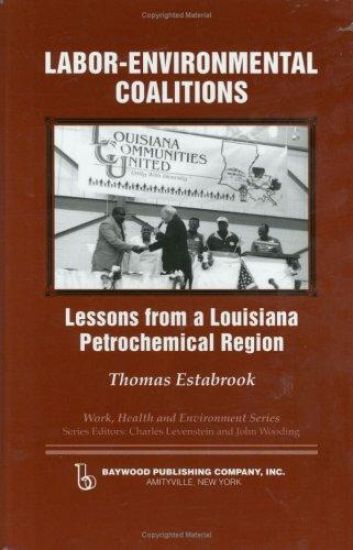
Labor-environmental Coalitions

Labor-environmental Coalitions

Thomas Estabrook; Charles Levenstein; John Wooding

Routledge
2019
nidottu
In 1984, the oil, chemical and atomic workers began a 5-year campaign to win back the jobs of its members locked out by the BASF Corp. in Geismar, Louisiana. The multiscale campaign involved coalitions with local environmentalists as well as international solidarity from environmental and religious organizations. The local coalition which helped break the lockout was maintained and expanded in the 1990s. This alliance is one of numerous labor-community coalitions to emerge increasingly over the past 20 years.""Labor-Environmental Coalitions: Lessons from a Louisiana Petrochemical Region"" traces the development of the Louisiana Labor-Neighbor Project from 1985 to the present, within the context of a long history of divisions between labor and community in the U.S. The Project continued after the lockout, thriving during 1990s, expanding from one community to four counties to include 20 local member organizations, and broadening its agenda from the original jobs crisis and pollution problems to address a wide range of worker, environmental health, and economic justice issues."" Labor-Environmental Coalitions"" explores the dynamics of the Louisiana coalition to offer lessons for other coalition efforts. The book seeks to understand coalitions as a necessary strategy to counteract the dominant forces of capitalist development. The author contends that the Labor-Neighbor Project, like labor-community coalitions generally, created a unique blend of politics shaped by the geographic nature industry's politics; by the relative openness of government; and by the class experience of labor and community members.The Louisiana Project demonstrates that for labor-community coalitions to thrive they must broaden their agenda, strengthen their leadership and coalition-building skills, and develop access to multiscale resources. The author argues that for labor-community coalitions to have longer term political impact, they should adopt an explicitly progressive approach by building a broader class and cultural leadership, and by demanding state and corporate accountability on economic, public health, and environmental justice issues.

Metal Fatigue

Metal Fatigue

Robert Forrant; Charles Levenstein; John Wooding

Routledge
2017
sidottu
On February 4, 1986, the lives of thousands of workers changed in ways they could only begin to imagine. On that day, United Technologies Corporation ordered the closure of the 76-year-old American Bosch manufacturing plant in Springfield, Massachusetts, capping a nearly 32-year history of job loss and work relocation from the sprawling factory. The author, a former Bosch worker and the business agent for the union representing nearly 1,200 Bosch employees when the plant closed, interjects his personal recollections into the story.For more than 150 years Springfield stood at the center of a prosperous 200-mile industrial corridor along the Connecticut River, between Bridgeport, Connecticut, and Springfield, Vermont, populated with hundreds of machine tool and metalworking plants and thousands of workers. This book is a historical account of the profound economic collapse of the Connecticut River Valley region, with a particular focus on Bosch, its workers, and its union. The shutdown is placed in the context of the wider region's deindustrialization. The closure marked the watershed for large-firm metalworking and metalworking unions in the Connecticut River Valley. The book also describes how the United States, in a ten-year period from the mid-1970s to the mid-1980s, went from being the world's leading exporter of machine tools to its leading importer, and how that sharp decline affected the region's leading city, Springfield, Massachusetts, which by 2005 was in danger of bankruptcy.
The Toxic Schoolhouse

The Toxic Schoolhouse

Madeleine Kangsen Scammell; Charles Levenstein

Routledge
2017
sidottu
The Toxic Schoolhouse is a collection of articles on chemical hazards endangering students, teachers, and staff in the education system of the United States and Canada. Some of the articles were originally published in a special issue of New Solutions: A Journal of Occupational and Environmental Policy, but all have been updated and several new articles have been added. The book is organized in three sections. The first describes problems ranging from the failures of coordination, monitoring, and siting of school buildings to the hazards of exposure to toxic substances, including lead and PCBs. The second section captures the voices of activists seeking change and describes community and union organizing efforts to improve school conditions. The third section covers policy "solutions." The authors include academics, union staff and rank-and-file activists, parent organization leaders, and public health professionals.
The Cotton Dust Papers

The Cotton Dust Papers

Charles Levenstein; Gregory Delaurier; Mary Lee Dunn

Routledge
2017
nidottu
"The Cotton Dust Papers" is the story of the 50-year struggle for recognition in the U.S. of this pernicious occupational disease. The authors contend that byssinosis could have and should have been recognized much sooner, as a great deal was known about the disease as early as the 1930s. Using mostly primary sources, the authors explore three instances from the 1930s to the 1960s in which evidence suggested the existence of brown lung in the mills, yet nothing was done. What the story of byssinosis makes clear is that the economic and political power of private owners and managers can hinder and shape the work of health investigators.
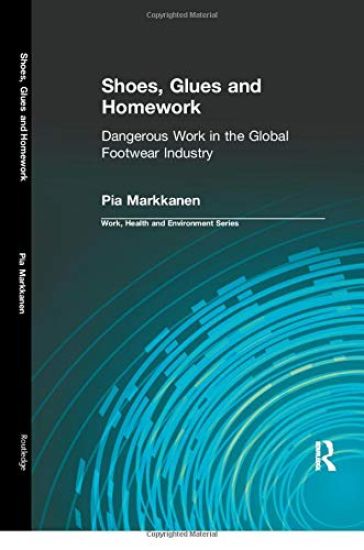
Shoes, Glues and Homework

Shoes, Glues and Homework

Pia Markkanen; Charles Levenstein; Robert Forrant; John Wooding

Routledge
2017
nidottu
This book describes working conditions in informal sector shoemaking in Indonesia and the Philippines, their national and international policy implications. It provides information on glues, an organic solvent, found in footwear chemicals and women garment homeworkers in Bulacan.
Who is Nursing Them? It is Us

Who is Nursing Them? It is Us

Jennifer Zelnick; Charles Levenstein; Robert Forrant; John Wooding

Routledge
2017
nidottu
This book explores the impacts of HIV/AIDS and neoliberal globalization on the occupational health of public sector hospital nurses in KwaZulu-Natal, South Africa. The story of South African public sector nurses provides multiple perspectives on the HIV/AIDS epidemic-for a workforce that played a role in the struggle against apartheid, women who deal with the burden of HIV/AIDS care at work and in the community, and a constituency of the new South African democracy that is working on the frontlines of the HIV/AIDS epidemic. Through case studies of three provincial hospitals in KwaZulu-Natal, set against a historical backdrop, this book tells the story of the HIV/AIDS epidemic in the post-apartheid period.
Northern Exposures

Northern Exposures

David Bennett; Charles Levenstein; Robert Forrant; John Wooding

Routledge
2017
nidottu
'Northern Exposures' is an important and thought-provoking book that shows how the labor movement has embraced environmental protection and is beginning to create a new and more sustainable vision for the future. Dave Bennett's knowledge and commitment shine through. He is, by turns, the skeptical philosopher sifting the evidence and the passionate partisan arguing for the rights of the people. It makes for a rich and exhilarating mixture.-Nigel Crisp, Permanent Secretary, U.K. Department of Health, and Chief Executive, National Health Service (2000-2006), Author, Turning the World Upside Down: The Search for Global Health in the 21st Century (Royal Society of Medicine Press, 2010)
The Ponderous Galapagos Turtle

The Ponderous Galapagos Turtle

Charles Levenstein

Lulu Publishing Services
2015
pokkari
A lifelong academic and teacher, Charles Levenstein has written poetry since the age of fifteen but was rarely published until the year 2000. Toward the end of his career, he watched one of his peers find comfort in projects outside the university environment. His peer built a sailboat as a form of solace and escape. Levenstein-never good with tools-sought a similar peace from the pressures of teaching. He then developed sleep apnea, which kept him awake most nights. Instead of suffering in the dark, he got up and found his tool: the written word. He lost himself in poetry. Some of the work was therapeutic, working through the inevitable sorrows and losses of a long life. The Ponderous Galapagos Turtle is the culmination of fifteen years of poetic practice. The symbol of the turtle is one of endurance and strength. To Levenstein, turtles may not be spectacular, but they survive-as do humans. Certain truths embrace the human spirit in us all and rise to the surface like a turtle taking a breath.
Business, Environment, and Society

Business, Environment, and Society

Vesela Veleva; Charles Levenstein; John Wooding; John Forrant

Baywood Publishing Company Inc
2014
nidottu
This book blends theory and practice to support courses in corporate social responsibility (CSR), business and society, and environmental management and sustainability. Based on her extensive work with companies, the author offers engaging readings and teaching cases that address key challenges for business today - measurement, supply chain management, public policy, and stakeholder pressures. Part I focuses on the macro-level and provides an overview of concepts such as the green economy, eco-industrial parks, corporate social responsibility (corporate citizenship), nanotechnology, and sustainable consumption. Part II provides specific frameworks and tools for sustainability management and measurement at the company level. Part III includes detailed teaching cases of several well-known firms. The main theme is that business is a key player in achieving a more sustainable development, yet its practices are often narrow in focus or shortsighted. The text provokes discussions around issues such as: Is business sustainability possible in a market economy focused on increasing consumption? Should a product or service be called "green" when it puts at risk the health and safety of workers? What can U.S. policymakers learn from their European counterparts when it comes to protecting human health and the environment? How can we ensure that the benefits of nanotechnology exceed its risks? How can sustainability indicators be used as a tool to advance sustainability by companies and policymakers? The book provides a flexible, up-to-date supplementary teaching tool for undergraduate and graduate students, executive education courses, and certificate programs. Intended Audience: Primarily undergraduate and graduate students taking courses in environmental management, corporate social responsibility (CSR), sustainability, or business and society; as a supplementary text in professional education and certificate programs in environmental management, corporate citizenship, sustainability, and CSR.
Business, Environment, and Society

Business, Environment, and Society

Vesela Veleva; Charles Levenstein; John Wooding; John Forrant

Baywood Publishing Company Inc
2014
sidottu
This book blends theory and practice to support courses in corporate social responsibility (CSR), business and society, and environmental management and sustainability. Based on her extensive work with companies, the author offers engaging readings and teaching cases that address key challenges for business today - measurement, supply chain management, public policy, and stakeholder pressures. Part I focuses on the macro-level and provides an overview of concepts such as the green economy, eco-industrial parks, corporate social responsibility (corporate citizenship), nanotechnology, and sustainable consumption. Part II provides specific frameworks and tools for sustainability management and measurement at the company level. Part III includes detailed teaching cases of several well-known firms. The main theme is that business is a key player in achieving a more sustainable development, yet its practices are often narrow in focus or shortsighted. The text provokes discussions around issues such as: Is business sustainability possible in a market economy focused on increasing consumption? Should a product or service be called "green" when it puts at risk the health and safety of workers? What can U.S. policymakers learn from their European counterparts when it comes to protecting human health and the environment? How can we ensure that the benefits of nanotechnology exceed its risks? How can sustainability indicators be used as a tool to advance sustainability by companies and policymakers? The book provides a flexible, up-to-date supplementary teaching tool for undergraduate and graduate students, executive education courses, and certificate programs. Intended Audience: Primarily undergraduate and graduate students taking courses in environmental management, corporate social responsibility (CSR), sustainability, or business and society; as a supplementary text in professional education and certificate programs in environmental management, corporate citizenship, sustainability, and CSR.
The Great Lawrence Textile Strike of 1912

The Great Lawrence Textile Strike of 1912

Robert Forrant; Jurg Siegenthaler; Charles Levenstein; John Wooding

Baywood Publishing Company Inc
2014
nidottu
"In Lawrence, Massachusetts, fully one-half of the population 14 years of age or over is employed in the woolen and worsted mills and cotton mills". Thus begins the federal government's Report on Strike of Textile Workers in Lawrence, Massachusetts in 1912 . This book follows up, one hundred years later. The story's retelling offers readers an exciting reexamination of just how powerful a united working class can be. The Great Lawrence Textile Strike of 1912 - the Bread and Roses Strike - was a public protest by 20,000 to 25,000 immigrant workers from several countries, prompted by a wage cut. Backed by skillful neighborhood organizing, supported by hundreds of acts of solidarity, and unified by a commitment to respect every striker's nationality and language, the walkout spread across the city's densely packed tenements. Defying the assumptions of mill owners and conservative trade unionists alike that largely female and ethnically diverse workers could not be organized, the women activists, as one mill boss described them, were full of "lots of cunning and also lots of bad temper. They're everywhere, and it's getting worse all the time." Events in Lawrence between January 11 and March 25, 1912, changed labor history. In this volume the authors tackle the strike story through new lenses and dispel assumptions that the citywide walkout was a spontaneous one led by outside agitators. They also discuss the importance of grasping the significance of events like the 1912 strike and engaging in the process of community remembrance. This book appeals to a wide constituency. Most directly, it is of great relevance to historians of labor, industrialization, immigration, and the development of cities, as well as researchers studying social movements. The story of the Bread and Roses Strike resonates strongly with social justice supporters, the women's movement, advocates for children's well-being, and anti-poverty organizations. Social studies and college-level teachers will find it a rich resource. Graduate-level students will find inspiration for further research. The Bread and Roses strike has excellent name recognition and has always had a considerable international audience.
The Great Lawrence Textile Strike of 1912

The Great Lawrence Textile Strike of 1912

Robert Forrant; Jurg Siegenthaler; Charles Levenstein; John Wooding

Baywood Publishing Company Inc
2014
sidottu
"In Lawrence, Massachusetts, fully one-half of the population 14 years of age or over is employed in the woolen and worsted mills and cotton mills". Thus begins the federal government's Report on Strike of Textile Workers in Lawrence, Massachusetts in 1912 . This book follows up, one hundred years later. The story's retelling offers readers an exciting reexamination of just how powerful a united working class can be. The Great Lawrence Textile Strike of 1912 - the Bread and Roses Strike - was a public protest by 20,000 to 25,000 immigrant workers from several countries, prompted by a wage cut. Backed by skillful neighborhood organizing, supported by hundreds of acts of solidarity, and unified by a commitment to respect every striker's nationality and language, the walkout spread across the city's densely packed tenements. Defying the assumptions of mill owners and conservative trade unionists alike that largely female and ethnically diverse workers could not be organized, the women activists, as one mill boss described them, were full of "lots of cunning and also lots of bad temper. They're everywhere, and it's getting worse all the time." Events in Lawrence between January 11 and March 25, 1912, changed labor history. In this volume the authors tackle the strike story through new lenses and dispel assumptions that the citywide walkout was a spontaneous one led by outside agitators. They also discuss the importance of grasping the significance of events like the 1912 strike and engaging in the process of community remembrance. This book appeals to a wide constituency. Most directly, it is of great relevance to historians of labor, industrialization, immigration, and the development of cities, as well as researchers studying social movements. The story of the Bread and Roses Strike resonates strongly with social justice supporters, the women's movement, advocates for children's well-being, and anti-poverty organizations. Social studies and college-level teachers will find it a rich resource. Graduate-level students will find inspiration for further research. The Bread and Roses strike has excellent name recognition and has always had a considerable international audience.
The Toxic Schoolhouse

The Toxic Schoolhouse

Madeleine Kangsen Scammell; Charles Levenstein

Baywood Publishing Company Inc
2014
nidottu
The Toxic Schoolhouse is a collection of articles on chemical hazards endangering students, teachers, and staff in the education system of the United States and Canada. Some of the articles were originally published in a special issue of New Solutions: A Journal of Occupational and Environmental Policy, but all have been updated and several new articles have been added. The book is organized in three sections. The first describes problems ranging from the failures of coordination, monitoring, and siting of school buildings to the hazards of exposure to toxic substances, including lead and PCBs. The second section captures the voices of activists seeking change and describes community and union organizing efforts to improve school conditions. The third section covers policy "solutions." The authors include academics, union staff and rank-and-file activists, parent organization leaders, and public health professionals.
Who is Nursing Them? It is Us

Who is Nursing Them? It is Us

Jennifer Zelnick; Charles Levenstein; Robert Forrant; John Wooding

Baywood Publishing Company Inc
2011
sidottu
This book explores the impacts of HIV/AIDS and neoliberal globalization on the occupational health of public sector hospital nurses in KwaZulu-Natal, South Africa. The story of South African public sector nurses provides multiple perspectives on the HIV/AIDS epidemic-for a workforce that played a role in the struggle against apartheid, women who deal with the burden of HIV/AIDS care at work and in the community, and a constituency of the new South African democracy that is working on the frontlines of the HIV/AIDS epidemic. Through case studies of three provincial hospitals in KwaZulu-Natal, set against a historical backdrop, this book tells the story of the HIV/AIDS epidemic in the post-apartheid period.
Northern Exposures

Northern Exposures

David Bennett; Charles Levenstein; Robert Forrant; John Wooding

Baywood Publishing Company Inc
2011
sidottu
'Northern Exposures' is an important and thought-provoking book that shows how the labor movement has embraced environmental protection and is beginning to create a new and more sustainable vision for the future. Dave Bennett's knowledge and commitment shine through. He is, by turns, the skeptical philosopher sifting the evidence and the passionate partisan arguing for the rights of the people. It makes for a rich and exhilarating mixture.-Nigel Crisp, Permanent Secretary, U.K. Department of Health, and Chief Executive, National Health Service (2000-2006), Author, Turning the World Upside Down: The Search for Global Health in the 21st Century (Royal Society of Medicine Press, 2010)
Shoes, Glues and Homework

Shoes, Glues and Homework

Pia Markkanen; Charles Levenstein; Robert Forrant; John Wooding

Baywood Publishing Company Inc
2009
sidottu
This book describes working conditions in informal sector shoemaking in Indonesia and the Philippines, their national and international policy implications. It provides information on glues, an organic solvent, found in footwear chemicals and women garment homeworkers in Bulacan.
Metal Fatigue

Metal Fatigue

Robert Forrant; Charles Levenstein; John Wooding

Baywood Publishing Company Inc
2008
nidottu
On February 4, 1986, the lives of thousands of workers changed in ways they could only begin to imagine. On that day, United Technologies Corporation ordered the closure of the 76-year-old American Bosch manufacturing plant in Springfield, Massachusetts, capping a nearly 32-year history of job loss and work relocation from the sprawling factory. The author, a former Bosch worker and the business agent for the union representing nearly 1,200 Bosch employees when the plant closed, interjects his personal recollections into the story.For more than 150 years Springfield stood at the center of a prosperous 200-mile industrial corridor along the Connecticut River, between Bridgeport, Connecticut, and Springfield, Vermont, populated with hundreds of machine tool and metalworking plants and thousands of workers. This book is a historical account of the profound economic collapse of the Connecticut River Valley region, with a particular focus on Bosch, its workers, and its union. The shutdown is placed in the context of the wider region's deindustrialization. The closure marked the watershed for large-firm metalworking and metalworking unions in the Connecticut River Valley. The book also describes how the United States, in a ten-year period from the mid-1970s to the mid-1980s, went from being the world's leading exporter of machine tools to its leading importer, and how that sharp decline affected the region's leading city, Springfield, Massachusetts, which by 2005 was in danger of bankruptcy.
Labor-environmental Coalitions

Labor-environmental Coalitions

Thomas Estabrook; Charles Levenstein; John Wooding

Baywood Publishing Company Inc
2005
sidottu
In 1984, the oil, chemical and atomic workers began a 5-year campaign to win back the jobs of its members locked out by the BASF Corp. in Geismar, Louisiana. The multiscale campaign involved coalitions with local environmentalists as well as international solidarity from environmental and religious organizations. The local coalition which helped break the lockout was maintained and expanded in the 1990s. This alliance is one of numerous labor-community coalitions to emerge increasingly over the past 20 years.""Labor-Environmental Coalitions: Lessons from a Louisiana Petrochemical Region"" traces the development of the Louisiana Labor-Neighbor Project from 1985 to the present, within the context of a long history of divisions between labor and community in the U.S. The Project continued after the lockout, thriving during 1990s, expanding from one community to four counties to include 20 local member organizations, and broadening its agenda from the original jobs crisis and pollution problems to address a wide range of worker, environmental health, and economic justice issues."" Labor-Environmental Coalitions"" explores the dynamics of the Louisiana coalition to offer lessons for other coalition efforts. The book seeks to understand coalitions as a necessary strategy to counteract the dominant forces of capitalist development. The author contends that the Labor-Neighbor Project, like labor-community coalitions generally, created a unique blend of politics shaped by the geographic nature industry's politics; by the relative openness of government; and by the class experience of labor and community members.The Louisiana Project demonstrates that for labor-community coalitions to thrive they must broaden their agenda, strengthen their leadership and coalition-building skills, and develop access to multiscale resources. The author argues that for labor-community coalitions to have longer term political impact, they should adopt an explicitly progressive approach by building a broader class and cultural leadership, and by demanding state and corporate accountability on economic, public health, and environmental justice issues.

The Cotton Dust Papers

The Cotton Dust Papers

Charles Levenstein; Gregory Delaurier; Mary Lee Dunn

Baywood Publishing Company Inc
2001
sidottu
"The Cotton Dust Papers" is the story of the 50-year struggle for recognition in the U.S. of this pernicious occupational disease. The authors contend that byssinosis could have and should have been recognized much sooner, as a great deal was known about the disease as early as the 1930s. Using mostly primary sources, the authors explore three instances from the 1930s to the 1960s in which evidence suggested the existence of brown lung in the mills, yet nothing was done. What the story of byssinosis makes clear is that the economic and political power of private owners and managers can hinder and shape the work of health investigators.