Kirjojen hintavertailu. Mukana 12 595 353 kirjaa ja 12 kauppaa.

Kirjailija

Charles R. Johnson

Kirjat ja teokset yhdessä paikassa: 11 kirjaa, julkaisuja vuosilta 1987-2026, suosituimpien joukossa Totally Nonnegative Matrices. Vertaile teosten hintoja ja tarkista saatavuus suomalaisista kirjakaupoista.

11 kirjaa

Kirjojen julkaisuhaarukka 1987-2026.

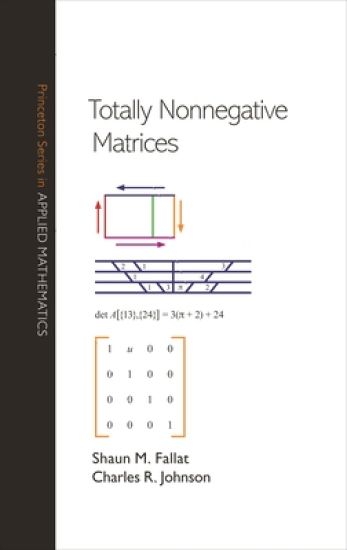
Totally Nonnegative Matrices

Totally Nonnegative Matrices

Shaun M. Fallat; Charles R. Johnson

PRINCETON UNIVERSITY PRESS
2022
pokkari
Totally nonnegative matrices arise in a remarkable variety of mathematical applications. This book is a comprehensive and self-contained study of the essential theory of totally nonnegative matrices, defined by the nonnegativity of all subdeterminants. It explores methodological background, historical highlights of key ideas, and specialized topics.The book uses classical and ad hoc tools, but a unifying theme is the elementary bidiagonal factorization, which has emerged as the single most important tool for this particular class of matrices. Recent work has shown that bidiagonal factorizations may be viewed in a succinct combinatorial way, leading to many deep insights. Despite slow development, bidiagonal factorizations, along with determinants, now provide the dominant methodology for understanding total nonnegativity. The remainder of the book treats important topics, such as recognition of totally nonnegative or totally positive matrices, variation diminution, spectral properties, determinantal inequalities, Hadamard products, and completion problems associated with totally nonnegative or totally positive matrices. The book also contains sample applications, an up-to-date bibliography, a glossary of all symbols used, an index, and related references.
Totally Nonnegative Matrices

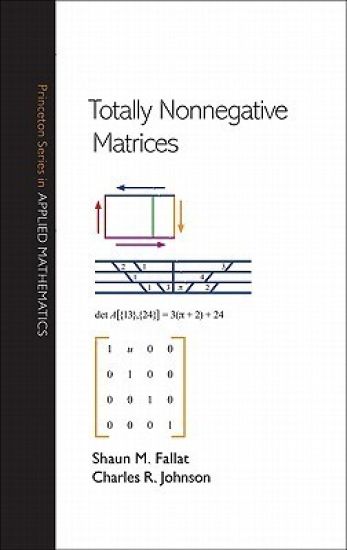
Totally Nonnegative Matrices

Shaun M. Fallat; Charles R. Johnson

Princeton University Press
2011
sidottu
Totally nonnegative matrices arise in a remarkable variety of mathematical applications. This book is a comprehensive and self-contained study of the essential theory of totally nonnegative matrices, defined by the nonnegativity of all subdeterminants. It explores methodological background, historical highlights of key ideas, and specialized topics. The book uses classical and ad hoc tools, but a unifying theme is the elementary bidiagonal factorization, which has emerged as the single most important tool for this particular class of matrices. Recent work has shown that bidiagonal factorizations may be viewed in a succinct combinatorial way, leading to many deep insights. Despite slow development, bidiagonal factorizations, along with determinants, now provide the dominant methodology for understanding total nonnegativity. The remainder of the book treats important topics, such as recognition of totally nonnegative or totally positive matrices, variation diminution, spectral properties, determinantal inequalities, Hadamard products, and completion problems associated with totally nonnegative or totally positive matrices. The book also contains sample applications, an up-to-date bibliography, a glossary of all symbols used, an index, and related references.

I Will Take to the Water

I Will Take to the Water

Charles R. Johnson

THE UNIVERSITY OF CHICAGO PRESS
2026
nidottu
A landmark survey of African American literature about Black experiences of the maritime environment. The ocean is foundational to the story of Africans in America, beginning with the searing Middle Passage. Initially evoking terror, pain, and death, the ocean also became associated with escape, empowerment, freedom, and home, as over time, African Americans in seaport towns found work, built communities, and gained knowledge from travelers. David R. Anderson shows in this groundbreaking collection of memoir, fiction, poetry, and more that African American maritime literature summons many of the traditional themes—survival in the face of overwhelming natural force, sublimity, demonstration of skill and merit, and self-discovery—but often with an eye on legacies of imperialism, slavery, discrimination, and cultural erasure. Divided thematically across ten sections that address peril, labor, recreation, and more, the book gathers work by influential writers and intellectuals from the eighteenth century to the present, including: Lucille Clifton, Edwidge Danticat, Frederick Douglass, Alice Dunbar-Nelson, W. E. B. DuBois, Camille T. Dungy, Marcus Garvey, Robert Hayden, Zora Neale Hurston, Major Jackson, Harriet Jacobs, John S. Jacobs, Nella Larsen, Claude McKay, Toni Morrison, Walter Mosley, Natasha Trethewey, Phillis Wheatley, Colson Whitehead, and Kevin Young.
I Will Take to the Water

I Will Take to the Water

Charles R. Johnson

THE UNIVERSITY OF CHICAGO PRESS
2026
sidottu
A landmark survey of African American literature about Black experiences of the maritime environment. The ocean is foundational to the story of Africans in America, beginning with the searing Middle Passage. Initially evoking terror, pain, and death, the ocean also became associated with escape, empowerment, freedom, and home, as over time, African Americans in seaport towns found work, built communities, and gained knowledge from travelers. David R. Anderson shows in this groundbreaking collection of memoir, fiction, poetry, and more that African American maritime literature summons many of the traditional themes—survival in the face of overwhelming natural force, sublimity, demonstration of skill and merit, and self-discovery—but often with an eye on legacies of imperialism, slavery, discrimination, and cultural erasure. Divided thematically across ten sections that address peril, labor, recreation, and more, the book gathers work by influential writers and intellectuals from the eighteenth century to the present, including: Lucille Clifton, Edwidge Danticat, Frederick Douglass, Alice Dunbar-Nelson, W. E. B. DuBois, Camille T. Dungy, Marcus Garvey, Robert Hayden, Zora Neale Hurston, Major Jackson, Harriet Jacobs, John S. Jacobs, Nella Larsen, Claude McKay, Toni Morrison, Walter Mosley, Natasha Trethewey, Phillis Wheatley, Colson Whitehead, and Kevin Young.
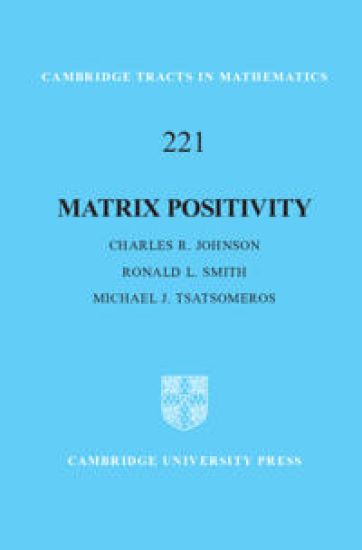
Matrix Positivity

Matrix Positivity

Charles R. Johnson; Ronald L. Smith; Michael J. Tsatsomeros

Cambridge University Press
2020
sidottu
Matrix positivity is a central topic in matrix theory: properties that generalize the notion of positivity to matrices arose from a large variety of applications, and many have also taken on notable theoretical significance, either because they are natural or unifying. This is the first book to provide a comprehensive and up-to-date reference of important material on matrix positivity classes, their properties, and their relations. The matrix classes emphasized in this book include the classes of semipositive matrices, P-matrices, inverse M-matrices, and copositive matrices. This self-contained reference will be useful to a large variety of mathematicians, engineers, and social scientists, as well as graduate students. The generalizations of positivity and the connections observed provide a unique perspective, along with theoretical insight into applications and future challenges. Direct applications can be found in data analysis, differential equations, mathematical programming, computational complexity, models of the economy, population biology, dynamical systems and control theory.
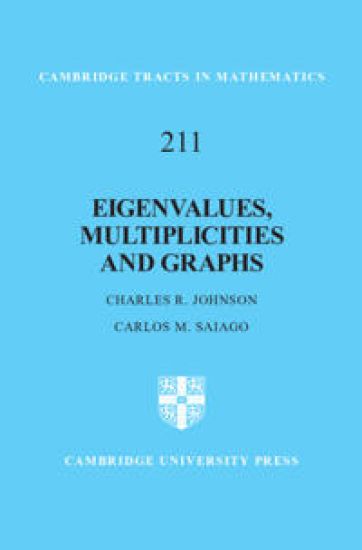
Eigenvalues, Multiplicities and Graphs

Eigenvalues, Multiplicities and Graphs

Charles R. Johnson; Carlos M. Saiago

Cambridge University Press
2018
sidottu
The arrangement of nonzero entries of a matrix, described by the graph of the matrix, limits the possible geometric multiplicities of the eigenvalues, which are far more limited by this information than algebraic multiplicities or the numerical values of the eigenvalues. This book gives a unified development of how the graph of a symmetric matrix influences the possible multiplicities of its eigenvalues. While the theory is richest in cases where the graph is a tree, work on eigenvalues, multiplicities and graphs has provided the opportunity to identify which ideas have analogs for non-trees, and those for which trees are essential. It gathers and organizes the fundamental ideas to allow students and researchers to easily access and investigate the many interesting questions in the subject.
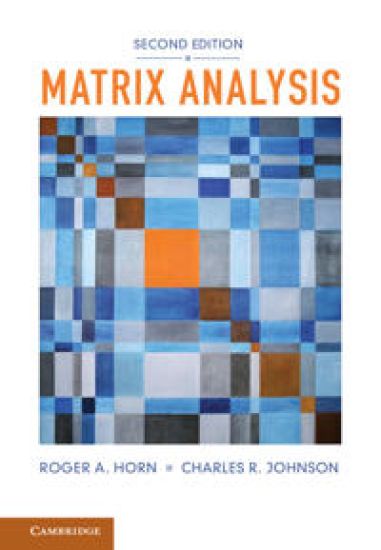
Matrix Analysis

Matrix Analysis

Roger A. Horn; Charles R. Johnson

Cambridge University Press
2012
sidottu
Linear algebra and matrix theory are fundamental tools in mathematical and physical science, as well as fertile fields for research. This second edition of this acclaimed text presents results of both classic and recent matrix analysis using canonical forms as a unifying theme and demonstrates their importance in a variety of applications. This thoroughly revised and updated second edition is a text for a second course on linear algebra and has more than 1,100 problems and exercises, new sections on the singular value and CS decompositions and the Weyr canonical form, expanded treatments of inverse problems and of block matrices, and much more.
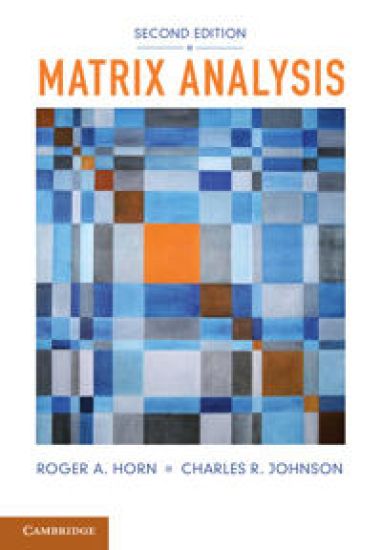
Matrix Analysis

Matrix Analysis

Roger A. Horn; Charles R. Johnson

Cambridge University Press
2012
pokkari
Linear algebra and matrix theory are fundamental tools in mathematical and physical science, as well as fertile fields for research. This second edition of this acclaimed text presents results of both classic and recent matrix analysis using canonical forms as a unifying theme and demonstrates their importance in a variety of applications. This thoroughly revised and updated second edition is a text for a second course on linear algebra and has more than 1,100 problems and exercises, new sections on the singular value and CS decompositions and the Weyr canonical form, expanded treatments of inverse problems and of block matrices, and much more.
Topics in Matrix Analysis

Topics in Matrix Analysis

Roger A. Horn; Charles R. Johnson

Cambridge University Press
1994
pokkari
Building on the foundations of its predecessor volume, Matrix Analysis, this book treats in detail several topics in matrix theory not included in the previous volume, but with important applications and of special mathematical interest. As with the previous volume, the authors assume a background knowledge of elementary linear algebra and rudimentary analytical concepts. Many examples and exercises of varying difficulty are included.