Kirjojen hintavertailu. Mukana 12 657 676 kirjaa ja 12 kauppaa.

Kirjailija

Charles Villa-Vicencio

Kirjat ja teokset yhdessä paikassa: 6 kirjaa, julkaisuja vuosilta 1992-2021, suosituimpien joukossa Walk with Us and Listen. Vertaile teosten hintoja ja tarkista saatavuus suomalaisista kirjakaupoista.

6 kirjaa

Kirjojen julkaisuhaarukka 1992-2021.

Living Between Science and Belief

Living Between Science and Belief

Charles Villa-Vicencio; John W de Gruchy

Cascade Books
2021
sidottu
Most thoughtful people live in an interregnum between science and religion. Traditional religious answers concerning the beginning, purpose, and end of life are questioned by the natural sciences, with neuroscience conceivably constituting the last frontier where skeptics and believers explore common ground. The question concerns the nature of reflective and creative moments in life. Can these be reduced to the intersect between the nerve cells and molecules of the physical brain? Does this account for the human sense of mystery, or even spirituality? Is there a nexus between the physical and unknown dimensions of existence? The mutation in the history of theism suggests that progressive theology in the West may be set for further change.
Living Between Science and Belief

Living Between Science and Belief

Charles Villa-Vicencio; John W de Gruchy

Cascade Books
2021
pokkari
Most thoughtful people live in an interregnum between science and religion. Traditional religious answers concerning the beginning, purpose, and end of life are questioned by the natural sciences, with neuroscience conceivably constituting the last frontier where skeptics and believers explore common ground. The question concerns the nature of reflective and creative moments in life. Can these be reduced to the intersect between the nerve cells and molecules of the physical brain? Does this account for the human sense of mystery, or even spirituality? Is there a nexus between the physical and unknown dimensions of existence? The mutation in the history of theism suggests that progressive theology in the West may be set for further change.
Walk with Us and Listen

Walk with Us and Listen

Charles Villa-Vicencio; Desmond Tutu

Georgetown University Press
2009
pokkari
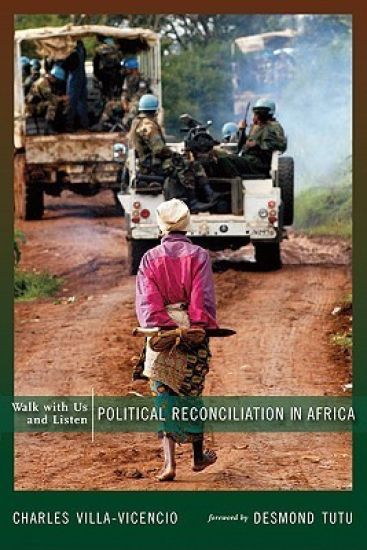
Effective peace agreements are rarely accomplished by idealists. The process of moving from situations of entrenched oppression, armed conflict, open warfare, and mass atrocities toward peace and reconciliation requires a series of small steps and compromises to open the way for the kind of dialog and negotiation that make political stability, the beginning of democracy, and the rule of law a possibility. For over forty years, Charles Villa-Vicencio has been on the front lines of Africa's battle for racial equality. In "Walk with Us and Listen", he argues that reconciliation needs honest talk to promote trust building and enable former enemies and adversaries to explore joint solutions to the cause of their conflicts. He offers a critical assessment of the South African experiment in transitional justice as captured in the Truth and Reconciliation Commission and considers the influence of ubuntu, in which individuals are defined by their relationships, and other traditional African models of reconciliation. Political reconciliation is offered as a cautious model against which transitional politics needs to be measured. Villa-Vicencio challenges those who stress the obligation to prosecute those allegedly guilty of gross violation of human rights, replacing this call with the need for more complementarity between the International Criminal Court and African mechanisms to achieve the greater goals of justice and peace building.
The Spirit of Freedom

The Spirit of Freedom

Charles Villa-Vicencio; Thomas G. Karis

University of California Press
1996
pokkari
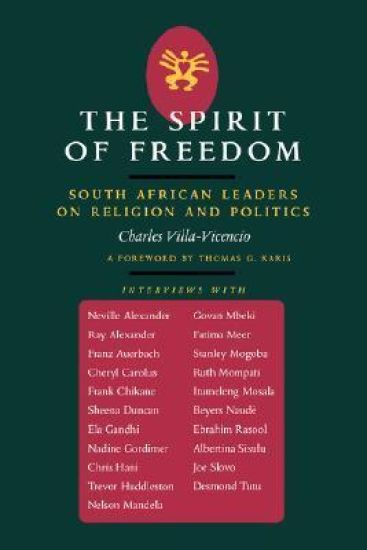
This collection of interviews explores the role of religion in the lives of eminent South Africans who led the struggle against apartheid. Nelson Mandela, Chris Hani, Desmond Tutu, Nadine Gordimer, and seventeen other political, religious, and cultural leaders share the beliefs and values that informed the moral positions they adopted, often at great cost. From all ethnic, religious, and political backgrounds, these men and women have shaped one of the greatest political transformations of the century. What emerges from the interviews are reflections on all aspects of life in an embattled country. There are stories of the homelands and townships, and tales of imprisonment and exile. Dedicated communists relate their intense youthful devotion to Christianity; Muslim activists discuss the complexity of their relationships with their communities. As the respondents grapple with difficult questions about faith, politics, and authority, they expose a more personal picture: of their daily lives, of their pasts, and of the enormous conflicts that arise in a society that continually strains the moral fiber of its citizens. Taken together, these interviews reveal the many-faceted vision that has fueled South Africa's struggle for democracy.
A Theology of Reconstruction

A Theology of Reconstruction

Charles Villa-Vicencio

Cambridge University Press
1992
sidottu
The changing situation in South Africa and eastern Europe prompts Charles Villa-Vicencio to investigate the implications of transforming liberation theology into a theology of reconstruction and nation-building. Such a transformation, he argues, requires theology to become an unambiguously inter-disciplinary study. This book explores the encounter between theology, on the one hand, and constitutional writing, law-making, human rights, economics, and the freedom of conscience on the other. Locating his discussion in the context of the South African struggle, the author compares this situation to that in eastern Europe, and the challenge of what is happening in these situations is identified for contexts where ‘the empire has not yet crumbled’.
A Theology of Reconstruction

A Theology of Reconstruction

Charles Villa-Vicencio

Cambridge University Press
1992
pokkari
The changing situation in South Africa and eastern Europe prompts Charles Villa-Vicencio to investigate the implications of transforming liberation theology into a theology of reconstruction and nation-building. Such a transformation, he argues, requires theology to become an unambiguously inter-disciplinary study. This book explores the encounter between theology, on the one hand, and constitutional writing, law-making, human rights, economics, and the freedom of conscience on the other. Locating his discussion in the context of the South African struggle, the author compares this situation to that in eastern Europe, and the challenge of what is happening in these situations is identified for contexts where ‘the empire has not yet crumbled’.