Kirjojen hintavertailu. Mukana 12 595 353 kirjaa ja 12 kauppaa.

Kirjailija

Ching Kwan Lee

Kirjat ja teokset yhdessä paikassa: 6 kirjaa, julkaisuja vuosilta 1998-2025, suosituimpien joukossa Southern Interregnum. Vertaile teosten hintoja ja tarkista saatavuus suomalaisista kirjakaupoista.

6 kirjaa

Kirjojen julkaisuhaarukka 1998-2025.

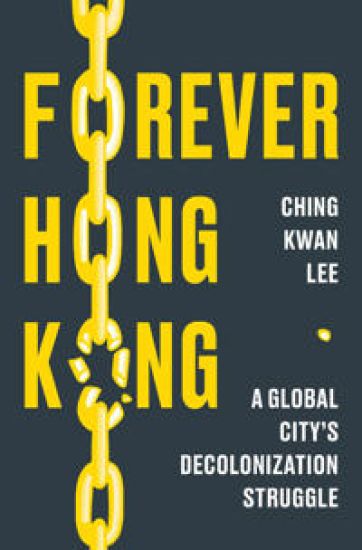
Forever Hong Kong

Forever Hong Kong

Ching Kwan Lee

HARVARD UNIVERSITY PRESS
2025
sidottu
An on-the-ground account of the dramatic 2019 Hong Kong protests, showing how they represent the latest stage of a decades-old decolonization struggle.Long known for its glamour and affluence, Hong Kong shocked the world in 2019 when millions of its citizens took to the streets in protest. For more than six months, Hong Kongers braved the police’s often violent suppression. At the forefront were young adults fighting not just for universal suffrage but for their vision of a good society, a just economy, rule of law, and a future of self-determination.Forever Hong Kong takes readers deep inside this improbable decolonization struggle in one of the global centers of capitalism, providing granular insight into a movement that had been gestating for decades. Caught between the relentlessly encroaching Chinese party-state and the kingpins of international commerce—for whom political complacency is the foundation of a stable and profitable business environment—are Hong Kongers themselves. They have inherited an island long under British and now Chinese rule, while maintaining a strong, distinct identity to be defended at all costs.Offering a reflective history, a vivid ethnography, and a piercing analysis of political economy, Ching Kwan Lee tells the story of her native city at a pivotal moment of geopolitical rivalry between China and the West. Her novel analysis of how colonized subjects have transformed into agents of history breaks new ground for the study of decolonization worldwide.
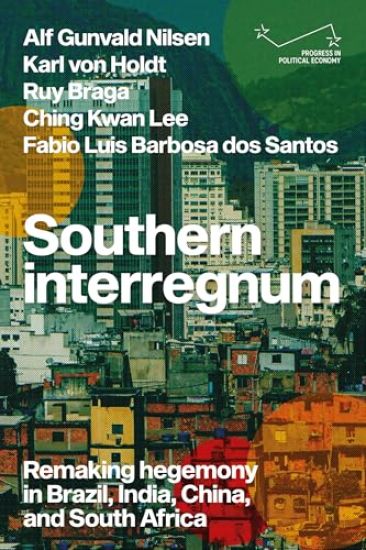
Southern Interregnum

Southern Interregnum

Alf Gunvald Nilsen; Karl von Holdt; Ruy Braga; Ching Kwan Lee; Fabio Luis Barbosa dos Santos

MANCHESTER UNIVERSITY PRESS
2025
sidottu
How do governing elites in the global South attempt to remake hegemony in a conjuncture of durable crisis? This is the question at the core of Southern interregnum, a comparative conjunctural analysis of hegemonic projects in Brazil, India, China, and South Africa. Working with a Gramscian notion of crisis, centred on the interregnum as an enduring period of instability and uncertainty, in which hegemonic authority erodes and competing projects for crisis resolution emerge, the book proposes a novel critical reading of the convulsions that are currently reshaping the political economy of the global South and the world-system.Mapping the variegated trajectories of elite projects to reconcile accumulation and legitimation – and probing the limits of these projects – the book breaks new ground in the study of the contemporary global South.
Hong Kong

Hong Kong

Ching Kwan Lee

Cambridge University Press
2022
pokkari
How did Hong Kong transform itself from a 'shoppers' and capitalists' paradise' into a 'city of protests' at the frontline of a global anti-China backlash? CK Lee situates the post-1997 China–Hong Kong contestation in the broader context of 'global China.' Beijing deploys a bundle of power mechanisms – economic statecraft, patron-clientelism, and symbolic domination – around the world, including Hong Kong. This Chinese power project triggers a variety of countermovements from Asia to Africa, ranging from acquiescence and adaptation to appropriation and resistance. In Hong Kong, reactions against the totality of Chinese power have taken the form of eventful protests, which, over two decades, have broadened into a momentous decolonization struggle. More than an ideological conflict between a liberal capitalist democratizing city and its Communist authoritarian sovereign, the Hong Kong story, stunning and singular in its many peculiarities, offers lessons about China as a global force. This title is also available as Open Access on Cambridge Core.
The Specter of Global China

The Specter of Global China

Ching Kwan Lee

University of Chicago Press
2018
nidottu
China has recently emerged as one of Africa's top business partners, aggressively pursuing its raw materials and establishing a mighty presence in the continent's booming construction market. Even though Africa has become a popular destination of foreign investment from around the world, China has stirred the most fear, hope, and controversy. Yet global debates about China in Africa have been based more on rhetoric than empirical evidence. Ching Kwan Lee's The Specter of Global China is the first comparative ethnographic study that addresses the critical question: Is Chinese capital a different kind of capital? Conducting extensive fieldwork in Zambia over a period of six years, Lee shadowed Chinese, Indian, and South African managers in underground mines, interviewed Zambian miners and construction workers, and worked with Zambian officials. Distinguishing carefully between Chinese state capital and global private capital in terms of their business objectives, labor practices, managerial ethos, and political engagement with Zambian state and society, she concludes that Chinese state investment presents unique potentials and perils for African development. The first book to explore this phenomenon, The Specter of Global China will interest anyone curious in the future of China, Africa, and capitalism worldwide.
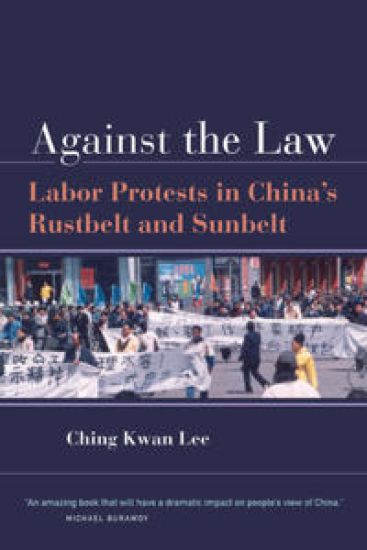
Against the Law

Against the Law

Ching Kwan Lee

University of California Press
2007
pokkari
This study opens a critical perspective on the slow death of socialism and the rebirth of capitalism in the world's most dynamic and populous country. Based on remarkable fieldwork and extensive interviews in Chinese textile, apparel, machinery, and household appliance factories, "Against the Law" finds a rising tide of labor unrest mostly hidden from the world's attention. Providing a broad political and economic analysis of this labor struggle together with fine-grained ethnographic detail, the book portrays the Chinese working class as workers' stories unfold in bankrupt state factories and global sweatshops, in crowded dormitories and remote villages, at street protests as well as in quiet disenchantment with the corrupt officialdom and the fledgling legal system.
Gender and the South China Miracle

Gender and the South China Miracle

Ching Kwan Lee

University of California Press
1998
pokkari
Both Yuk-ling, a busy Hong Kong mother of two, and Chi-ying, a young single woman from a remote village in northern China, work in electronics factories owned by the same foreign corporation, manufacturing identical electronic components. After a decade of job growth and increasing foreign investment in Hong Kong and South China, both women are also participating in the spectacular economic transformation that has come to be called the South China miracle. Yet, as Ching Kwan Lee demonstrates in her unique and fascinating study of women workers on either side of the Chinese-Hong Kong border, the working lives and factory cultures of these women are vastly different. In this rich comparative ethnography, Lee describes how two radically different factory cultures have emerged from a period of profound economic change. In Hong Kong, 'matron workers' remain in factories for decades. In Guangdong, a seemingly endless number of young 'maiden workers' travel to the south from northern provinces, following the promise of higher wages. Whereas the women in Hong Kong participate in a management system characterized by 'familial hegemony,' the young women in Guangdong find an internal system of power based on regional politics and kin connections, or 'localistic despotism.' Having worked side-by-side with these women on the floors of both factories, Lee concludes that it is primarily the differences in the gender politics of the two labor markets that determine the culture of each factory. Posing an ambitious challenge to sociological theories that reduce labor politics to pure economics or state power structures, Lee argues that gender plays a crucial role in the cultures and management strategies of factories that rely heavily on women workers.