Kirjojen hintavertailu. Mukana 12 390 323 kirjaa ja 12 kauppaa.

Kirjailija

Chongbin Zhao

Kirjat ja teokset yhdessä paikassa: 8 kirjaa, julkaisuja vuosilta 2008-2016, suosituimpien joukossa Physical and Chemical Dissolution Front Instability in Porous Media. Vertaile teosten hintoja ja tarkista saatavuus suomalaisista kirjakaupoista.

8 kirjaa

Kirjojen julkaisuhaarukka 2008-2016.

Physical and Chemical Dissolution Front Instability in Porous Media

Physical and Chemical Dissolution Front Instability in Porous Media

Chongbin Zhao

Springer International Publishing AG
2016
nidottu
This monograph provides state-of-the-art theoretical and computational findings from investigations on physical and chemical dissolution front instability problems in porous media, based on the author’s own work. Although numerical results are provided to complement theoretical ones, the focus of this monograph is on the theoretical aspects of the topic and those presented in this book are applicable to a wide range of scientific and engineering problems involving the instability of nonlinear dynamic systems. To appeal to a wider readership, common mathematical notations are used to derive the theoretical solutions. The book can be used either as a useful textbook for postgraduate students or as a valuable reference book for computational scientists, mathematicians, engineers and geoscientists.
Physical and Chemical Dissolution Front Instability in Porous Media

Physical and Chemical Dissolution Front Instability in Porous Media

Chongbin Zhao

Springer International Publishing AG
2014
sidottu
This monograph provides state-of-the-art theoretical and computational findings from investigations on physical and chemical dissolution front instability problems in porous media, based on the author’s own work. Although numerical results are provided to complement theoretical ones, the focus of this monograph is on the theoretical aspects of the topic and those presented in this book are applicable to a wide range of scientific and engineering problems involving the instability of nonlinear dynamic systems. To appeal to a wider readership, common mathematical notations are used to derive the theoretical solutions. The book can be used either as a useful textbook for postgraduate students or as a valuable reference book for computational scientists, mathematicians, engineers and geoscientists.
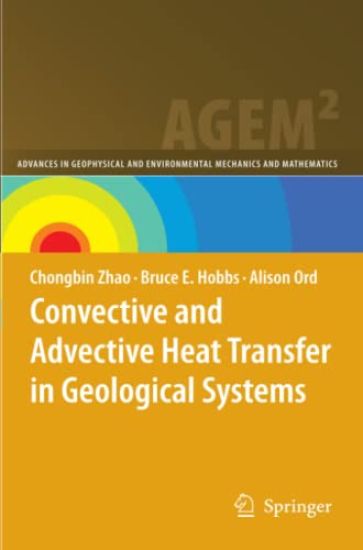
Convective and Advective Heat Transfer in Geological Systems

Convective and Advective Heat Transfer in Geological Systems

Chongbin Zhao; Bruce E. Hobbs; Alison Ord

Springer-Verlag Berlin and Heidelberg GmbH Co. K
2010
nidottu
The study of heat transfer mechanisms in hydrothermal systems is important for understanding the basic physics behind orebody formation and mineralization in the upper crust (Bickle and Mckenzie 1987; Bjorlykke et al. 1988; Brady 1988; England and Thompson 1989; Hoisch 1991; Connolly 1997). Generally, heat energy may be transferred within the crust in the following forms: conduction, advection (including forced convection) where the heat is carried by a moving mass of rock during def- mation or by a moving uid, convection (i. e. , free convection, natural convection, buoyancy driven convection, temperature gradient driven convection) and a com- nation of these processes. Since advective ow is usually generated by a pore- uid pressure gradient, heat transfer due to advective ow is largely dependent on the pore- uid pressure gradient distribution in hydrothermal systems. A typical ex- ple of this advective ow is the upward through ow caused by lithostatic pore- uid pressure gradients within the lower crust. Extensive studies (Connolly and Ko 1995; Etheridge et al. 1983; England et al. 1987; Fyfe et al. 1978; Walther and Orville 1982; Peacock 1989; Yardley and Bottrell 1992; Hanson 1992; Yardley and Lloyd 1995; Norton and Knapp 1970) have shown that lithostatic pore- uid pressure can be built up by metamorphic uids arising from devolatilization and dehydration - actions, if the permeability is low enough to control uid ow in the lower crust.
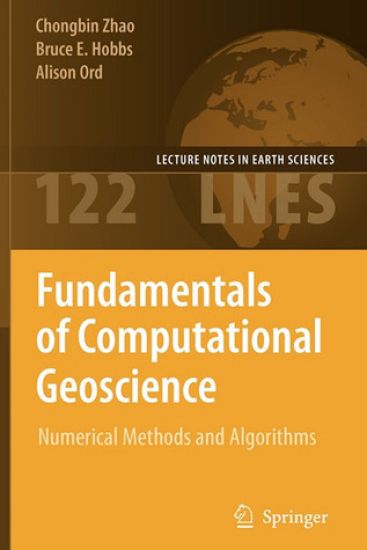
Fundamentals of Computational Geoscience

Fundamentals of Computational Geoscience

Chongbin Zhao; Bruce E. Hobbs; Alison Ord

Springer-Verlag Berlin and Heidelberg GmbH Co. K
2010
nidottu
Geoscience is a fundamental natural science discipline dealing with the origin, evolutionary history and behaviour of the planet Earth. As a result of its complicated and complex nature, the Earth system not only provides the necessary materials and environment for mankind to live, but also brings many types of natural disasters, such as earthquakes, volcanic eruptions, tsunamis, ?oods and tornadoes, to mention just a few. With the ever-increasing demand for improving our living standards, it has been recognized that the existing natural resources will be exhausted in the near future and that our living environments are, in fact, deteriorating. To maintain the sustainable development of our living standards and the further improvement of our living environments, an inevitable and challenging task that geoscientists are now confronting is how accurately to predict not only the occurrences of these natural disasters, but also the locations of large concealed natural resources in the deepEarth. For this reason, geoscientists must study the processes, rules and laws, by which the Earth system operates, instead of simply describing and observing g- science phenomena.
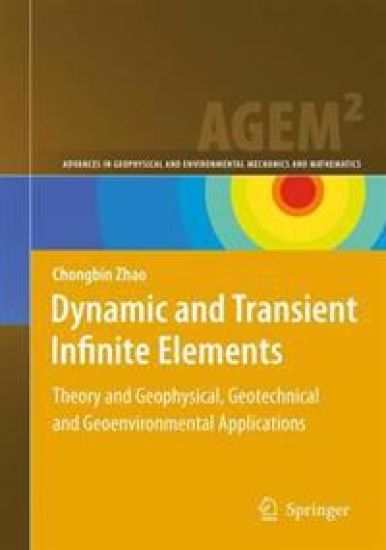
Dynamic and Transient Infinite Elements

Dynamic and Transient Infinite Elements

Chongbin Zhao

Springer-Verlag Berlin and Heidelberg GmbH Co. K
2009
sidottu
Effective and ef cient modelling of in nite media is important for the production of accurate and useful solutions for many scienti c and engineering problems invo- ing in nite domains (Bettess 1977, 1980; Chow and Smith 1981; Medina and Taylor 1983; Zhang and Zhao 1987; Zhao et al. 1989; Zhao and Valliappan 1993a, b, c, d; Astley 1996, 1998; Yang et al. 1996; Yang and Huang 2001; Yun et al. 2000, 2007; Wang et al. 2006). Some typical examples involving in nite domains are as follows: (1) earthquake wave propagation within the upper crust of the Earth in the elds of geophysics and seismology; (2) dynamic structure-foundation interaction in the elds of geotechnical, civil and dam engineering; and (3) transient pore- uid ow, heat transfer and mass transport within the interior of the Earth in the elds of g- science and geoenvironmental engineering. Although the solid Earth is viewed as a bounded domain at the terrestrial scale, it can be treated as an unbounded domain at the human scale. For instance, in the case of predicting possible property damages caused by an earthquake, only a limited region around the epicentre is of interest because the earthquake wave energy is signi cantly reduced as the distance from the epicentre is increased.
Fundamentals of Computational Geoscience

Fundamentals of Computational Geoscience

Chongbin Zhao; Bruce E. Hobbs; Alison Ord

Springer-Verlag Berlin and Heidelberg GmbH Co. K
2009
sidottu
Geoscience is a fundamental natural science discipline dealing with the origin, evolutionary history and behaviour of the planet Earth. As a result of its complicated and complex nature, the Earth system not only provides the necessary materials and environment for mankind to live, but also brings many types of natural disasters, such as earthquakes, volcanic eruptions, tsunamis, ?oods and tornadoes, to mention just a few. With the ever-increasing demand for improving our living standards, it has been recognized that the existing natural resources will be exhausted in the near future and that our living environments are, in fact, deteriorating. To maintain the sustainable development of our living standards and the further improvement of our living environments, an inevitable and challenging task that geoscientists are now confronting is how accurately to predict not only the occurrences of these natural disasters, but also the locations of large concealed natural resources in the deepEarth. For this reason, geoscientists must study the processes, rules and laws, by which the Earth system operates, instead of simply describing and observing g- science phenomena.
Convective and Advective Heat Transfer in Geological Systems

Convective and Advective Heat Transfer in Geological Systems

Chongbin Zhao; Bruce E. Hobbs; Alison Ord

Springer-Verlag Berlin and Heidelberg GmbH Co. K
2008
sidottu
The study of heat transfer mechanisms in hydrothermal systems is important for understanding the basic physics behind orebody formation and mineralization in the upper crust (Bickle and Mckenzie 1987; Bjorlykke et al. 1988; Brady 1988; England and Thompson 1989; Hoisch 1991; Connolly 1997). Generally, heat energy may be transferred within the crust in the following forms: conduction, advection (including forced convection) where the heat is carried by a moving mass of rock during def- mation or by a moving uid, convection (i. e. , free convection, natural convection, buoyancy driven convection, temperature gradient driven convection) and a com- nation of these processes. Since advective ow is usually generated by a pore- uid pressure gradient, heat transfer due to advective ow is largely dependent on the pore- uid pressure gradient distribution in hydrothermal systems. A typical ex- ple of this advective ow is the upward through ow caused by lithostatic pore- uid pressure gradients within the lower crust. Extensive studies (Connolly and Ko 1995; Etheridge et al. 1983; England et al. 1987; Fyfe et al. 1978; Walther and Orville 1982; Peacock 1989; Yardley and Bottrell 1992; Hanson 1992; Yardley and Lloyd 1995; Norton and Knapp 1970) have shown that lithostatic pore- uid pressure can be built up by metamorphic uids arising from devolatilization and dehydration - actions, if the permeability is low enough to control uid ow in the lower crust.