Kirjojen hintavertailu. Mukana 12 595 353 kirjaa ja 12 kauppaa.

Kirjailija

Chris Enss

Kirjat ja teokset yhdessä paikassa: 45 kirjaa, julkaisuja vuosilta 2002-2026, suosituimpien joukossa Happy Trails: A Pictorial Celebration of the Life and Times of Roy Rogers and Dale Evans. Vertaile teosten hintoja ja tarkista saatavuus suomalaisista kirjakaupoista.

45 kirjaa

Kirjojen julkaisuhaarukka 2002-2026.

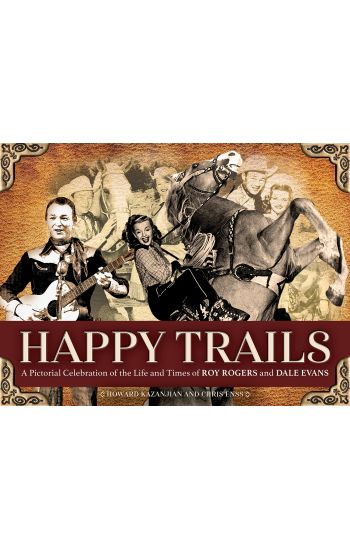
Happy Trails: A Pictorial Celebration of the Life and Times of Roy Rogers and Dale Evans
A unique and captivating collection of photographs and memories chronicling the lives of the King of the Cowboys and the Queen of the West.Roy Rogers and Dale Evans made their first movie together in 1944, and so began a dazzling partnership with a devoted public following that lasted 52 years. In this charming photographic biography, readers meet the talented young man and woman who would eventually become the royal couple of B-rated Westerns, a reign that would last more than a decade. The dynamic pair, adored by fans for both their acting and their singing abilities, costarred in 29 movies and recorded more than 200 albums together, eventually parlaying their fame to the small screen with a half-hour television The Roy Rogers Show, as well as a comic book series and a long list of merchandise (including clothes, boots, and toys), bearing their names.In these pages, rarely seen personal photos and striking publicity shots capture all aspects of Rogers' and Evans' life, including: The rise of their stardom, from the box office to Broadway.The mutual friendship that evolved into a proposal of marriage, delivered from the back of Roy's famous Palomino horse, Trigger.Trigger himself--the "golden boy" of the horse world.The nine children they adored, and the heartbreaking loss of three.Their time spent visiting children in hospitals and orphanages.The strong faith that held them together through the years and the challenges they faced, professionally and personally.With a complete list of filmography for both stars and a look back at the artifacts once visible to the public at the Roy Rogers--Dale Evans Museum, this book transports nostalgic readers back to a time when the good always save the day and lovers ride off together into the sunset to the now-famous tune written by Evans that would become the couple's theme: "Happy Trails." It is both a classic reminder for aficionados and a beguiling introduction to new fans, demonstrating how even when both career and family are in the limelight, they can still be well-lived.

Helen Hunt Jackson and Standing Bear
On a November night in 1879 in Boston, Massachusetts, a lecture was given by Chief Standing Bear of the Ponca Tribe. It was attended by a forty-nine-year old woman who sat mesmerized as the dignified Indian told of the injustice that had driven his people from their ancestral lands. The next day the woman sent a cable to her husband at home in Colorado explaining that she would be delayed in returning. “Thankful you will be in the east on business next month,” she wrote, “situation with the Ponca Indians necessitates extended time here.” And so began a path that was to thrust Helen Hunt Jackson into the public eye as one of the foremost Indian policy reformers of the 19th century. From that moment in the Brunswick Hotel Jackson was imbued with the indignation that would be the motivating factor in everything she did, thought, or wrote for the rest of her life. “I cannot think of anything else from night to morning,” she wrote in a letter to a friend in 1880. “I shall be found with Indians engraved on my brain when I’m dead. A fire has been kindled within me which will never go out.” Jackson and Chief Standing Bear became fast friends and she used her considerable talents as a writer to pen her most famous work, a book entitled A Century of Dishonor. The book chronicled the injustices perpetrated against Native Americans in the United States after the arrival of European settlers through the famed Indian Wars of the 1870s and their aftermath. Jackson’s friendship with Chief Standing Bear and her daring efforts to publish a book about the broken promises of the United States government made with the Native Americans is a compelling story. During the three years it took Jackson to write the book attempts were twice made on her life. There was a lot of speculation about who tried to kill her, including many politicians who resented her association with Chief Standing Bear and the book she was working on, but no one was ever charged with the crimes.
Meet the Kellys

Meet the Kellys

Chris Enss

CITADEL PRESS INC.,U.S.
2025
sidottu
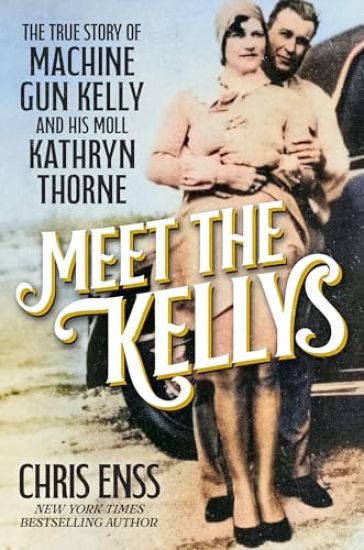
Gangsters. Lovers. Legends. Meet the Kellys--the bootlegging, bank-robbing, husband-wife duo known as "Machine Gun" Kelly and Kathyrn Thorne--who masterminded one of the most infamous kidnappings in American crime. . . . How did a small-time, hip-pocket bootlegger become one of the most notorious gangsters in the country? For George "Machine Gun" Kelly, the answer was simple: a woman. Her name was Kathryn Thorne, a charming, strong-minded beauty who had family connections in the crime world--and big ambitions for the tall, handsome bootlegger. By the time she met Kelly, she was already an experienced criminal herself, divorced twice, and ready to marry a man who could give her the posh life she always dreamed of. With that in mind, she bought Kelly his first machine gun. And the rest is history . . . George Kelly wasn't a natural-born gangster and never carried a weapon bigger than a revolver. But Kathryn changed all that. Like a mobbed-up Lady Macbeth, she pushed her husband to commit greater crimes, introducing him to her friends in the underworld and convincing him to join in a series of bank robberies. Soon, the Kellys were living large, with a house in Texas, expensive jewelry, the works. But it wasn't enough, and eventually the couple hatched a daring plot to kidnap oil tycoon Charles Urschel. Their plan worked. They collected the ransom--and captured the attention of the nation, the world . . . and the FBI. A shocking story of ambition and greed, crime and punishment, Meet the Kellys offers a fascinating portrait of a reluctant gangster named after a machine gun and a scheming moll as driven as Bonnie Parker and Ma Barker. A must-read for true crime fans.
Tilghman

Tilghman

Howard Kazanjian; Chris Enss

TwoDot Books
2024
pokkari
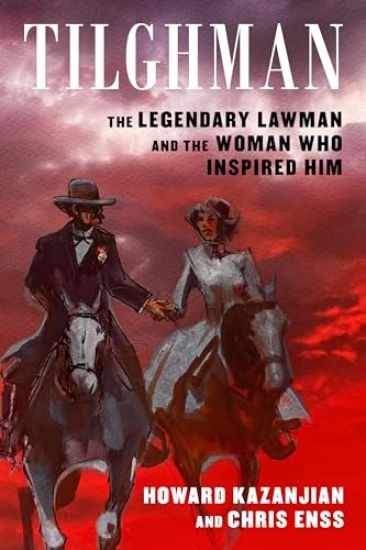
He was steely eyed, hard riding and straight shooting; a soft-spoken, tee-totaling lawman who never drew his gun...unless he meant to use it. Among other things he was also a buffalo hunter, Indian fighter, rancher horse breeder, saloon keeper, politician…even a movie maker. His name was Bill Tilghman and of all the heroes of the Old West he was one of the last, one of the most heroic, and a legend in his own time. Tilghman is about his life and the woman who memorialized his adventures. Tilghman began his career in Dodge City in 1878 when his friend Bat Masterson, newly elected sheriff, made him under sheriff. Still going strong in 1924, the 70-year-old Tilghman was called out of retirement to help rid Cromwell, Oklahoma, of bootlegging gangsters. In 1878 the bad guys rode horses; in 1924 they drove Piece-Arrows and Fords and flew airplanes. Frontier outlaw or prohibition hoodlum, Tilghman fought them all. In his lifetime he saw the vast herds of buffalo disappear from the great plains and Oklahoma transformed from Indian territory and outlaw haven into homesteading land and booming oil country. Oklahoma City evolved from a collection of muddy tents and shacks into a thriving metropolis. It was a dramatic transformation and Bill Tilghman helped make it happen. Beside him through most of that transformation was his wife, author Zoe Agnes Stratton. Zoe not only had an up close view of the various outlaws her husband pursued, but was instrumental in preserving those daring exploits on paper. The short stories and books she wrote about Tilghman’s life as a law enforcement agent helped make him a celebrated figure throughout the West. Zoe recorded Marshal Tilghman’s capture of such criminals as the Doolin Gang, Cattle Annie and Little Britches, and the Jennings brothers. She also wrote of his friendship with such well-known figures as Marshal Heck Thomas, Marshal Bass Reeves, and Judge Isaac Parker. When Bill Tilghman was gunned down in 1924 by a corrupt federal agent, Zoe had to find a way to continue on and financially support the two sons she’d had with the lawman. She earned a living writing about each case her husband had taken on during his career. Zoe hoped her sons, Richard and Woodie, would do better than their father had when he was young as the old frontier days were past, but Bill Tilghman’s brace of pistols remained symbolic of the family’s fate. In October 1929, nineteen-year-old Richard was killed in a crooked gambling game, along with his friend James Chitwood, a farmer. Seventeen-year-old Woodie was arrested soon after for killing the man who shot his brother. Woodie was arrested for manslaughter and sentenced to five years in prison. Zoe wrote about those heartbreaking events as well. Her body of work is recognized as some of the state’s finest historical writing. The book Tilghman is not only the story of a man - it’s a colorful, exciting history of the last days of the Western frontier. It’s also the story of a woman, desperate to hold onto her family and honor the life of the man she loved so dearly.
The Doctor Was a Woman

The Doctor Was a Woman

Chris Enss

TwoDot Books
2024
sidottu
A New York Times Bestseller!"No women need apply." Western towns looking for a local doctor during the frontier era often concluded their advertisements in just that manner. Yet apply they did. And in small towns all over the West, highly trained women from medical colleges in the East took on the post of local doctor to great acclaim. In this new book, author Chris Enss offers a glimpse into the fascinating lives of fourteen of these amazing women. This edition includes 4 new chapters on pioneering female physicians.
Frontier Teachers

Frontier Teachers

Chris Enss

ROWMAN LITTLEFIELD
2023
pokkari
If countless books and movies are to be believed, America's Wild West was, at heart, a world of cowboys and Indians, sheriffs and gunslingers, scruffy settlers and mountain men—a man's world. Here, Chris Enss, in the latest of her popular books to take on this stereotype, tells the stories of twelve courageous women who faced down schoolrooms full of children on the open prairies and in the mining towns of the Old West. Between 1847 and 1858, more than 600 women teachers traveled across the untamed frontier to provide youngsters with an education, and the numbers grew rapidly in the decades to come, as women took advantage of one of the few career opportunities for respectable work for ladies of the era. Enduring hardship, the dozen women whose stories are movingly told in the pages of Frontier Teachers demonstrated the utmost dedication and sacrifice necessary to bring formal education to the Wild West. As immortalized in works of art and literature, for many students their women teachers were heroic figures who introduced them to a world of possibilities—and changed America forever.
An Open Secret

An Open Secret

Chris Enss; Geri Jewell

ROWMAN LITTLEFIELD
2023
pokkari
The discovery of gold in the southern Black Hills in 1874 set off one of the great gold rushes in America. In 1876, miners moved into the northern Black Hills. That’s where they came across a gulch full of dead trees and a creek full of gold and Deadwood was born. Practically overnight, the tiny gold camp boomed into a town that played by its own rules that attracted outlaws, gamblers and gunslingers along with the gold seekers.Deadwood was comprised mostly of single men, a ration of men to women as high as 8 to 1, never less than 3 to 1.The lack of affordable housing, the hostile environment, the high cost of travel, and the expense of living in Deadwood prevented many men from bringing their wives, girlfriends and families to the growing town. Hoards of prostitutes and madams came to Deadwood to capitalize on the lack of women. By the mid-1880s, there were more than a hundred fifty brothels in the mining community.The most notorious cat house in Deadwood was owned and operated by Al Swearengen. Swearengen was an entertainment entrepreneur who opened the house of ill-reputed shortly after he arrived in town in the spring of 1876.Initially known as The Gem, the brothel was host to a number of well-known soiled doves of the Old West from Eleanor Dumont to Nita Celaya. The brothel was in continual operation for more than sixty years. The business changed hands a number of times during the six decades it was in existence. Among the many madams who ran the cat house were Poker Alice Tubbs, Mert O’Hara, and Gertrude Bell. The business also changed names a number of times. It was known as Fern’s Place, The Combination, and The Meoldian. When the brothel officially closed in 1956, it was known as The Beige Door.In the spring of 2022, The Beige Door will once again be open for business. This time as a museum. The South Dakota Historical Society have invested in refurbishing the brothel and making it ready for the public to tour.The book Deadwood’s Red-Light Ladies: Behind the Beige Door will focus on the infamous cat house, those that managed the business, their employees, its well-known clientele, the various crimes committed at the location, and its ultimate demise.
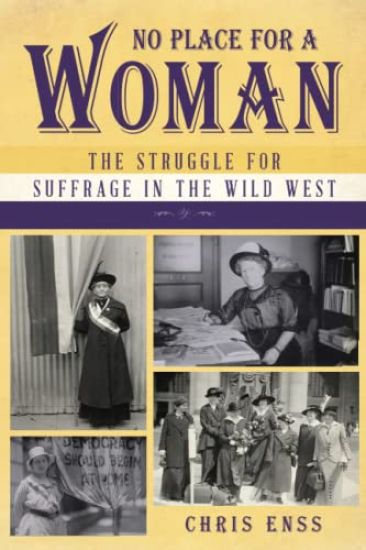
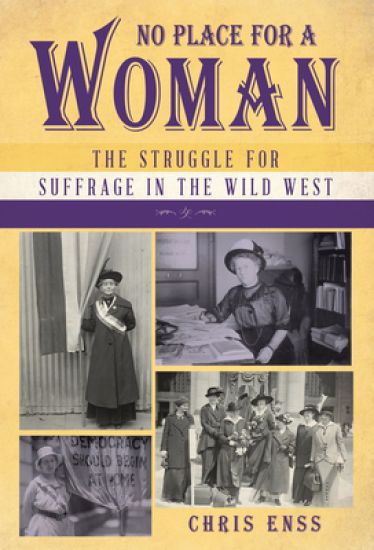
No Place for a Woman

No Place for a Woman

Chris Enss

ROWMAN LITTLEFIELD
2023
pokkari
In 1869, more than twenty years after Elizabeth Cady Stanton and Susan B. Anthony made their declaration of the rights of woman at Seneca Falls, New York, the men of the Wyoming Territorial Legislature granted women over the age of 21 the right to vote in general elections. And on September 6, 1870, a grandmother named Louisa Ann Swain stepped up to a ballot box in Laramie, Wyoming, and became the first woman in the United States to exercise that right, ushering in the era of Western states’ early foray into suffrage equality. Wyoming Territory’s motives for extending the vote to women might have had more to do with publicity and attracting female settlers than with any desire to establish a more egalitarian society. However, individual men’s interests in the idea of women’s rights had their roots in diverse ideologies, and the women who agitated for those rights were equally diverse in their attitudes.No Place for a Woman explores the history of the fight for women’s rights in the West, examining the conditions that prevailed during the vast migration of pioneers looking for free land and opportunity on the frontier, the politics of the emerging Western territories at the end of the Civil War, and the changing social and economic conditions of the country recovering from war and on the brink of the Gilded Age. The stories of the women who helped settle the West and who ushered in voting rights decades ahead of the 19th Amendment and the stories of the country they were forging in the West will be of great interest to readers as the 100th anniversary of national woman suffrage approaches and is relevant in our current political climate. Through the individual stories of women like Esther Hobart Morris, Martha Cannon, and Jeannette Rankin, this book fills a hole in the story of the West, revealing the real story of how the hard work and individual lobbying of a few heroines, plus a little bit of publicity-seeking and opportunism by promoters of the Wyoming Territory, ushered in a new era for the expansion of women’s rights.
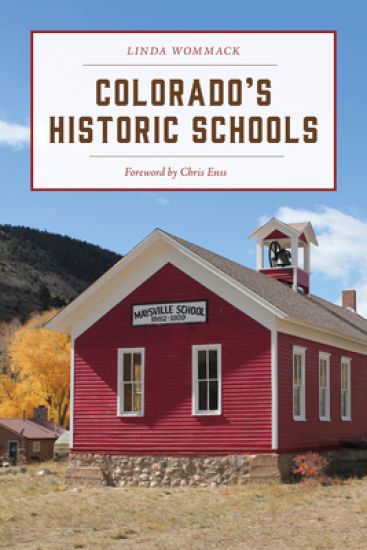
Colorado's Historic Schools

Colorado's Historic Schools

Linda Wommack; Chris Enss

ROWMAN LITTLEFIELD
2022
pokkari
People love getting nostalgic and what better way than the history of school days of yesteryear? Over six hundred school buildings are scattered across the Centennial State—and some were still operating in rural communities through the 1950s. A community’s construction of a school building reflected the importance of universal education, and also a desire to establish permanence in the community itself in the ever-expanding Western frontier. These schools were often the social centers of the community. Civic town meetings were held in them, as well as other political events. Today, these schools are the touchstones to Colorado’s pioneering past. Colorado’s Historic Schools is part-regional history, and part-travel guide featuring over 150 of the most significant schools across the state, all recognized as historic landmarks. Along with interesting school stories and building descriptions, there are historic photos, and information on how to visit the schools that are open to the public. Readers will also enjoy sidebars featuring stories of legendary teachers, tragedies, and even murder over the 150-year history of Colorado’s schools.
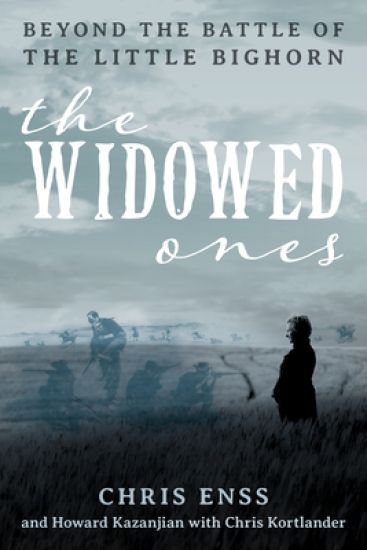
The Widowed Ones

The Widowed Ones

Chris Enss; Howard Kazanjian

TwoDot Books
2022
sidottu
History has a way of bestowing a more lasting immortality on important people who die at the height of their earthly achievements. Famous personalities who are cut down at the height of their fame leave people clamoring to know more about them. Books and songs are written about them. Pictorial mementoes and keepsakes are in demand. The celebrated military figure General George Armstrong Custer, whose life ended so abruptly, is no exception. Interest in him, and those associated with him, has never diminished with the passing time. Elizabeth Bacon Custer, George’s faithful wife, and more than two dozen women who lost their husbands at the Battle of Little Big Horn, fall into that category. Elizabeth Bacon Custer set the social tone at Fort Lincoln, Nebraska, where she and twenty-five other women were living when their spouses perished in June 1876. She helped the ladies deal with the difficulties of life on the Plains; how to handle frostbite, how to treat heat prostration due to the suffocating amount of clothing, how to obtain water through holes cut in the ice of lakes or rivers, and how best to entertain themselves while waiting for their husbands to return from a campaign. When a soldier left the fort, his wife never knew if he would return. Eliza Porter, wife of 1st Lieutenant Colonel I. Porter of Custer’s 7th Cavalry, described the last get-together Elizabeth Custer hosted for the officers and their families this way. “Here are those nice fellows gathered around the Custer’s table, all discussing the situation and all knowing they will never all come back. One leaves his watch and little fixings and says, ‘if one of those bullets gets me, send this to my wife waiting for me in Independence.’ One need not search any further to unearth the reason why “Boots and Saddles,” the call to battle written by Elizabeth Custer, struck terror into the hearts of Army wives. Each wondered if she would be widowed or if the role of widowhood would be forced upon her friends. After the men were assembled, they rode out proudly to the strains of “The Girl I Left Behind Me.” In order to hide their tears and anxiety from their husbands, many wives did as Elizabeth Porter did; they refused to watch the column’s ride away from the fort. They preferred to say goodbye behind closed doors. Fear and weeping were private. Nine months after the massacre at Custer’s Last Stand, Elizabeth Custer scheduled a reunion with the widows of the Little Big Horn. On June 25, 1887, the women met in Monroe, Michigan, to reflect on the events leading up to the battle, remember the loved ones that were killed, and share how they have been able to go on. The widows got together every year for more than twenty years. In between reunions they corresponded with each other, exchanged photographs, and supported one another through the difficult times. The never-before-seen materials that will be used to write the book entitled Elizabeth Custer and the Widows of the Little Big Horn will be provided by the curators of the Elizabeth Custer Library and Museum at Garryowen, Montana; an example of some of the historical materials that will be provided include letters between Elizabeth Custer and the other widows, letters to and from politicians and the widows supporting and criticizing General Custer, and agendas and pictures of the widows at the annual meetings. There have been many books written about General George Custer and a handful have been penned about Elizabeth Bacon Custer, but there have been nothing written about the widows of the Last Stand. This will be a first.
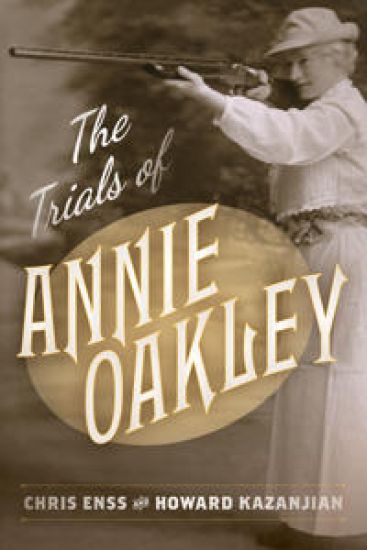
The Trials of Annie Oakley

The Trials of Annie Oakley

Chris Enss; Howard Kazanjian

Taylor Trade Publishing
2022
pokkari
Long before the screen placed the face of Mary Pickford before the eyes of millions of Americans, this girl, born August 13, 1860 as Phoebe Anne Oakley Moses, had won the right to the title of “America’s Sweetheart.” Having grown up learning to shoot game to help support her family, Annie won first prize and met her future husband at a shooting match when she was fifteen years old. He convinced her to change her name to Annie Oakley and became her husband, manager, and number-one fan for the next fifty years.Annie quickly gained worldwide fame as an incredible crack shot, and could amaze audiences at her uncanny accuracy with nearly any rifle or pistol, whether aiming at stationary objects or shooting fast-flying targets from the cockpit of a moving airplane. Despite struggles with her health and even a long, drawn-out legal battle with media magnate William Randolph Hearst, Annie Oakley poured her energy into advocating for the U.S. military, encouraging women to engage in sport shooting, and supporting orphans.
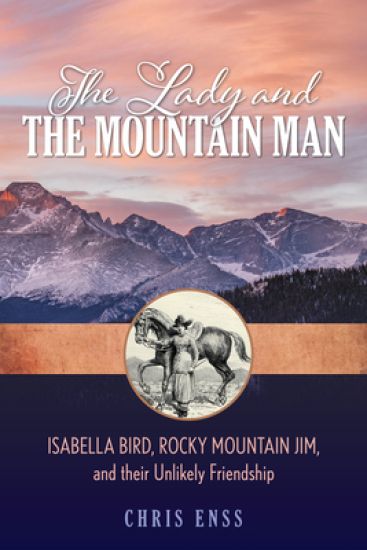
The Lady and the Mountain Man

The Lady and the Mountain Man

Chris Enss

TwoDot Books
2021
pokkari
An Englishwoman born in 1831, Isabella Bird was frequently ill as a child and young woman, and her doctors recommended a life of travel and fresh air as the cure. Ultimately, she took the advice and traveled the world. And traveled. And traveled. Bird connected with the beauty of the Colorado Plains and the valleys and mountain parks that she found exhilarating. She would be the first woman to stand atop Colorado’s Longs Peak, in 1873. While in Colorado she spent most of her time in Estes Park, but she traveled to Garden of the Gods, across South Park and through many of the mining towns. More than just traveling, she engaged the places she visited and the people she encountered. In the Rockies, Bird became acquainted with a local character, the mountain man known as “Rocky Mountain Jim,” who would guide her up Longs Peak. Jim Nugent was a one-eyed ruffian of whom Isabella would write to her sister (in a paragraph excised from the published version of the letters) “A man any woman might love but no sane woman would marry.” Bird referred to Nugent as her “dear desperado,” and the mountain man seemingly had great affection for Bird, as well. Bird was 41 and single when she entered Colorado on September 9, 1873; she was 42 and still single when she left Colorado on December 12. Less than a year later, Nugent was shot and killed. This new book reveals the story of Bird’s year in Colorado and her relationship with Nugent by re-examining Bird’s letters to her beloved sister and putting her work in historical context.
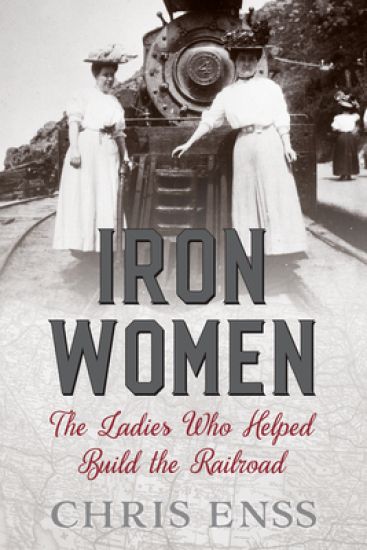
Iron Women

Iron Women

Chris Enss

TwoDot Books
2021
pokkari
When the last spike was hammered into the steel track of the Transcontinental Railroad on May 10, 1869, at Promontory Point, Utah, Western Union lines sounded the glorious news of the railroad’s completion from New York to San Francisco. For more than five years an estimated four thousand men mostly Irish working west from Omaha and Chinese working east from Sacramento, moved like a vast assembly line toward the end of the track. Editorials in newspapers and magazines praised the accomplishment and some boasted that the work that “was begun, carried on, and completed solely by men.” The August edition of Godey’s Lady’s Book even reported “No woman had laid a rail and no woman had made a survey.” Although the physical task of building the railroad had been achieved by men, women made significant and lasting contributions to the historic operation. However, the female connection with railroading dates as far back as 1838 when women were hired as registered nurses/stewardesses in passenger cars. Those ladies attended to the medical needs of travelers and also acted as hostesses of sorts helping passengers have a comfortable journey. Beyond nursing and service roles, however, women played a larger part in the actual creation of the rail lines than they have been given credit for. Miss E. F. Sawyer became the first female telegraph operator when she was hired by the Burlington Railroad in Montgomery, Illinois, in 1872. Eliza Murfey focused on the mechanics of the railroad, creating devices for improving the way bearings on a rail wheel attached to train cars responded to the axles. Murfey held sixteen patents for her 1870 invention. In 1879, another woman inventor named Mary Elizabeth Walton developed a system that deflected emissions from the smoke stacks on railroad locomotives. She was awarded two patents for her pollution reducing device. Their stories and many more are included in this illustrated volume celebrating women and the railroad.
No Place for a Woman

No Place for a Woman

Chris Enss

TwoDot Books
2020
sidottu
In 1869, more than twenty years after Elizabeth Cady Stanton and Susan B. Anthony made their declaration of the rights of woman at Seneca Falls, New York, the men of the Wyoming Territorial Legislature granted women over the age of 21 the right to vote in general elections. And on September 6, 1870, a grandmother named Eliza Swain stepped up to a ballet box in Laramie, Wyoming, and became the first woman in the United States to exercise that right, ushering in the era of Western states’ early foray into suffrage equality. Wyoming Territory’s motives for extending the vote to women might have had more to do with publicity and attracting female settlers than with any desire to establish a more egalitarian society. However, individual men’s interests in the idea of women’s rights had their roots in diverse ideologies, and the women who agitated for those rights were equally diverse in their attitudes. No Place for a Woman explores the history of the fight for women’s rights in the West, examining the conditions that prevailed during the vast migration of pioneers looking for free land and opportunity on the frontier, the politics of the emerging Western territories at the end of the Civil War, and the changing social and economic conditions of the country recovering from war and on the brink of the Gilded Age. The stories of the women who helped settle the west and who ushered in voting rights decades ahead of the 19th Amendment and the stories of the country they were forging in the west will be of great interest to readers as the 100th anniversary of national woman suffrage approaches and is relevant in our current political climate. Revealed through the individual stories of women like Esther Hobart Morris, Martha Cannon, and Jeannette Rankin, this book fills a hole in the story of the West, revealing the real story of how the hard work and individual lobbying of a few heroines, plus a little bit of publicity-seeking and opportunism by promoters of the Wyoming Territory, ushered in a new era for the expansion of women’s rights.
According to Kate

According to Kate

Chris Enss

TwoDot Books
2019
sidottu
Doc Holliday’s paramour Big Nose Kate could never get a publisher to give her the big bucks she demanded to tell the story of her life, but that didn’t mean she didn’t collect material she wanted to use in a biography. Over the fifty years Mary Kate Cummings, alias Big Nose Kate, traversed the West she saved letters from her family, musings she had written about her love interests, and life with the notorious John Henry Holliday. Using rare, never before published material Big Nose Kate stock-piled in anticipation of writing the tale of her days on the Wild Frontier, the definitive book about the famous soiled dove will finally be told. Kate claims to have witnessed the Gunfight at the OK Corral and exchanged words with the likes of Wyatt Earp and Josephine Marcs. There’s no doubt she embellished her adventures, but that doesn’t take away from their historical importance. She was a controversial figure in a rough and rowdy territory. What she witnessed, the lifestyle she led, and the influential western people she met are fascinating and represent a time period much romanticized.