Kirjojen hintavertailu. Mukana 12 152 606 kirjaa ja 12 kauppaa.

Kirjailija

Chris Lintott

Kirjat ja teokset yhdessä paikassa: 7 kirjaa, julkaisuja vuosilta 2019-2026, suosituimpien joukossa Cosmos. Vertaile teosten hintoja ja tarkista saatavuus suomalaisista kirjakaupoista.

7 kirjaa

Kirjojen julkaisuhaarukka 2019-2026.

Cosmos

Cosmos

Chris Lintott; Amaury Triaud; Sian Prosser; Ione Parkin

SANSOM CO
2026
nidottu
Artists and astronomers are trained observers. This publication offers a thought-provoking gathering of visual artists contemplating their place in the universe, ranging from personal subjective responses through to artists whose work connects directly with science data. A richly-illustrated catalogue containing artists’ statements revealing the depth and breadth of their creative practice. A Foreword by the engaging astrophysicist, author and broadcaster, Chris Lintott; an essay by the exhibition curator and artist, Ione Parkin; Sian Prosser writes on some of the key historical figures whose drawings, prints and early photographs influenced the spread of astronomical discoveries; exoplanetologist Amaury Triaud reveals an astronomer’s perspective on the science and research functions of light. This publication accompanies the exhibition Cosmos: The Art of Observing Space held at the Royal West of England Academy in January-April 2026.
Our Accidental Universe

Our Accidental Universe

Chris Lintott

TRANSWORLD PUBLISHERS LTD
2025
pokkari
An astonishing tour of the key astronomical events of the past century, and of all the accidents and human error involved in our pursuit of asteroids, radio waves, new stars and alien life. *Now updated to include a new Afterword.*'A riveting real-life Hitchhiker's Guide to the Galaxy.' Telegraph'‘An enjoyable tour of astronomical discoveries…His excellent book is a layman’s guide to the surprises’ - Daily Mail'Lintott's boundless enthusiasm for everything cosmic makes it hard to put this book away once you start reading.' BBC Sky at Night Magazine'Entertaining and enlightening' - The Idler.....................................................................................................................................................................................................The BBC presenter of 'Sky at Night', and Gresham Professor of Astronomy, Chris Lintott, takes us on an astonishing tour of bizarre accidents, big characters, and human error to tell the story of some of the most important astronomical events of the past hundred years.- Our first views of the earliest galaxies were brought to us by the Hubble Space Telescope when it was pointed at absolutely nothing.- The ice-covered Enceladus, one of Saturn's nearly one hundred moons, was revealed as a possible habitat for life after a by-chance fly by of NASA's Cassini probe on a mission elsewhere.- Pulsars, the spectacular remnants of long-dead massive stars, were discovered as 'scruff' in the data for measurements of the twinkling of possible radio stars.As new telescopes are built on mountaintops and in deserts around the world, aiming to transform our view of the universe once more, Chris Lintott shows us that keeping an open mind will benefit us all - whatever might still be out there for us to find.........................................................................................................................Praise for Our Accidental Universe'A scientific tour de force.' Dr Becky Smethurst'Highly recommended.' Tristan Gooley'Extravagantly entertaining ... warmly informative.' Lev Parikian'A fascinating look at the strange and alien side of space.' Dr Lucy RogersMore praise for Chris Lintott'Superbly written insights.' - Professor Brian Cox'Chris Lintott is a modest genius. He has quietly revolutionized modern astronomy.' Brian May'Lintott deftly interweaves personal experience and more philosophical ruminations.' Michael West, Nature
Accidental Astronomy: How Random Discoveries Shape the Science of Space
A "riveting real-life Hitchhiker's Guide to the Galaxy" (The Telegraph), told "with an engaging voice, a diverting sense of humor, and a humble awe for the wonders of the universe" (Wall Street Journal), shows why so much of astronomy comes down to looking up and lucking out If you learn about the scientific method, you learn that first we hypothesize about something we've experienced, and then we look for more of it. This works well enough--but what if you are interested in studying a heretofore unknown comet or supernova? That is the essential problem of the astronomer: the most important discoveries happen without notice Indeed, as Chris Lintott argues in Accidental Astronomy, luck defines astronomy. Lintott explores the ways in which happenstance shapes how we investigate the sky. To catch a glimpse of a comet, asteroid, or even a sign of alien life, we must be in the right place at the right time. And if we can't be there, we must have a team of professionals and amateurs, across the globe, ready to spring into action at a moment's--or a night's--notice. For any astronomer, regardless of their experience or resources, the first step to discovery is the same: to stare at the sky and wait. A celebration of astronomy, stargazing, and cosmic discovery, Accidental Astronomy offers an irresistible window into how luck defines our knowledge of the skies.
Our Accidental Universe

Our Accidental Universe

Chris Lintott

TRANSWORLD PUBLISHERS LTD
2024
sidottu
An astonishing tour of the key astronomical events of the past century, and of all the accidents and human error involved in our pursuit of asteroids, radio waves, new stars and alien life.'A riveting real-life Hitchhiker's Guide to the Galaxy.' Telegraph'‘An enjoyable tour of astronomical discoveries…His excellent book is a layman’s guide to the surprises’ - Daily Mail'Lintott's boundless enthusiasm for everything cosmic makes it hard to put this book away once you start reading.' BBC Sky at Night Magazine'Entertaining and enlightening' - The Idler.....................................................................................................................................................................................................The BBC presenter of 'Sky at Night', and Gresham Professor of Astronomy, Chris Lintott, takes us on an astonishing tour of bizarre accidents, big characters, and human error to tell the story of some of the most important astronomical events of the past hundred years.- Our first views of the earliest galaxies were brought to us by the Hubble Space Telescope when it was pointed at absolutely nothing.- The ice-covered Enceladus, one of Saturn's nearly one hundred moons, was revealed as a possible habitat for life after a by-chance fly by of NASA's Cassini probe on a mission elsewhere.- Pulsars, the spectacular remnants of long-dead massive stars, were discovered as 'scruff' in the data for measurements of the twinkling of possible radio stars.As new telescopes are built on mountaintops and in deserts around the world, aiming to transform our view of the universe once more, Chris Lintott shows us that keeping an open mind will benefit us all - whatever might still be out there for us to find.........................................................................................................................Praise for Our Accidental UniverseA scientific tour de force.' Dr Becky Smethurst'Highly recommended.' Tristan Gooley'Extravagantly entertaining ... warmly informative.' Lev Parikian'A fascinating look at the strange and alien side of space.' Dr Lucy RogersMore praise for Chris Lintott'Superbly written insights.' - Professor Brian Cox'Chris Lintott is a modest genius. He has quietly revolutionized modern astronomy.' Brian May'Lintott deftly interweaves personal experience and more philosophical ruminations.' Michael West, Nature
Bang!! 2

Bang!! 2

Brian May; Chris Lintott; Hannah Wakeford; Patrick Moore

Welbeck Publishing Group
2021
sidottu
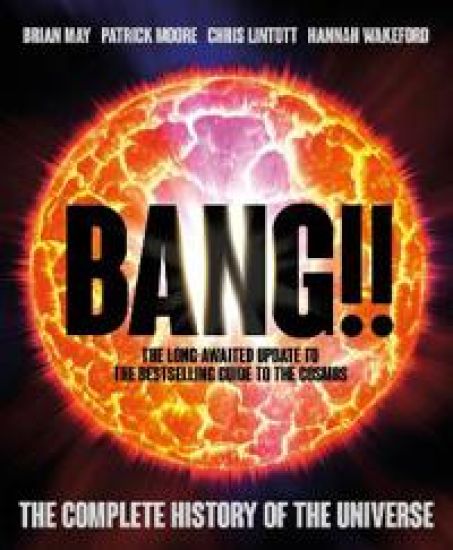
In 2004 a rock star, a TV astronomer and a young research astronomer sat down to write the story of the Universe in the order in which it happened, from its birth at the Big Bang 13.7 billion years ago, through to its ultimate demise in the infinitely far future.The aim of this book is to explain the Big Bang and everything that followed in a way that made sense, in the strict order in which events occurred, and without using maths, so it would be understandable to everyone, regardless of educational background. The original edition of Bang! was a bestseller, and a go-to for anyone wanting to understand the story of the origins and evolution of our Universe that did not duck the science.Since the first edition, thousands of planets have been discovered, the 'habitable zone' has expanded and a flotilla of new satellites has explored our own solar system, bringing back fresh images and new science. In this book all the latest findings about the evolution of stars and galaxies are included, and the current thinking about our ultimate origins. The latest ideas about Dark Matter and Dark Energy are explained, all illustrated with new images from the world's largest telescopes and space missions.This is the new, updated, popular guide to 'Life, the Universe, and Everything' – The Complete History of the Universe.
The Crowd and the Cosmos

The Crowd and the Cosmos

Chris Lintott

Oxford University Press
2021
nidottu
'fascinating' Brian Cox This is the story of citizen science. Where once astronomers sat at the controls of giant telescopes in remote locations, praying for clear skies, now they have no need to budge from their desks, as data arrives in their inbox. And what they receive is overwhelming; projects now being built provide more data in a few nights than in the whole of humanity's history of observing the Universe. It's not just astronomy either--dealing with this deluge of data is the major challenge for scientists at CERN, and for biologists who use automated cameras to spy on animals in their natural habitats. Artificial intelligence is one part of the solution--but will it spell the end of human involvement in scientific discovery? No, argues Chris Lintott. We humans still have unique capabilities to bring to bear--our curiosity, our capacity for wonder, and, most importantly, our capacity for surprise. It seems that humans and computers working together do better than computers can on their own. But with so much scientific data, you need a lot of scientists--a crowd, in fact. Lintott found such a crowd in the Zooniverse, the web-based project that allows hundreds of thousands of enthusiastic volunteers to contribute to science. In this book, Lintott describes the exciting discoveries that people all over the world have made, from galaxies to pulsars, exoplanets to moons, and from penguin behaviour to old ship's logs. This approach builds on a long history of so-called 'citizen science', given new power by fast internet and distributed data. Discovery is no longer the remit only of scientists in specialist labs or academics in ivory towers. It's something we can all take part in. As Lintott shows, it's a wonderful way to engage with science, yielding new insights daily. You, too, can help explore the Universe in your lunch hour.
The Crowd and the Cosmos

The Crowd and the Cosmos

Chris Lintott

Oxford University Press
2019
sidottu
The world of science has been transformed. Where once astronomers sat at the controls of giant telescopes in remote locations, praying for clear skies, now they have no need to budge from their desks, as data arrives in their inbox. And what they receive is overwhelming; projects now being built provide more data in a few nights than in the whole of humanity's history of observing the Universe. It's not just astronomy either - dealing with this deluge of data is the major challenge for scientists at CERN, and for biologists who use automated cameras to spy on animals in their natural habitats. Artificial intelligence is one part of the solution - but will it spell the end of human involvement in scientific discovery? No, argues Chris Lintott. We humans still have unique capabilities to bring to bear - our curiosity, our capacity for wonder, and, most importantly, our capacity for surprise. It seems that humans and computers working together do better than computers can on their own. But with so much scientific data, you need a lot of scientists - a crowd, in fact. Lintott found such a crowd in the Zooniverse, the web-based project that allows hundreds of thousands of enthusiastic volunteers to contribute to science. In this book, Lintott describes the exciting discoveries that people all over the world have made, from galaxies to pulsars, exoplanets to moons, and from penguin behaviour to old ship's logs. This approach builds on a long history of so-called 'citizen science', given new power by fast internet and distributed data. Discovery is no longer the remit only of scientists in specialist labs or academics in ivory towers. It's something we can all take part in. As Lintott shows, it's a wonderful way to engage with science, yielding new insights daily. You, too, can help explore the Universe in your lunch hour.