Kirjojen hintavertailu. Mukana 12 657 676 kirjaa ja 12 kauppaa.

Kirjailija

Chris Rumford

Kirjat ja teokset yhdessä paikassa: 6 kirjaa, julkaisuja vuosilta 2002-2011, suosituimpien joukossa Rethinking Europe. Vertaile teosten hintoja ja tarkista saatavuus suomalaisista kirjakaupoista.

6 kirjaa

Kirjojen julkaisuhaarukka 2002-2011.

Cosmopolitan Spaces

Cosmopolitan Spaces

Chris Rumford

Routledge
2011
nidottu
Cosmopolitan Spaces: Europe, Globalization, Theory endeavors a highly innovative reading of both globalization theory and contemporary European transformations. Interpreting cosmopolitanism as a politics of space, Rumford positions his analysis at the intersection of two exciting currents in contemporary social science research: the ‘spatial turn’ in the social sciences and the renewed interest in cosmopolitanism. Rumford elaborates a completely new theoretical framework for understanding the contemporary social and political transformation of Europe, and takes issue with many aspects of the globalization-inspired accounts of Europeanization which remain blind to the spatial dimensions of change. In addition to its compelling reading of cosmopolitanism, Cosmopolitan Spaces: Europe, Globalization, Theory, offers a provocative critique for thinking about Europe in terms of Empire, and advances the startling claim that Europe should be considered ‘postwestern’.
Cosmopolitan Spaces

Cosmopolitan Spaces

Chris Rumford

Routledge
2008
sidottu
Cosmopolitan Spaces: Europe, Globalization, Theory endeavors a highly innovative reading of both globalization theory and contemporary European transformations. Interpreting cosmopolitanism as a politics of space, Rumford positions his analysis at the intersection of two exciting currents in contemporary social science research: the ‘spatial turn’ in the social sciences and the renewed interest in cosmopolitanism. Rumford elaborates a completely new theoretical framework for understanding the contemporary social and political transformation of Europe, and takes issue with many aspects of the globalization-inspired accounts of Europeanization which remain blind to the spatial dimensions of change. In addition to its compelling reading of cosmopolitanism, Cosmopolitan Spaces: Europe, Globalization, Theory, offers a provocative critique for thinking about Europe in terms of Empire, and advances the startling claim that Europe should be considered ‘postwestern’.
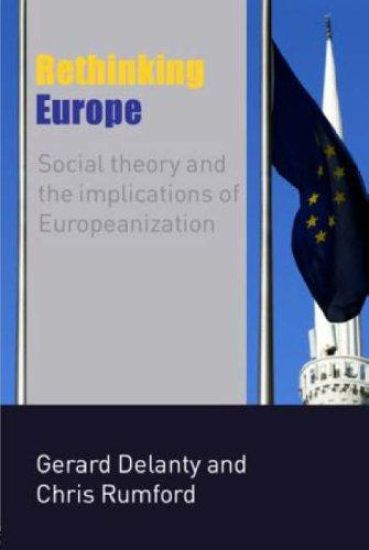
Rethinking Europe

Rethinking Europe

Gerard Delanty; Chris Rumford

Routledge
2005
sidottu
Dominant approaches to the transformation of Europe ignore contemporary social theory interpretations of the nature and dynamics of social change. Here, Delanty and Rumford argue that we need a theory of society in order to understand Europeanization. This book advances the case that Europeanization should be theorized in terms of:globalization major social transformations that are not exclusively spear-headed by the EU the wider context of the transformation of modernity. This fascinating book broadens the terms of the debate on Europeanization, conventionally limited to the supersession of the nation-state by a supra-national authority and the changes within member states consequent upon EU membership.Demonstrating the relevance of social theory to contemporary issues and with a focus on European transformation rather than simplistic notions of Europe-building, this truly multidisciplinary volume will appeal to readers from a range of social science disciplines, including sociology, geography, political science and European studies.
Rethinking Europe

Rethinking Europe

Gerard Delanty; Chris Rumford

Routledge
2005
nidottu
Dominant approaches to the transformation of Europe ignore contemporary social theory interpretations of the nature and dynamics of social change. Here, Delanty and Rumford argue that we need a theory of society in order to understand Europeanization. This book advances the case that Europeanization should be theorized in terms of:globalization major social transformations that are not exclusively spear-headed by the EU the wider context of the transformation of modernity. This fascinating book broadens the terms of the debate on Europeanization, conventionally limited to the supersession of the nation-state by a supra-national authority and the changes within member states consequent upon EU membership.Demonstrating the relevance of social theory to contemporary issues and with a focus on European transformation rather than simplistic notions of Europe-building, this truly multidisciplinary volume will appeal to readers from a range of social science disciplines, including sociology, geography, political science and European studies.
The European Union

The European Union

Chris Rumford

Blackwell Publishers
2002
sidottu
"The European Union" is the first full-length treatment of European integration from a sociological perspective. It redirects the core concerns of political sociology away from nationally bounded societies towards a 'sociology beyond societies', capable of making a valuable contribution to thinking about the nature and problems of the European Union. Within this broad objective, the book concerns itself with such key issues as the relation between the EU and globalization, the nature of the EU state, and the question of whether a European society can be said to exist. The book also addresses crucial policy areas such as unemployment, citizenship, social exclusion, cohesion, core-periphery relations, the "democratic deficit", and enlargement. Students, scholars, and sociologists interested in the history, development, and legacies of the European Union will find this to be a unique and informative text.
The European Union

The European Union

Chris Rumford

Blackwell Publishers
2002
nidottu
The European Union is the first full-length treatment of European integration from a sociological perspective. It redirects the core concerns of political sociology away from nationally bounded societies towards a "sociology beyond societies," capable of making a valuable contribution to thinking about the nature and problems of the European Union. Within this broad objective the book concerns itself with such key issues as the relation between the EU and globalization, the nature of the EU state, and the question of whether a European society can be said to exist. Students, scholars, and sociologists interested in the history, development, and legacies of the European Union will find this to be a unique and informative text.