Kirjojen hintavertailu. Mukana 12 595 353 kirjaa ja 12 kauppaa.

Kirjailija

Christian Davenport

Kirjat ja teokset yhdessä paikassa: 16 kirjaa, julkaisuja vuosilta 2005-2026, suosituimpien joukossa Rocket Dreams. Vertaile teosten hintoja ja tarkista saatavuus suomalaisista kirjakaupoista.

16 kirjaa

Kirjojen julkaisuhaarukka 2005-2026.

Rocket Dreams

Rocket Dreams

Christian Davenport

John Blake Publishing Ltd
2026
nidottu
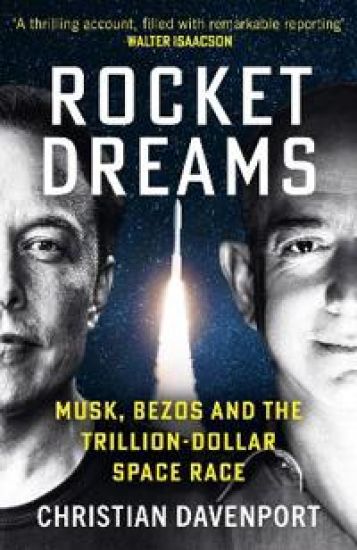
'A thrilling account' - Walter Isaacson Musk versus Bezos. China versus the United States. The government versus the private sector. Welcome to the rivalries and alliances defining the New Space Age. At stake? Billions of dollars, national prestige, and a place in the history books. A fleet of powerful new rockets is poised to take humans into the cosmos more than ever before. A lunar land rush has sparked a geopolitical competition among nations. And the world's two richest men have engaged in escalating brinkmanship, as NASA and the US government embraces Silicon Valley innovation to jump-start the nation's ambitions. Space has entered a golden age, and this is just the beginning. In this gripping work, award-winning Washington Post writer Christian Davenport chronicles the mad scramble to shape humanity's off-planet future. He takes readers behind the scenes at NASA and the Pentagon as China's aggressive moon mining plans raise alarms, onto the sprawling Cape Canaveral factory where Blue Origin is working toward Amazon-style lunar deliveries, and onto SpaceX launch pads as Musk's engineers log 100-hour weeks - leaving veteran astronauts marvelling that they're now operating 'flying iPhones.' What will happen as human ambition outpaces governmental regulation? Which country will win the race back to the moon? Was Donald Trump's much-derided creation of the Space Force a surprising act of foresight, and will the US finally make a real push to the moon and eventually toward Mars? Masterfully paced, rigorously reported and vividly told, Rocket Dreams offers a riveting, fly-on-the-wall account of the grit-fuelled global battle to push humankind further into the cosmos -revealing that the science fiction dreams of the last century may soon become our reality.
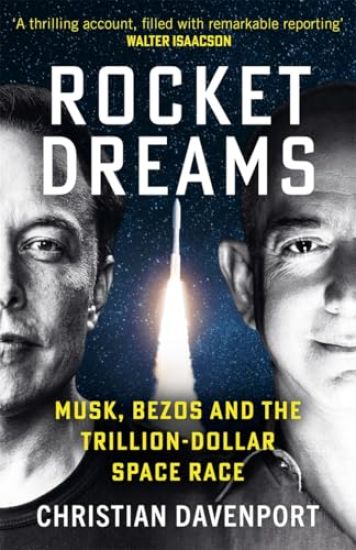
Rocket Dreams

Rocket Dreams

Christian Davenport

John Blake Publishing Ltd
2025
sidottu
A fleet of modern rockets among the most powerful in the world. A lunar land rush that has sparked a competition over the strategic high ground. Scientific discoveries that could offer new insights into the origins of the solar system. Escalating brinkmanship between the world's two richest men. Space has entered a golden age, and this is just the beginning. After the first Trump administration launched the Artemis program, NASA created a historic competition that pit Elon Musk's SpaceX against Jeff Bezos's Blue Origin, flanked far away by Russia and China. At stake: billions of dollars, national prestige, and a place in the history books.In this gripping work, veteran reporter Christian Davenport chronicles the mad scramble to shape humanity's off-planet future. He takes readers behind the scenes at NASA and the Pentagon as China's aggressive moon mining and military plans raise alarms, onto the sprawling Cape Canaveral factory where Bezos works toward Amazon-style lunar deliveries, and onto SpaceX launch pads as Musk's engineers log 100-hour weeks, ultimately pulling off the harrowing but triumphant launch of its first human spaceflight mission.What will happen as frenetic public and private ambition outpaces governmental regulation? Who will win the race to the moon, and will the US finally be able to start a real push toward Mars? Masterfully paced, rigorously reported, and vividly told, Rocket Dreams weaves cutting-edge science with high-stakes capitalism and old-fashioned nationalism into a vision of humanity's next giant leap.
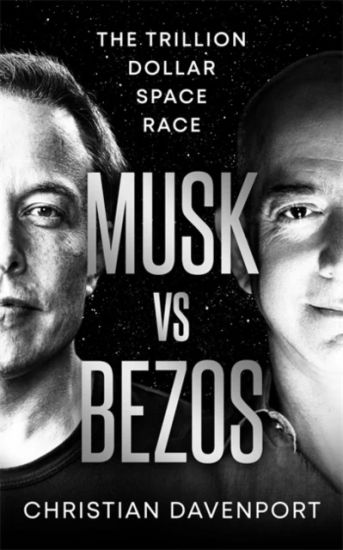
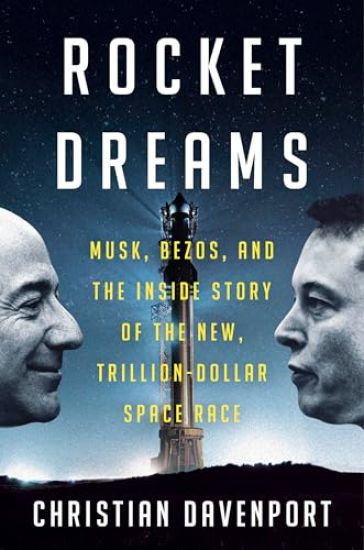
Rocket Dreams: Musk, Bezos, and the Inside Story of the New, Trillion-Dollar Space Race
Musk versus Bezos.China versus the United States.The government versus the private sector.Welcome to the rivalries and alliances defining the New Space Age.At stake? Billions of dollars, national prestige, and a place in the history books. Moon landings and space walks once captivated the public's attention. But, in recent decades, the U.S. space enterprise has felt moribund. Now, that's finally about to change. A fleet of powerful new rockets is poised to take humans into the cosmos more than ever before. A lunar land rush has sparked a geopolitical competition among nations. And the world's two richest men have engaged in escalating brinkmanship, as NASA and the U.S. government embraces Silicon Valley innovation to jump-start the nation's ambitions. Space has entered a golden age, and this is just the beginning. In this gripping work, award-winning Washington Post writer Christian Davenport chronicles the mad scramble to shape humanity's off-planet future. He takes readers behind the scenes at NASA and the Pentagon as China's aggressive moon mining plans raise alarms, onto the sprawling Cape Canaveral factory where Blue Origin is working toward Amazon-style lunar deliveries, and onto SpaceX launch pads as Musk's engineers log 100-hour weeks--leaving veteran astronauts marveling that they're now operating "flying iPhones." What will happen as human ambition outpaces governmental regulation? Which country will win the race back to the moon? Was Donald Trump's much-derided creation of the Space Force a surprising act of foresight, and will the U.S. finally make a real push to the moon and eventually toward Mars? Masterfully paced, rigorously reported, and vividly told, Rocket Dreams offers a riveting, fly-on-the-wall account of the grit-fueled global battle to push humankind further into the cosmos--revealing that the science fiction dreams of the last century may soon become our reality.
The Death and Life of State Repression

The Death and Life of State Repression

Christian Davenport; Benjamin Appel

OXFORD UNIVERSITY PRESS INC
2022
nidottu
The Death and Life of State Repression addresses a problem that dates back at least 75 years, if not before. Since World War II, individuals and institutions from around the world have been concerned with state repression/human rights violations and since about 1990, a robust empirical literature has emerged to investigate what drives this behavior up or down (i.e., exploring variation). While useful, this work has generally ignored important aspects of the "Death/Life cycle" of state repression: i.e., its onset, escalation, termination and recurrence. Such an approach is important because different explanations and policies might be relevant for different parts of the cycle. Exploring a new database of repressive spells from 1976-2006 and new theory regarding spells, The Death and Life of State Repression breaks new ground in a variety of different ways. The book argues that repression is a sticky process that is largely slow-moving and non-adaptive. Consequently, change in this behavior is rare unless the ruling cohort is perturbed in some manner. What perturbs is somewhat surprising. The authors do not argue or find support for the predominant variables/policies advanced by the international community (i.e., naming/shaming, international law, military intervention and economic sanctions). Rather, their research advances and finds that political democratization plays a crucial role in reducing and stopping most aspects of repressive spells, and democratization itself is influenced by non-violent direct action. The book has major implications for those who wish to study state repression, as well as those who have an interest in trying to reduce and stop it from occurring across the Death/Life cycle. The path to less repressive behavior has never been clearer.
The Death and Life of State Repression

The Death and Life of State Repression

Christian Davenport; Benjamin Appel

OXFORD UNIVERSITY PRESS INC
2022
sidottu
The Death and Life of State Repression addresses a problem that dates back at least 75 years, if not before. Since World War II, individuals and institutions from around the world have been concerned with state repression/human rights violations and since about 1990, a robust empirical literature has emerged to investigate what drives this behavior up or down (i.e., exploring variation). While useful, this work has generally ignored important aspects of the "Death/Life cycle" of state repression: i.e., its onset, escalation, termination and recurrence. Such an approach is important because different explanations and policies might be relevant for different parts of the cycle. Exploring a new database of repressive spells from 1976-2006 and new theory regarding spells, The Death and Life of State Repression breaks new ground in a variety of different ways. The book argues that repression is a sticky process that is largely slow-moving and non-adaptive. Consequently, change in this behavior is rare unless the ruling cohort is perturbed in some manner. What perturbs is somewhat surprising. The authors do not argue or find support for the predominant variables/policies advanced by the international community (i.e., naming/shaming, international law, military intervention and economic sanctions). Rather, their research advances and finds that political democratization plays a crucial role in reducing and stopping most aspects of repressive spells, and democratization itself is influenced by non-violent direct action. The book has major implications for those who wish to study state repression, as well as those who have an interest in trying to reduce and stop it from occurring across the Death/Life cycle. The path to less repressive behavior has never been clearer.
The Space Barons

The Space Barons

Christian Davenport

PublicAffairs,U.S.
2019
pokkari
The Space Barons is the story of a group of billionaire entrepreneurs who are pouring their fortunes into the epic resurrection of the American space program. Nearly a half-century after Neil Armstrong walked on the moon, these Space Barons-most notably Elon Musk and Jeff Bezos, along with Richard Branson and Paul Allen-are using Silicon Valley-style innovation to dramatically lower the cost of space travel, and send humans even further than NASA has gone. These entrepreneurs have founded some of the biggest brands in the world-Amazon, Microsoft, Virgin, Tesla, PayPal-and upended industry after industry. Now they are pursuing the biggest disruption of all: space.Based on years of reporting and exclusive interviews with all four billionaires, this authoritative account is a dramatic tale of risk and high adventure, the birth of a new Space Age, fueled by some of the world's richest men as they struggle to end governments' monopoly on the cosmos. The Space Barons is also a story of rivalry-hard-charging startups warring with established contractors, and the personal clashes of the leaders of this new space movement, particularly Musk and Bezos, as they aim for the moon and Mars and beyond.
The Peace Continuum

The Peace Continuum

Christian Davenport; Erik Melander; Patrick Regan

Oxford University Press Inc
2018
sidottu
The idea of studying peace - over studying war, genocide and political violence (hereafter violent conflict) and then inferring about peace - has gained considerable traction in the past few years after languishing in the shadows of conflict for decades but how should it be studied? The Peace Continuum offers a parallax view of how we think about peace and the complexities that surround the concept (i.e., the book explores the topic from different positions at the same time). Toward this end, we review existing literature and provide insights into how peace should be conceptualized - particularly as something more interesting than the absence of conflict. We provide an approach that can help scholars overcome what we see as the initial shock that comes with unpacking the 'zero' in the war-peace model of conflict studies. Additionally, we provide a framework for understanding how peace and conflict have/have not been related to one another in the literature. To reveal how the Peace Continuum could be applied, we put forward three alternative ways that peace could be studied. With this approach, the book is less trying to control the emerging peace research agenda than it is trying to assist in/encourage thinking about the topic that we all have some opinion on but that has yet to be measured and analyzed in a way comparable to political conflict and violence. Indeed, we attempt to help facilitate a veritable explosion of approaches and efforts to study peace.
The Peace Continuum

The Peace Continuum

Christian Davenport; Erik Melander; Patrick Regan

Oxford University Press Inc
2018
nidottu
The idea of studying peace - over studying war, genocide and political violence (hereafter violent conflict) and then inferring about peace - has gained considerable traction in the past few years after languishing in the shadows of conflict for decades but how should it be studied? The Peace Continuum offers a parallax view of how we think about peace and the complexities that surround the concept (i.e., the book explores the topic from different positions at the same time). Toward this end, we review existing literature and provide insights into how peace should be conceptualized - particularly as something more interesting than the absence of conflict. We provide an approach that can help scholars overcome what we see as the initial shock that comes with unpacking the 'zero' in the war-peace model of conflict studies. Additionally, we provide a framework for understanding how peace and conflict have/have not been related to one another in the literature. To reveal how the Peace Continuum could be applied, we put forward three alternative ways that peace could be studied. With this approach, the book is less trying to control the emerging peace research agenda than it is trying to assist in/encourage thinking about the topic that we all have some opinion on but that has yet to be measured and analyzed in a way comparable to political conflict and violence. Indeed, we attempt to help facilitate a veritable explosion of approaches and efforts to study peace.
The Space Barons

The Space Barons

Christian Davenport

PublicAffairs,U.S.
2018
sidottu
The visionary quest to rekindle the human exploration and colonization of space led by two rivals and their vast fortunes, egos, concern about the future of humanity, and visions of space as the next entrepreneurial frontierFor years, space enthusiasts have imagined people in spaceships colonizing the cosmos, and for more than four decades, US presidents have been predicting a real-life journey to Mars. Little progress, however, has been made since the halcyon days of the Mercury and Apollo programs--until now. Chris Davenport tells the story of the "Space Barons"--notably Elon Musk and Jeff Bezos, but also Richard Branson and Paul Allen--and their unbelievably big ambitions to revive the US manned space program and reignite ancient dreams. These tycoons, with deep imaginations and deeper wallets, have ambitions to go far into space, well beyond the lower Earth orbit of the International Space Station. They are the founders of some of the biggest brands in the world--Amazon, Tesla, PayPal, Microsoft, Virgin--and have poured hundreds of millions of their own money into their new companies, betting that space tourism, asteroid mining, CubeSats (satellites the size of shoe boxes), and other new ventures will prove to be the next great technological revolution. For them, this is about more than monetizing space and space travel; it's exploration for exploration's sake: striking out with one destination in mind, but finding something else entirely. "Do we want," Elon Musk asks, "a future where we are forever confined to one planet until some eventual extinction event--however far in the future that might occur? Or do we want to become a multi-planet species, ultimately out there among the stars?"With an inside track on the businesses, rivalries, and rocketry that are fueling the new space race, The Space Barons is the story of how these billionaires plan to open the space frontier, extending humanity's reach and fulfilling the dreams of a generation.
How Social Movements Die

How Social Movements Die

Christian Davenport

Cambridge University Press
2014
sidottu
How do social movements die? Some explanations highlight internal factors like factionalization, whereas others stress external factors like repression. Christian Davenport offers an alternative explanation where both factors interact. Drawing on organizational, as well as individual-level, explanations, Davenport argues that social movement death is the outgrowth of a coevolutionary dynamic whereby challengers, influenced by their understanding of what states will do to oppose them, attempt to recruit, motivate, calm, and prepare constituents while governments attempt to hinder all of these processes at the same time. Davenport employs a previously unavailable database that contains information on a black nationalist/secessionist organization, the Republic of New Africa, and the activities of authorities in the US city of Detroit and state and federal authorities.
State Repression and the Domestic Democratic Peace

State Repression and the Domestic Democratic Peace

Christian Davenport

Cambridge University Press
2010
pokkari
Does democracy decrease state repression in line with the expectations of governments, international organizations, NGOs, social movements, academics and ordinary citizens around the world? Most believe that a 'domestic democratic peace' exists, rivalling that found in the realm of interstate conflict. Investigating 137 countries from 1976 to 1996, this book seeks to shed light on this question. Specifically, three results emerge. First, while different aspects of democracy decrease repressive behaviour, not all do so to the same degree. Human rights violations are especially responsive to electoral participation and competition. Second, while different types of repression are reduced, not all are limited at comparable levels. Personal integrity violations are decreased more than civil liberties restrictions. Third, the domestic democratic peace is not bulletproof; the negative influence of democracy on repression can be overwhelmed by political conflict. This research alters our conception of repression, its analysis and its resolution.
Media Bias, Perspective, and State Repression

Media Bias, Perspective, and State Repression

Christian Davenport

Cambridge University Press
2009
pokkari
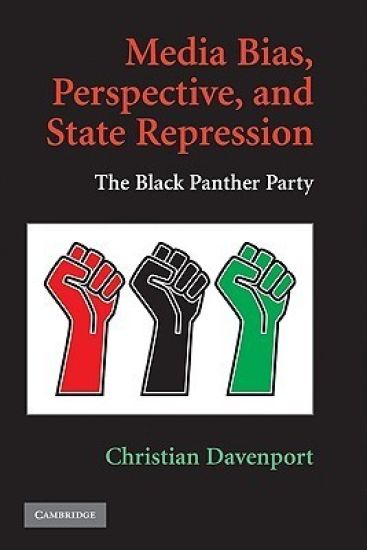
This book examines information reported within the media regarding the interaction between the Black Panther Party and government agents in the Bay Area of California (1967–1973). Christian Davenport argues that the geographic locale and political orientation of the newspaper influences how specific details are reported, including who starts and ends the conflict, who the Black Panthers target (government or non-government actors), and which part of the government responds (the police or court). Specifically, proximate and government-oriented sources provide one assessment of events, whereas proximate and dissident-oriented sources have another; both converge on specific aspects of the conflict. The methodological implications of the study are clear; Davenport's findings prove that in order to understand contentious events, it is crucial to understand who collects or distributes the information in order to comprehend who reportedly does what to whom as well as why.
As You Were

As You Were

Christian Davenport

John Wiley Sons Ltd
2009
sidottu
A powerful, enraging, tear-jerking reminder of how so few Americans have sacrificed so much during the so-called' war on terror'. the best kind of war book. - Alex Kershaw, author of The Bedford Boys and Escape from the Deep ""Through the voices and experiences of five very diverse members of the Virginia National Guard, As You Were gives the great majority of Americans who have not been sent to war a sense of the experiences of our citizen-soldiers and the family, employment, and health problems they face reentering American society after experiencing combat."" - David R. Segal, Drector, Center for Research on Military Organization, University of Maryland""A sad, stirring, sometimes maddening story. Christian Davenport writes not so much about combat, but rather the home front-the struggles of the families left behind while their providers go off to war and of the solders themselves as they stagger back to a civilian world that declines to reward, or even betrays, their sacrifice."" - Fred Kaplan, ""War Stories"" columist, Slate; author of Daydream Believers: How a Few Grand Ideas Wrecked American Power
State Repression and the Domestic Democratic Peace

State Repression and the Domestic Democratic Peace

Christian Davenport

Cambridge University Press
2007
sidottu
Does democracy decrease state repression in line with the expectations of governments, international organizations, NGOs, social movements, academics and ordinary citizens around the world? Most believe that a 'domestic democratic peace' exists, rivalling that found in the realm of interstate conflict. Investigating 137 countries from 1976 to 1996, this book seeks to shed light on this question. Specifically, three results emerge. First, while different aspects of democracy decrease repressive behaviour, not all do so to the same degree. Human rights violations are especially responsive to electoral participation and competition. Second, while different types of repression are reduced, not all are limited at comparable levels. Personal integrity violations are decreased more than civil liberties restrictions. Third, the domestic democratic peace is not bulletproof; the negative influence of democracy on repression can be overwhelmed by political conflict. This research alters our conception of repression, its analysis and its resolution.
Repression and Mobilization

Repression and Mobilization

Christian Davenport

University of Minnesota Press
2005
nidottu
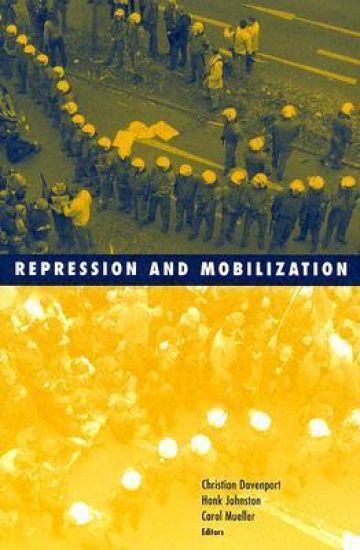
Brings together leading scholars from political science and sociology Recent events-from the collapse of Leninist regimes in Eastern Europe to the democratization of South Asian and South American states-have profoundly changed our ways of understanding and studying contentious politics, particularly the relationship between state repression and political mobilization.With case studies that range from Germany to the Philippines, the United States to Japan, Guatemala to China, the authors take up topics as varied as the dynamic interactions between protesters and policing agents, distinctions between “hard” and “soft” repression, the impact of media on our understanding of political contention, the timing and shape of protest and resistance cycles, and how measurements of social and geographic control influence states’s responses to insurgencies. Together these essays synthesize what we know about repression and mobilization and provide thoughtful insight for the future.Contributors: Patrick Ball, Science and Human Rights Program of the American Association for the Advancement of Science; Vince Boudreau, City College of New York; Myra Marx Ferree, U of Wisconsin; Ronald A. Francisco, U of Kansas; Ruud Koopmans, Free U Amsterdam; Mark Lichbach, U of Maryland; John D. McCarthy, Pennsylvania State U; Clark McPhail, U of Illinois, Urbana-Champaign; Patricia Steinhoff, U of Hawaii; Charles Tilly, Columbia U; Gilda Zwerman, SUNY, Old Westbury.