Kirjojen hintavertailu. Mukana 12 657 676 kirjaa ja 12 kauppaa.

Kirjailija

Christian Reus-Smit

Kirjat ja teokset yhdessä paikassa: 12 kirjaa, julkaisuja vuosilta 1999-2021, suosituimpien joukossa Internationella relationer - - en kort introduktion. Vertaile teosten hintoja ja tarkista saatavuus suomalaisista kirjakaupoista.

Mukana myös kirjoitusasut: Christian Reus Smit

12 kirjaa

Kirjojen julkaisuhaarukka 1999-2021.

Internationella relationer - - en kort introduktion

Internationella relationer - - en kort introduktion

Christian Reus-Smit

Studentlitteratur AB
2021
nidottu
Internationella relationer påverkar alla människors tillvaro: vår trygghet, vår ekonomiska välfärd, våra rättigheter och friheter samt vår gemensamma miljö. Övergången från en värld dominerad av stora imperier till en värld präglad av suveräna stater - vilka är inflätade i en invecklad väv av internationella institutioner, och som alla utövar politisk auktoritet i någon form - har haft långtgående följder för oss.I den här introduktionsboken beskrivs denna nya globala organi­sering av politisk auktoritet. För att visa hur internationella relationer fungerar diskuteras fyra områden i detalj: krig, ekonomi, rättigheter och kultur. Boken inleds med ett förord av Thomas Jonter, professor i internationella relationer vid Stockholms universitet.Internationella relationer vänder sig till studenter på grundnivå i internationella relationer, statsvetenskap, historia och andra närliggande ämnen, men kan med behållning läsas av alla som är intresserade av att förstå det internationella politiska sammanhanget i dag.
International Relations

International Relations

Christian Reus-Smit

Oxford University Press
2020
nidottu
International relations affects everyone's lives: their security, economic well-being, rights and freedoms, and the environment they share. Recently we have seen the transformation from a world of empires to today's world of sovereign states, which are enmeshed in a complex array of international institutions, all exercising degrees of political authority. The new global organization of political authority has far-reaching consequences. This Very Short Introduction untangles this complex world, providing an accessible framework for understanding the contours of global political change. Christian Reus-Smit treats theory as an indispensable tool for grasping international relations, but demystifies theorizing, introducing it as an everyday human practice. He surveys a range of theories, from realism to feminism: reading them as contrasting perspectives on the global organization of political authority. Historically, such organization has been shaped by diverse social forces, four of which are discussed in detail: shifting patterns of warfare, changing economic conditions, struggles for rights, and the politics of culture. Reus-Smit concludes with a reflection on the future of international relations in an era of profound global change. ABOUT THE SERIES: The Very Short Introductions series from Oxford University Press contains hundreds of titles in almost every subject area. These pocket-sized books are the perfect way to get ahead in a new subject quickly. Our expert authors combine facts, analysis, perspective, new ideas, and enthusiasm to make interesting and challenging topics highly readable.
On Cultural Diversity

On Cultural Diversity

Christian Reus-Smit

Cambridge University Press
2018
pokkari
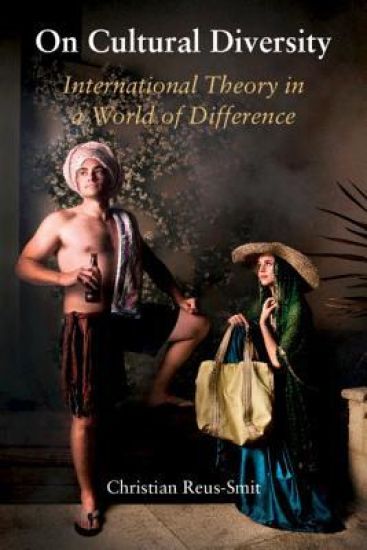
The rise of non-Western Great Powers, the spread of transnational religiously-justified insurgencies, and the resurgence of ethno-nationalism raise fundamental questions about the effects of cultural diversity on international order. Yet current debate - among academics, popular commentators, and policy-makers alike - rests on flawed understandings of culture and inaccurate assumptions about how historically cultural diversity has shaped the evolution of international orders. In this path-breaking book, Christian Reus-Smit details how the major theories of international relations have consistently misunderstood the nature and effects of culture, returning time and again to a conception long abandoned in specialist fields: the idea of cultures as coherent, bounded, and constitutive. Drawing on theoretical insights from anthropology, cultural studies, and sociology, and informed by new histories of diverse historical orders, this book presents a new theoretical account of the relationship between cultural diversity and international order: an account with far-reaching implications for how we understand contemporary transformations.
On Cultural Diversity

On Cultural Diversity

Christian Reus-Smit

Cambridge University Press
2018
sidottu
The rise of non-Western Great Powers, the spread of transnational religiously-justified insurgencies, and the resurgence of ethno-nationalism raise fundamental questions about the effects of cultural diversity on international order. Yet current debate - among academics, popular commentators, and policy-makers alike - rests on flawed understandings of culture and inaccurate assumptions about how historically cultural diversity has shaped the evolution of international orders. In this path-breaking book, Christian Reus-Smit details how the major theories of international relations have consistently misunderstood the nature and effects of culture, returning time and again to a conception long abandoned in specialist fields: the idea of cultures as coherent, bounded, and constitutive. Drawing on theoretical insights from anthropology, cultural studies, and sociology, and informed by new histories of diverse historical orders, this book presents a new theoretical account of the relationship between cultural diversity and international order: an account with far-reaching implications for how we understand contemporary transformations.
Individual Rights and the Making of the International System

Individual Rights and the Making of the International System

Christian Reus-Smit

Cambridge University Press
2013
pokkari
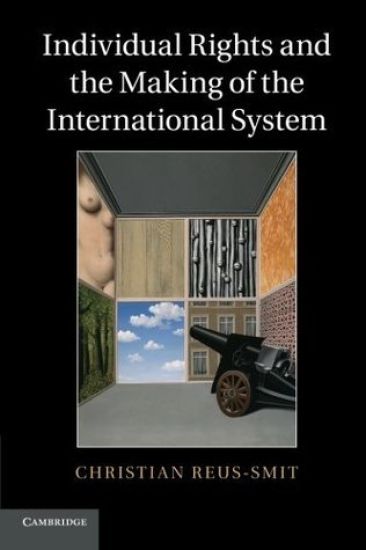
We live today in the first global system of sovereign states in history, encompassing all of the world's polities, peoples, religions and civilizations. Christian Reus-Smit presents a new account of how this system came to be, one in which struggles for individual rights play a central role. The international system expanded from its original European core in five great waves, each involving the fragmentation of one or more empires into a host of successor sovereign states. In the most important, associated with the Westphalian settlement, the independence of Latin America, and post-1945 decolonization, the mobilization of new ideas about individual rights challenged imperial legitimacy, and when empires failed to recognize these new rights, subject peoples sought sovereign independence. Combining theoretical innovation with detailed historical case studies, this book advances a new understanding of human rights and world politics, with individual rights deeply implicated in the making of the global sovereign order.
Individual Rights and the Making of the International System

Individual Rights and the Making of the International System

Christian Reus-Smit

Cambridge University Press
2013
sidottu
We live today in the first global system of sovereign states in history, encompassing all of the world's polities, peoples, religions and civilizations. Christian Reus-Smit presents a new account of how this system came to be, one in which struggles for individual rights play a central role. The international system expanded from its original European core in five great waves, each involving the fragmentation of one or more empires into a host of successor sovereign states. In the most important, associated with the Westphalian settlement, the independence of Latin America, and post-1945 decolonization, the mobilization of new ideas about individual rights challenged imperial legitimacy, and when empires failed to recognize these new rights, subject peoples sought sovereign independence. Combining theoretical innovation with detailed historical case studies, this book advances a new understanding of human rights and world politics, with individual rights deeply implicated in the making of the global sovereign order.
Special Responsibilities

Special Responsibilities

Mlada Bukovansky; Ian Clark; Robyn Eckersley; Richard Price; Christian Reus-Smit; Nicholas J. Wheeler

Cambridge University Press
2012
sidottu
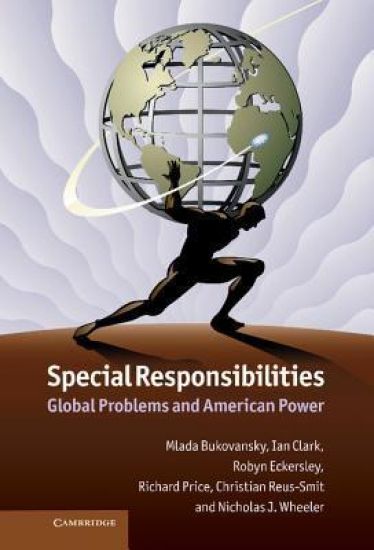
The language of special responsibilities is ubiquitous in world politics, with policymakers and commentators alike speaking and acting as though particular states have, or ought to have, unique obligations in managing global problems. Surprisingly, scholars are yet to provide any in-depth analysis of this fascinating aspect of world politics. This path-breaking study examines the nature of special responsibilities, the complex politics that surround them and how they condition international social power. The argument is illustrated with detailed case-studies of nuclear proliferation, climate change and global finance. All three problems have been addressed by an allocation of special responsibilities, but while this has structured politics in these areas, it has also been the subject of ongoing contestation. With a focus on the United States, this book argues that power must be understood as a social phenomenon and that American power varies significantly across security, economic and environmental domains.
Special Responsibilities

Special Responsibilities

Mlada Bukovansky; Ian Clark; Robyn Eckersley; Richard Price; Christian Reus-Smit; Nicholas J. Wheeler

Cambridge University Press
2012
pokkari
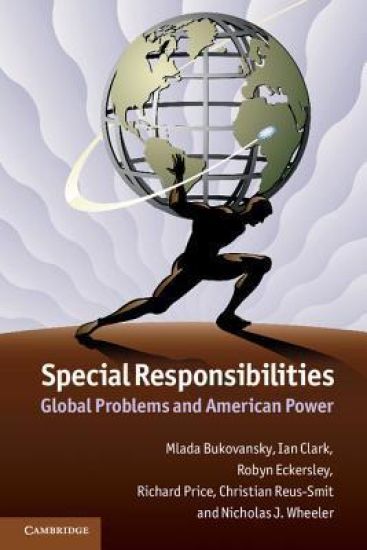
The language of special responsibilities is ubiquitous in world politics, with policymakers and commentators alike speaking and acting as though particular states have, or ought to have, unique obligations in managing global problems. Surprisingly, scholars are yet to provide any in-depth analysis of this fascinating aspect of world politics. This path-breaking study examines the nature of special responsibilities, the complex politics that surround them and how they condition international social power. The argument is illustrated with detailed case-studies of nuclear proliferation, climate change and global finance. All three problems have been addressed by an allocation of special responsibilities, but while this has structured politics in these areas, it has also been the subject of ongoing contestation. With a focus on the United States, this book argues that power must be understood as a social phenomenon and that American power varies significantly across security, economic and environmental domains.
The Moral Purpose of the State

The Moral Purpose of the State

Christian Reus-Smit

Princeton University Press
2009
pokkari
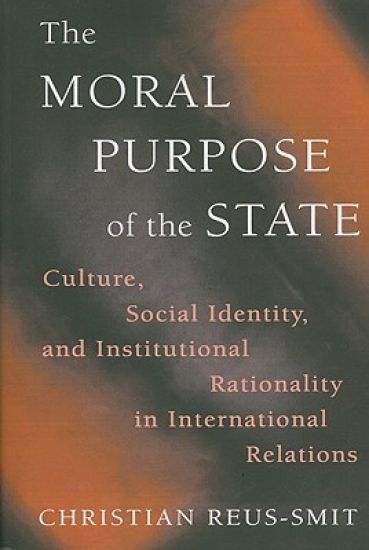
This book seeks to explain why different systems of sovereign states have built different types of fundamental institutions to govern interstate relations. Why, for example, did the ancient Greeks operate a successful system of third-party arbitration, while international society today rests on a combination of international law and multilateral diplomacy? Why did the city-states of Renaissance Italy develop a system of oratorical diplomacy, while the states of absolutist Europe relied on naturalist international law and "old diplomacy"? Conventional explanations of basic institutional practices have difficulty accounting for such variation. Christian Reus-Smit addresses this problem by presenting an alternative, "constructivist" theory of international institutional development, one that emphasizes the relationship between the social identity of the state and the nature and origin of basic institutional practices. Reus-Smit argues that international societies are shaped by deep constitutional structures that are based on prevailing beliefs about the moral purpose of the state, the organizing principle of sovereignty, and the norm of procedural justice. These structures inform the imaginations of institutional architects as they develop and adjust institutional arrangements between states. As he shows with detailed reference to ancient Greece, Renaissance Italy, absolutist Europe, and the modern world, different cultural and historical contexts lead to profoundly different constitutional structures and institutional practices. The first major study of its kind, this book is a significant addition to our theoretical and empirical understanding of international relations, past and present.
American Power and World Order

American Power and World Order

Christian Reus Smit

Polity Press
2004
nidottu
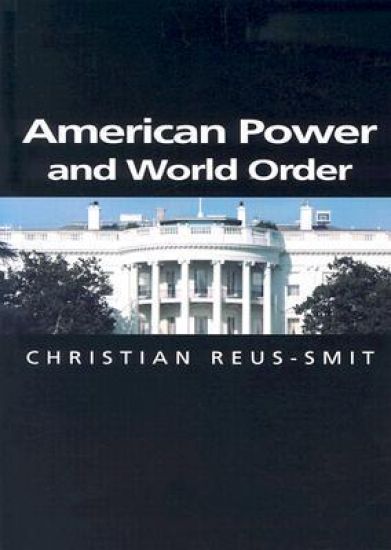
In recent years American foreign policy has taken a unilateralist turn. Confident of America’s economic supremacy and cultural magnetism, the Bush administration has embarked on an ambitious mission to further American interests and reshape global order. In this compelling and insightful book, Christian Reus-Smit offers a sustained critique of the Bush Doctrine and its impact on the United States and the world community. Far from being a realistic response to the challenges of the post-September 11 global order, Reus-Smit contends that the current neo-conservative approach to foreign policy is deeply idealist and naïve. He argues that the quest to re-establish US hegemony in the contemporary world is based on a flawed understanding of the nature of power and the complexities of the global system. This has led Washington to pursue policies ill-suited to addressing current sources of global disorder, such as intra-state conflict and transnational violence, inequality, alienation and environmental degradation. If this trend continues, Reus-Smit warns that it will have serious implications for global order and justice in the 21st Century.
American Power and World Order

American Power and World Order

Christian Reus Smit

Polity Press
2004
sidottu
In recent years American foreign policy has taken a unilateralist turn. Confident of America’s economic supremacy and cultural magnetism, the Bush administration has embarked on an ambitious mission to further American interests and reshape global order. In this compelling and insightful book, Christian Reus-Smit offers a sustained critique of the Bush Doctrine and its impact on the United States and the world community. Far from being a realistic response to the challenges of the post-September 11 global order, Reus-Smit contends that the current neo-conservative approach to foreign policy is deeply idealist and naïve. He argues that the quest to re-establish US hegemony in the contemporary world is based on a flawed understanding of the nature of power and the complexities of the global system. This has led Washington to pursue policies ill-suited to addressing current sources of global disorder, such as intra-state conflict and transnational violence, inequality, alienation and environmental degradation. If this trend continues, Reus-Smit warns that it will have serious implications for global order and justice in the 21st Century.
The Moral Purpose of the State

The Moral Purpose of the State

Christian Reus-Smit

Princeton University Press
1999
sidottu
This book seeks to explain why different systems of sovereign states have built different types of fundamental institutions to govern interstate relations. Why, for example, did the ancient Greeks operate a successful system of third-party arbitration, while international society today rests on a combination of international law and multilateral diplomacy? Why did the city-states of Renaissance Italy develop a system of oratorical diplomacy, while the states of absolutist Europe relied on naturalist international law and "old diplomacy"? Conventional explanations of basic institutional practices have difficulty accounting for such variation. Christian Reus-Smit addresses this problem by presenting an alternative, "constructivist" theory of international institutional development, one that emphasizes the relationship between the social identity of the state and the nature and origin of basic institutional practices. Reus-Smit argues that international societies are shaped by deep constitutional structures that are based on prevailing beliefs about the moral purpose of the state, the organizing principle of sovereignty, and the norm of procedural justice. These structures inform the imaginations of institutional architects as they develop and adjust institutional arrangements between states. As he shows with detailed reference to ancient Greece, Renaissance Italy, absolutist Europe, and the modern world, different cultural and historical contexts lead to profoundly different constitutional structures and institutional practices. The first major study of its kind, this book is a significant addition to our theoretical and empirical understanding of international relations, past and present.