Kirjojen hintavertailu. Mukana 12 476 078 kirjaa ja 12 kauppaa.

Kirjailija

Christian Smith

Kirjat ja teokset yhdessä paikassa: 39 kirjaa, julkaisuja vuosilta 1991-2026, suosituimpien joukossa The Sacred Project of American Sociology. Vertaile teosten hintoja ja tarkista saatavuus suomalaisista kirjakaupoista.

39 kirjaa

Kirjojen julkaisuhaarukka 1991-2026.

Young Catholic America

Young Catholic America

Christian Smith; Kyle Longest; Jonathan Hill; Kari Christoffersen

Oxford University Press Inc
2014
sidottu
Studies of young American Catholics over the last three decades suggest a growing crisis in the Catholic Church: compared to their elders, young Catholics are looking to the Church less as they form their identities, and fewer of them can even explain what it means to be Catholic and why that matters. Young Catholic America, the latest book based on the groundbreaking National Study of Youth and Religion, explores a crucial stage in the life of Catholics. Drawing on in-depth surveys and interviews of Catholics and ex-Catholics ages eighteen to twenty-threea demographic commonly known as early emerging adulthoodleading sociologist Christian Smith and his colleagues offer a wealth of insight into the wide variety of religious practices and beliefs among young Catholics today, the early influences and life-altering events that lead them to embrace the Church or abandon it, and how being Catholic affects them as they become full-fledged adults. Beyond its rich collection of statistical data, the book includes vivid case studies of individuals spanning a full decade, as well as insight into the twentieth-century events that helped to shape the Church and its members in America. An innovative contribution to what we know about religion in the United States and the evolving Catholic Church, Young Catholic America is the definitive source for anyone seeking to understand what it means to be young and Catholic in America today.
The Bible Made Impossible – Why Biblicism Is Not a Truly Evangelical Reading of Scripture
Biblicism, an approach to the Bible common among some American evangelicals, emphasizes together the Bible's exclusive authority, infallibility, clarity, self-sufficiency, internal consistency, self-evident meaning, and universal applicability. Acclaimed sociologist Christian Smith argues that this approach is misguided and unable to live up to its own claims. If evangelical biblicism worked as its proponents say it should, there would not be the vast variety of interpretive differences that biblicists themselves reach when they actually read and interpret the Bible. Far from challenging the inspiration and authority of Scripture, Smith critiques a particular rendering of it, encouraging evangelicals to seek a more responsible, coherent, and defensible approach to biblical authority.This important book has generated lively discussion and debate. The paperback edition adds a new chapter responding to the conversation that the cloth edition has sparked.
What Is a Person?

What Is a Person?

Christian Smith

University of Chicago Press
2011
nidottu
What is a person? This fundamental question is a perennial concern of philosophers and theologians. But, Christian Smith argues, it also lies at the center of the social scientist's quest to interpret and explain social life. In this ambitious book, Smith presents a new model for social theory that does justice to the best of our humanistic visions of people, life, and society. Finding much current thinking on personhood to be confusing or misleading, Smith finds inspiration in critical realism and personalism. Drawing on these ideas, he constructs a theory of personhood that forges a middle path between the extremes of positivist science and relativism. Smith then builds on the work of Pierre Bourdieu, Anthony Giddens, and William Sewell to demonstrate the importance of personhood to our understanding of social structures. From there he broadens his scope to consider how we can know what is good in personal and social life and what sociology can tell us about human rights and dignity. Innovative, critical, and constructive, "What Is a Person?" offers an inspiring vision of a social science committed to pursuing causal explanations, interpretive understanding, and general knowledge in the service of truth and the moral good.
Lost in Transition

Lost in Transition

Christian Smith; Kari Christoffersen; Hilary Davidson; Patricia Snell Herzog

Oxford University Press Inc
2011
sidottu
Life for emerging adults is vastly different today than it was for their counterparts even a generation ago. Young people are waiting longer to marry, to have children, and to choose a career direction. As a result, they enjoy more freedom, opportunities, and personal growth than ever before. But the transition to adulthood is also more complex, disjointed, and confusing. In Lost in Transition, Christian Smith and his collaborators draw on 230 in-depth interviews with a broad cross-section of emerging adults (ages 18-23) to investigate the difficulties young people face today, the underlying causes of those difficulties, and the consequences both for individuals and for American society as a whole. Rampant consumer capitalism, ongoing failures in education, hyper-individualism, postmodernist moral relativism, and other aspects of American culture are all contributing to the chaotic terrain that emerging adults must cross. Smith identifies five major problems facing very many young people today: confused moral reasoning, routine intoxication, materialistic life goals, regrettable sexual experiences, and disengagement from civic and political life. The trouble does not lie only with the emerging adults or their poor individual decisions but has much deeper roots in mainstream American culture--a culture which emerging adults have largely inherited rather than created. Older adults, Smith argues, must recognize that much of the responsibility for the pain and confusion young people face lies with them. Rejecting both sky-is-falling alarmism on the one hand and complacent disregard on the other, Smith suggests the need for what he calls "realistic concern"--and a reconsideration of our cultural priorities and practices--that will help emerging adults more skillfully engage unique challenges they face. Even-handed, engagingly written, and based on comprehensive research, Lost in Transition brings much needed attention to the darker side of the transition to adulthood.
What Is a Person?

What Is a Person?

Christian Smith

University of Chicago Press
2010
sidottu
What is a person? This fundamental question is a perennial concern of philosophers and theologians. But, Christian Smith argues, it also lies at the center of the social scientist's quest to interpret and explain social life. In this ambitious book, Smith presents a new model for social theory that does justice to the best of our humanistic visions of people, life, and society. Finding much current thinking on personhood to be confusing or misleading, Smith finds inspiration in critical realism and personalism. Drawing on these ideas, he constructs a theory of personhood that forges a middle path between the extremes of positivist science and relativism. Smith then builds on the work of Pierre Bourdieu, Anthony Giddens, and William Sewell to demonstrate the importance of personhood to our understanding of social structures. From there he broadens his scope to consider how we can know what is good in personal and social life and what sociology can tell us about human rights and dignity. Innovative, critical, and constructive, "What Is a Person?" offers an inspiring vision of a social science committed to pursuing causal explanations, interpretive understanding, and general knowledge in the service of truth and the moral good.
Souls in Transition

Souls in Transition

Christian Smith; Patricia Snell

Oxford University Press Inc
2009
sidottu
How important is religion for young people in America today? What are the major influences on their developing spiritual lives? How do their religious beliefs and practices change as young people enter into adulthood? Christian Smith's Souls in Transition explores these questions and many others as it tells the definitive story of the religious and spiritual lives of emerging adults, ages 18 to 24, in the U.S. today. This is the much-anticipated follow-up study to the landmark book, Soul Searching: The Religious and Spiritual Lives of American Teenagers. Based on candid interviews with thousands of young people tracked over a five-year period, Souls in Transition reveals how the religious practices of the teenagers portrayed in Soul Searching have been strengthened, challenged, and often changed as they have moved into adulthood. The book vividly describes as well the broader cultural world of today's emerging adults, how that culture shapes their religious outlooks, and what the consequences are for religious faith and practice in America more generally. Some of Smith's findings are surprising. Parents turn out to be the single most important influence on the religious outcomes in the lives of young adults. On the other hand, teenage participation in evangelization missions and youth groups does not predict a high level of religiosity just a few years later. Moreover, the common wisdom that religiosity declines sharply during the young adult years is shown to be greatly exaggerated. Painstakingly researched and filled with remarkable findings, Souls in Transition will be essential reading for youth ministers, pastors, parents, teachers and students at church-related schools, and anyone who wishes to know how religious practice is affected by the transition into adulthood in America today.
Moral, Believing Animals

Moral, Believing Animals

Christian Smith

Oxford University Press Inc
2009
nidottu
What kind of animals are human beings? And how do our visions of the human shape our theories of social action and institutions? In Moral, Believing Animals, Christian Smith advances a creative theory of human persons and culture that offers innovative, challenging answers to these and other fundamental questions in sociological, cultural, and religious theory. Smith suggests that human beings have a peculiar set of capacities and proclivities that distinguishes them significantly from other animals on this planet. Despite the vast differences in humanity between cultures and across history, no matter how differently people narrate their lives and histories, there remains an underlying structure of human personhood that helps to order human culture, history, and narration. Drawing on important recent insights in moral philosophy, epistemology, and narrative studies, Smith argues that humans are animals who have an inescapable moral and spiritual dimension. They cannot avoid a fundamental moral orientation in life and this, says Smith, has profound consequences for how sociology must study human beings.
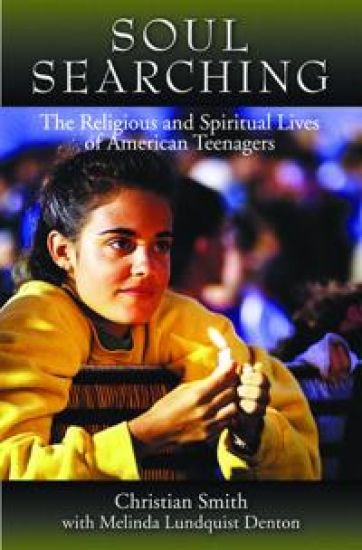
Soul Searching

Soul Searching

Christian Smith; Melinda Lundquist Denton

Oxford University Press Inc
2009
nidottu
In innumerable discussions and activities dedicated to better understanding and helping teenagers, one aspect of teenage life is curiously overlooked. Very few such efforts pay serious attention to the role of religion and spirituality in the lives of American adolescents. But many teenagers are very involved in religion. Surveys reveal that 35% attend religious services weekly and another 15% attend at least monthly. 60% say that religious faith is important in their lives. 40% report that they pray daily. 25% say that they have been "born again." Teenagers feel good about the congregations they belong to. Some say that faith provides them with guidance and resources for knowing how to live well. What is going on in the religious and spiritual lives of American teenagers? What do they actually believe? What religious practices do they engage in? Do they expect to remain loyal to the faith of their parents? Or are they abandoning traditional religious institutions in search of a new, more authentic "spirituality"? This book attempts to answer these and related questions as definitively as possible. It reports the findings of The National Study of Youth and Religion, the largest and most detailed such study ever undertaken. The NYSR conducted a nationwide telephone survey of teens and significant caregivers, as well as nearly 300 in-depth face-to-face interviews with a sample of the population that was surveyed. The results show that religion and spirituality are indeed very significant in the lives of many American teenagers. Among many other discoveries, they find that teenagers are far more influenced by the religious beliefs and practices of their parents and caregivers than commonly thought. They refute the conventional wisdom that teens are "spiritual but not religious." And they confirm that greater religiosity is significantly associated with more positive adolescent life outcomes. This eagerly-awaited volume not only provides an unprecedented understanding of adolescent religion and spirituality but, because teenagers serve as bellwethers for possible future trends, it affords an important and distinctive window through which to observe and assess the current state and future direction of American religion as a whole.
Passing the Plate

Passing the Plate

Christian Smith; Michael O Emerson; Patricia Snell

Oxford University Press Inc
2008
sidottu
Passing the Plate shows that few American Christians donate generously to religious and charitable causes--a parsimony that seriously undermines the work of churches and ministries. Far from the 10 percent of one's income that tithing requires, American Christians' financial giving typically amounts, by some measures, to less than one percent of annual earnings. And a startling one out of five self-identified Christians gives nothing at all. This eye-opening book explores the reasons behind such ungenerous giving, the potential world-changing benefits of greater financial giving, and what can be done to improve matters. If American Christians gave more generously, say the authors, any number of worthy projects-from the prevention and treatment of HIV/AIDS to the promotion of inter-religious understanding to the upgrading of world missions-could be funded at astounding levels. Analyzing a wide range of social surveys and government and denominational statistical datasets and drawing on in-depth interviews with Christian pastors and church members in seven different states, the book identifies a crucial set of factors that appear to depress religious financial support-among them the powerful allure of a mass-consumerist culture and its impact on Americans' priorities, parishioners' suspicions of waste and abuse by nonprofit administrators, clergy hesitations to boldly ask for money, and the lack of structure and routine in the way most American Christians give away money. In their conclusion, the authors suggest practical steps that clergy and lay leaders might take to counteract these tendencies and better educate their congregations about the transformative effects of generous giving. By illuminating the social and psychological forces that shape charitable giving, Passing the Plate is sure to spark a much-needed debate on a critical issue.
Soul Searching

Soul Searching

Christian Smith; Melinda Lundquist Denton

Oxford University Press Inc
2005
sidottu
In most discussions and analyses of American teenage life, one major topic is curiously overlooked--religion. Yet most American teens say that religious faith is important in their lives. What is going on in the religious and spiritual lives of American teenagers? What do they actually believe? What religious practices do they engage in? Do they expect to remain loyal to the faith of their parents? Or are they abandoning traditional religious institutions in search of a new, more "authentic" spirituality? Answering these and many other questions, Soul Searching tells the definitive story of the religious and spiritual lives of contemporary American teenagers.
Moral, Believing Animals

Moral, Believing Animals

Christian Smith

Oxford University Press Inc
2003
sidottu
What kind of animals are human beings? And how do our visions of the human shape our theories of social action and institutions? In Moral, Believing Animals, Christian Smith offers innovative, challenging answers to these and other fundamental questions in sociological, cultural, and religious theory. Smith's work is based on the assumption (unfashionable in certain circles) that human beings have an identifiable and peculiar set of capacities and proclivities that distinguishes them significantly from other animals on this planet. Smith argues that all people are at bottom believers, whose lives, actions, and institutions are constituted, motivated, and governed by narrative traditions and moral orders on which they inescapably depend. This approach - which has profound consequences for how we think about knowledge, culture, social action, institutions, religion, and the task of social sciences - will be of interest to scholars in sociology, social theory, religious and cultural studies, psychology, and anthropology.
Christian America?

Christian America?

Christian Smith

University of California Press
2002
pokkari
In recent decades Protestant evangelicalism has become a conspicuous and - to many Americans, worrisome - part of this country's cultural and political landscape. But just how unified is the supposed constituency of the Christian Coalition? And who exactly are the people the Christian Right claims to represent? In the most extensive study of American evangelicals ever conducted, Christian Smith explores the beliefs, values, commitments, and goals of the ordinary men and women who make up this often misunderstood religious group. The result is a much-needed contribution to the discussion of issues surrounding fundamental American freedoms and the basic identity of the United States as a pluralistic nation. Based on data from a three-year national study, including more than 200 in-depth interviews of evangelicals around the country, "Christian America?" assesses the common stereotype of evangelicals as intolerant, right-wing, religious zealots seeking to impose a Christian moral order through political force. What Smith finds instead are people vastly more diverse and ambivalent than this stereotype suggests. On issues such as religion in education, 'family values,' Christian political activism, and tolerance of other religions and moralities, evangelicals are highly disparate and conflicted. As the voices of interviewees make clear, the labels 'conservative' and 'liberal' are too simplistic for understanding their approaches to public life and political action.
Divided by Faith

Divided by Faith

Michael O. Emerson; Christian Smith

Oxford University Press Inc
2001
nidottu
In recent years, the leaders of the American evangelical movement have brought their characteristic passion to the problem of race, notably in the Promise Keepers movement and in reconciliation theology. But the authors of this provocative new study reveal that despite their good intentions, evangelicals may actually be preserving America's racial chasm. In Divided by Faith, Michael O. Emerson and Christian Smith probe the grassroots of white evangelical America, through a nationwide telephone survey of 2,000 people, along with 200 face-to-face interviews. The results of their research are surprising. Most white evangelicals, they learned, see no systematic discrimination against blacks; indeed, they deny the existence of any ongoing racial problem in the United States. Many of their subjects blamed the continuing talk of racial conflict on the media, unscrupulous black leaders, and the inability of African Americans to forget the past. What lies behind this perception? Evangelicals, Emerson and Smith write, are not so much actively racist as committed to a theological view of the world that makes it difficult for them to see systematic injustice. The evangelical emphasis on individualism, free will, and personal relationships makes invisible the pervasive injustice that perpetuates inequality between the races. Most racial problems, they told the authors, can be solved by the repentance and conversion of the sinful individuals at fault. Combining a substantial body of evidence with sophisticated analysis and interpretation, Emerson and Smith throw sharp light on the oldest American dilemma. Despite the best intentions of evangelical leaders and some positive trends, the authors conclude that real racial reconciliation remains far over the horizon.
American Evangelicalism

American Evangelicalism

Christian Smith

University of Chicago Press
1998
nidottu
Based on a national telephone survey and 300 personal interviews with evangelicals and other churchgoing Protestants, this study provides an analysis of the commitments, beliefs, concerns and practices of this group. Examining how evangelicals interact with and attempt to influence secular society, the text argues that traditional, orthodox evangelicalism endures because of the challenges and structures of our modern pluralistic environment. It also looks beyond evangelicalism to explore the problems of traditional religious belief and practice in the modern world.
Resisting Reagan

Resisting Reagan

Christian Smith

University of Chicago Press
1996
nidottu
An analysis of the US Central America peace movement. This work explains why more than 100,000 US citizens marched in the streets, illegally housed refugees, travelled to Central American war zones, committed civil disobedience, and hounded their political representatives to contest the Reagan administration's policy of sponsoring wars in Nicaragua and El Salvador. Focusing on the movement's three most important national campaigns - Witness for Peace, Sanctuary, and the Pledge of Resistance - this work demonstrates the centrality of morality as a political motivator, highlights the importance of political opportunities in movement outcomes, and examines the social structuring of insurgent consciousness. Based on extensive surveys, interviews, and research, the book aims to increase understanding of the formation of individual activist identities, of national movement dynamics, and of religious resources for political activism.
Resisting Reagan

Resisting Reagan

Christian Smith

University of Chicago Press
1996
sidottu
An analysis of the US Central America peace movement. This work explains why more than 100,000 US citizens marched in the streets, illegally housed refugees, travelled to Central American war zones, committed civil disobedience, and hounded their political representatives to contest the Reagan administration's policy of sponsoring wars in Nicaragua and El Salvador. Focusing on the movement's three most important national campaigns - Witness for Peace, Sanctuary, and the Pledge of Resistance - this work demonstrates the centrality of morality as a political motivator, highlights the importance of political opportunities in movement outcomes, and examines the social structuring of insurgent consciousness. Based on extensive surveys, interviews, and research, the book aims to increase understanding of the formation of individual activist identities, of national movement dynamics, and of religious resources for political activism.
The Emergence of Liberation Theology

The Emergence of Liberation Theology

Christian Smith

University of Chicago Press
1991
nidottu
Liberation theology is a school of Roman Catholic thought which teaches that a primary duty of the church must be to promote social and economic justice. In this book, Christian Smith explains how and why the liberation theology movement emerged and succeeded when and where it did.