Kirjojen hintavertailu. Mukana 12 595 353 kirjaa ja 12 kauppaa.
Kirjailija
Christian Streffer
Kirjat ja teokset yhdessä paikassa: 8 kirjaa, julkaisuja vuosilta 1964-2021, suosituimpien joukossa Mechanismen Enzymatischer Reaktionen. Vertaile teosten hintoja ja tarkista saatavuus suomalaisista kirjakaupoista.
Th. Wieland; Kurt Wallenfels; Christian Streffer; Myron L. Bender; H. Fasold; U. Gröschel-Stewart; G. Gundlach; F. Turba; B. R. Rabin; A. P. Mathias; Herbert Witzel; C. Veeger; Peter Hemmerich; L. Jaenicke; G. Kohlhaw; H. Holzer; W. Schröter; J. Knappe; F. Lynen; V. M. Clark; V. Prelog; G. Pfleiderer; Horst Sund
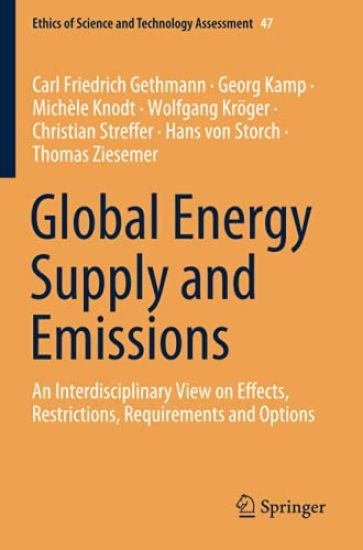
This book offers an authoritative analysis of the state-of-the art in energy and climate research and policy. It starts by describing the current status of technologies that are expected to have an influence on the energy systems of the future. For an adequate evaluation, it presents the latest findings on the effects of energy supply and consumption as well as of the emissions on both the environment and people’s health. This is followed by an extensive discussion of the economic and social problems related to climate change, the need for energy transitions, and other issues that may require public investment and international agreements. The book reviews the problem of energy policy from a global perspective, providing readers with the technical, political, economic and ethical background needed to understand the current situation and work at better solutions for a sustainable, just and prospering world.
This book offers an authoritative analysis of the state-of-the art in energy and climate research and policy. It starts by describing the current status of technologies that are expected to have an influence on the energy systems of the future. For an adequate evaluation, it presents the latest findings on the effects of energy supply and consumption as well as of the emissions on both the environment and people’s health. This is followed by an extensive discussion of the economic and social problems related to climate change, the need for energy transitions, and other issues that may require public investment and international agreements. The book reviews the problem of energy policy from a global perspective, providing readers with the technical, political, economic and ethical background needed to understand the current situation and work at better solutions for a sustainable, just and prospering world.
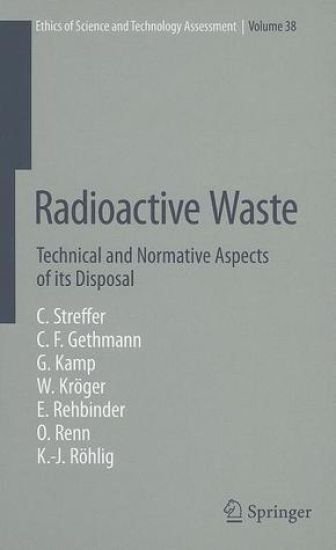
Radioactive waste (above all highly radioactive wastes from nuclear installations) caused by research, medicine and technology must be disposed of safely. However both the strategies disputed for the disposal of radioactive waste as well as concrete proposals for choosing a location for final waste disposal are highly debatable. An appropriate disposal must conform to both complex, technical requirements and fulfill the radio-biological conditions to appropriately protect man and nature. Ethical, legal and social conditions must also be considered. An interdisciplinary team from various, relevant fields compiled the current status-quo and developed criteria and strategies, which on the one hand meet the requirements of optimal warning and prevention of risk for present and future generations, and additionally on the other hand meet the needs of what current society agrees what is expected to be allowed. This study can be understood as an advanced and continuing contribution to the corresponding scientific specialized debates, due to its interdisciplinary treatment. At the same time it serves as a fundamentally informing contribution to public and political debates, offering an easily comprehensible executive summary and precise content recommendations.
Radioactive waste (above all highly radioactive wastes from nuclear installations) caused by research, medicine and technology must be disposed of safely. However both the strategies disputed for the disposal of radioactive waste as well as concrete proposals for choosing a location for final waste disposal are highly debatable. An appropriate disposal must conform to both complex, technical requirements and fulfill the radio-biological conditions to appropriately protect man and nature. Ethical, legal and social conditions must also be considered. An interdisciplinary team from various, relevant fields compiled the current status-quo and developed criteria and strategies, which on the one hand meet the requirements of optimal warning and prevention of risk for present and future generations, and additionally on the other hand meet the needs of what current society agrees what is expected to be allowed. This study can be understood as an advanced and continuing contribution to the corresponding scientific specialized debates, due to its interdisciplinary treatment. At the same time it serves as a fundamentally informing contribution to public and political debates, offering an easily comprehensible executive summary and precise content recommendations.
Christian Streffer; Josef Bücker; Adrienne Cansier; Dieter Cansier; Carl Friedrich Gethmann; Robert Guderian; Gerd Hanekamp; Dietrich Henschler; Gerald Pöch; Eckard Rehbinder; Ortwin Renn; Marco Slesina; Kerstin Wuttke
The rapid growth of the world population - nearly six-fold over the last hundred years - combined with the rising number of technical installations especially in the industrialized countries has lead to ever tighter and more strained living spaces on our planet. Because ofthe inevitable processes oflife, man was at first an exploiter rather than a careful preserver of the environment. Environmental awareness with the intention to conserve the environment has grown only in the last few decades. Environmental standards have been defined and limit values have been set largely guided, however, by scientific and medical data on single exposures, while public opinion, on the other hand, now increasingly calls for astronger consideration of the more complex situations following combined exposures. Furthermore, it turned out that environmental standards, while necessarily based on scientific data, must also take into account ethical, legal, economic, and sociological aspects. A task of such complexity can only be dealt with appropriately in the framework of an inter disciplinary group.
Die menschliche Entwicklung ist seit jeher von einer gesicherten Energieversorgung abhängig, die heute aus Gründen der Machbarkeit und der Umweltbelastungen global betrachtet werden muss. Angesichts eines weltweit steigenden Energiebedarfs kommt der sicheren und preiswerten Bereitstellung von Energie daher eine Schlüsselrolle in der menschlichen Entwicklung zu. Auf der Basis der heutigen und zukünftig möglichen Energietechnologien sowie der Kenntnisse der zur Verfügung stehenden Ressourcen erarbeitet die Studie Beurteilungen der weltweiten Energieversorgung unter Einbeziehung wirtschaftlicher und umweltverträglicher Kriterien. Es werden ferner Aspekte der Langfristigkeit, der Sozialverträglichkeit und der Verteilungsgerechtigkeit in den Diskurs einbezogen.
Christian Streffer; Josef Bücker; Adrienne Cansier; Dieter Cansier; Carl Friedrich Gethmann; Robert Guderian; Gerd Hanekamp; Dietrich Henschler; Gerald Pöch; Eckard Rehbinder; Ortwin Renn; Marco Slesina; Kerstin Wuttke
The rapid growth of the world population - nearly six-fold over the last hundred years - combined with the rising number of technical installations especially in the industrialized countries has lead to ever tighter and more strained living spaces on our planet. Because ofthe inevitable processes oflife, man was at first an exploiter rather than a careful preserver of the environment. Environmental awareness with the intention to conserve the environment has grown only in the last few decades. Environmental standards have been defined and limit values have been set largely guided, however, by scientific and medical data on single exposures, while public opinion, on the other hand, now increasingly calls for astronger consideration of the more complex situations following combined exposures. Furthermore, it turned out that environmental standards, while necessarily based on scientific data, must also take into account ethical, legal, economic, and sociological aspects. A task of such complexity can only be dealt with appropriately in the framework of an inter disciplinary group.