Kirjojen hintavertailu. Mukana 12 514 863 kirjaa ja 12 kauppaa.
Kirjailija
Christian Wiman
Kirjat ja teokset yhdessä paikassa: 17 kirjaa, julkaisuja vuosilta 2005-2026, suosituimpien joukossa The Dance: Poems. Vertaile teosten hintoja ja tarkista saatavuus suomalaisista kirjakaupoista.
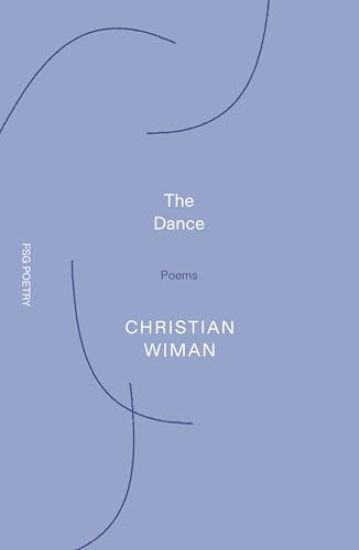
A new book of poetry from the celebrated poet and essayist, who has "wrestled eternity onto the page" (The New York Times). Few contemporary writers ask the questions about faith, morality, and God that Christian Wiman does, and even fewer--perhaps none --do so with his urgency and eloquence. In his seventh book of poetry, The Dance, Wiman is at the height of his powers. These searching, sharp, wide-ranging poems are a testament to the staying power of a poetic voice we will be reading for years to come.
From award-winning authors and Yale Divinity School colleagues Christian Wiman and Miroslav Volf--two world-renowned scholars exchange letters on the problems of faith today and the presence of divine love that persists through it all. Whether you're searching for something to believe in or no longer feel at home in your faith tradition of origin, the spiritual search can be deeply lonely.?Glimmerings brings the high-voltage tensions of faith as felt by many into the realm of relationship, where our hope might be bolstered in community with kindred minds. This vivid interpersonal offering brings together one of the world's leading Christian theologians, Miroslav Volf, with one of the most celebrated voices in modern American poetry, Christian Wiman, in this private-now-public exchange of letters on these very pressing tensions of our time. As close friends and Yale colleagues, their letters reveal visions of faith that are sometimes sharply divergent, yet always honest, modeling warmth, humor, disagreement and apology along the way. As the authors contend, certainty can never be ours. But perhaps God shows himself in "glimmerings," and as we companion each other on the search, we can take heart in being seen for who we are and held by a great and mysterious love. Candid, consoling, and ever-absorbing, Wiman and Volf's exchange creates a world where questions are dignified by a fair hearing, where the spiritual search in all its complexities is honored, where glimmerings might be found.
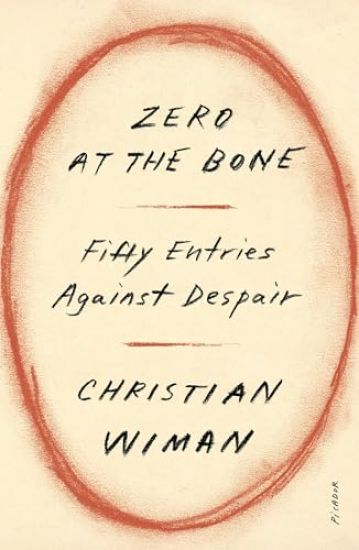
Zero at the Bone begins with Wiman’s preoccupation with despair, and through fifty brief pieces, he unravels its seductive appeal. The book is studded with the poetry and prose of writers who inhabit Wiman’s thoughts, and the voices of Wallace Stevens, Lucille Clifton, Emily Dickinson, and others join his own. At its heart and Wiman’s, however, are his family—his young children (who ask their own invaluable questions, like “Why are you a poet? I mean why?”), his wife, and those he grew up with in West Texas. Wiman is the rare thinker who takes on the mantle of our greatest mystics and does so with an honest, profound, and contemporary sensibility. Zero at the Bone is a revelation.
Few contemporary writers ask the questions about faith, morality, and God that Christian Wiman does, and even fewer - perhaps none - do so with his urgency and eloquence. Wiman, the author of My Bright Abyss and an award-winning poet, lays the motion of his mind on the page in this genre-defying work, an indivisible blend of poetry, criticism, theology, and searing memoir. As Marilynne Robinson wrote, “[Wiman's] poetry and his scholarship have a purifying urgency that is rare in this world . . . It enables him to say new things in timeless language, so that the reader’s surprise and assent are one and the same.” Zero at the Bone begins with Wiman’s preoccupation with despair, and through fifty brief pieces, framed by two more, he unravels its seductive appeal. The book is studded with the poetry and prose of writers who inhabit Wiman’s thoughts, and the voices of Wallace Stevens, Lucille Clifton, Emily Dickinson, and more join his own. At its heart and Wiman’s, however, are his family - his young children (who ask their own invaluable questions, like “Why are you a poet? I mean why?”), his wife, and those he grew up with in West Texas. Wiman is the rare thinker who takes up the mantle of our greatest mystics and does so with an honest, profound, and contemporary sensibility. Zero at the Bone is a revelation.
Molly McCully Brown; Victoria Reynolds Farmer; Edwidge Danticat; Stephanie Saldaña; Kelsey Osgood; Christian Wiman; Amy Julia Becker; Ross Douthat; Eugene Vodolazkin; Sarah C. Williams; Isaac T. Soon; Leah Libresco Sargeant
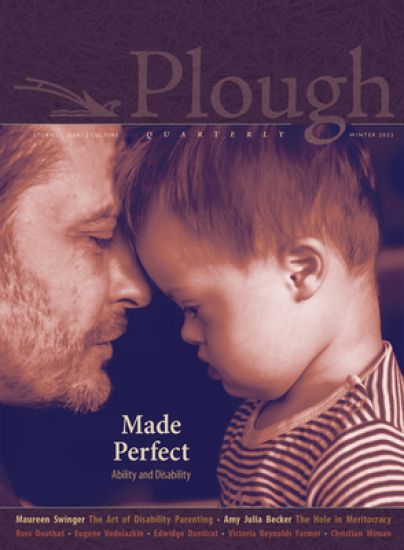
Whose lives count as fully human? The answer matters for everyone, disabled or not.The ancient Greek ideal linked physical wholeness to moral wholeness – the virtuous citizen was “beautiful and good.” It’s an ideal that has all too often turned deadly, casting those who do not measure up as less than human. In the pre-Christian era, infants with disabilities were left on the rocks; in modern times, they have been targeted by eugenics.Much has changed, thanks to the tenacious advocacy of the disability rights movement. Yesteryear’s hellish institutions have given way to customized educational programs and assisted living centers. Public spaces have been reconfigured to improve access. Therapies and medical technology have advanced rapidly in sophistication and effectiveness. Protections for people with disabilities have been enshrined in many countries’ antidiscrimination laws.But these victories, impressive as they are, mask other realities that collide awkwardly with society’s avowals of equality. Why are parents choosing to abort a baby likely to have a disability? Why does Belgian law allow for euthanasia in cases of disability, even absent a terminal diagnosis or physical pain? Why, when ventilators were in short supply during the first Covid wave, did some states list disability as a reason to deny care?On this theme: - Heonju Lee tells how his son with Down syndrome saved another child’s life.- Molly McCully Brown and Victoria Reynolds Farmer recount their personal experiences with disability.- Amy Julia Becker says meritocracies fail because they value the wrong things.- Maureen Swinger asks six mothers around the world about raising a child with disabilities.- Joe Keiderling documents the unfinished struggle for disability rights.- Isaac T. Soon wonders if Saint Paul’s “thorn in the flesh” was a disability.- Leah Libresco Sargeant reviews What Can a Body Do? and Making Disability Modern.- Sarah C. Williams says testing for fetal abnormalities is not a neutral practice.Also in the issue: - Ross Douthat is brought low by intractable Lyme disease.- Edwidge Danticat flees an active shooter in a packed mall.- Eugene Vodolazkin finds comic relief at funerals, including his own father’s.- Kelsey Osgood discovers that being an Orthodox Jew is strange, even in Brooklyn.- Christian Wiman pens three new poems.- Susannah Black profiles Flannery O’Conner.- Our writers review Eyal Press’s Dirty Work, Steve Coll’s Directorate S, and Millennial Nuns by the Daughters of Saint Paul.Plough Quarterly features stories, ideas, and culture for people eager to apply their faith to the challenges we face. Each issue includes in-depth articles, interviews, poetry, book reviews, and art.
Adam Nicolson; Gracy Olmstead; Christian Wiman; Kelsey Osgood; John Kempf; Leah Libresco Sargeant; Ian Marcus Corbin; Iván Bernal Marín; Phil Klay; Edmund Waldstein; Alfred Nicol
When we read the book of nature, what do we read there? “All things bright and beautiful, all creatures great and small, all things wise and wonderful, the Lord God made them all,” says a well-known hymn. This issue of Plough celebrates the creatures of our planet – plant, animal, and human – and the implications of humankind’s relationship to nature. But if nature can be read as a book that reveals the wisdom of its Creator, it also reveals things less lovely than stars and singing birds – a world of desperate competition for survival, mass extinctions, and deadly viruses. Is such a world a convincing argument for the Creator’s goodness? Turns out Christians and skeptics alike have been asking such questions since long before Darwin added a twist. Are we moderns out of practice at reading the book of nature? And if we forget how, will we fail to read human nature as well – what rights or purposes our Creator may have endowed us with? What then is there to limit the bounds of technological manipulation of humankind? This issue of Plough explores these and other fascinating questions about the natural world and our place in it. In this issue: - Sussex farmer Adam Nicholson evokes centuries of handwork that shaped the landscape of the Weald. - Gracy Olmstead revisits the land her forebears farmed in Idaho. - Ian Marcus Corbin tries walking phoneless to better note the beauty of the natural world. - Amish farmer John Kempf, a leader in regenerative agriculture, foresees a healthier future for farming. - Leah Libresco Sargeant offers a feminist critique of society’s war on women’s bodies. - Iván Bernal Marín visits Panama City’s traditional fishermen. - Maureen Swinger recalls to triumphs of second grade in forest school. - Edmund Waldstein questions head transplants and the limits of medical science. - Kelsey Osgood says it’s natural to fear death, and to transcend that fear through faith. - Tim Maendel lifts the veil on urban beekeeping along the Manhattan skyline. You’ll also find: - An essay by Christian Wiman on the poetry of doubt and faith - New poems by Alfred Nicol - A profile of Amazon activist nun Dorothy Stang - An appreciation of Keith Green’s songs - Insights on creation from Blaise Pascal, Julian of Norwich, Francis of Assisi, Mechthild of Magdeburg, Christopher Smart, Augustine of Hippo, The Book of Job, and Sadhu Sundar Singh - Reviews of The Opening of the American Mind, and Kazuo Ishiguro’s Klara and the Sun Plough Quarterly features stories, ideas, and culture for people eager to put their faith into action. Each issue brings you in-depth articles, interviews, poetry, book reviews, and art to help you put Jesus’ message into practice and find common cause with others.
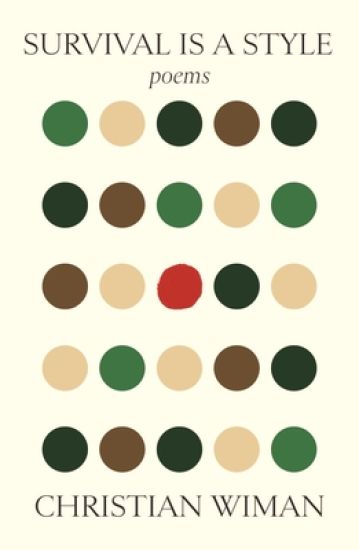
Named as a 2020 Book of the Year by The Times Literary Supplement Survival Is a Style, Christian Wiman's first collection of new poems in six years, may be his best book yet. His many readers will recognize the musical and formal variety, the voice that can be tender and funny, credibly mystical and savagely skeptical. But there are many new notes in this collection as well, including a moving elegy to the poet's father, sharp observations and distillations of modern American life, and rangy poems that merge and juxtapose different modes of speech and thought. The cumulative effect is extraordinary. Reading Survival Is a Style, one has the sense one is encountering work that will become a permanent part of American literature.
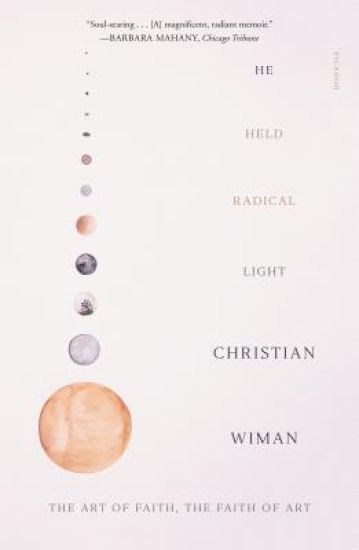
A moving meditation on memory, oblivion, and eternity by one of our most celebrated poets What is it we want when we can't stop wanting? And how do we make that hunger productive and vital rather than corrosive and destructive? These are the questions that animate Christian Wiman as he explores the relationships between art and faith, death and fame, heaven and oblivion. Above all, He Held Radical Light is a love letter to poetry, filled with moving, surprising, and sometimes funny encounters with the poets Wiman has known. Seamus Heaney opens a suddenly intimate conversation about faith; Mary Oliver puts half of a dead pigeon in her pocket; A. R. Ammons stands up in front of an audience and refuses to read. He Held Radical Light is as urgent and intense as it is lively and entertaining--a sharp sequel to Wiman's earlier memoir, My Bright Abyss.
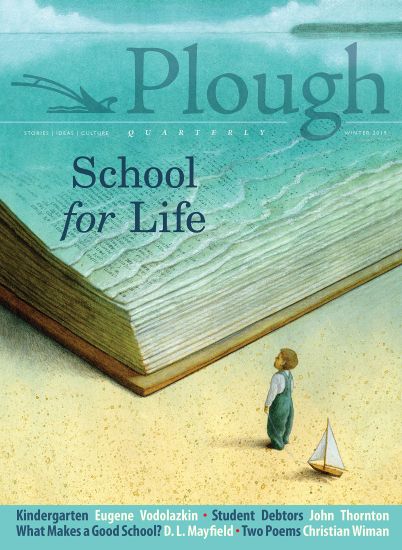
Eugene Vodolazkin; Karen Swallow Prior; Christian Wiman; John Thornton; D. L. Mayfield; Andrew Balio; Julian Peters; Denise Uwimana; Alfred Delp; Martin Luther; Michael St. Thomas; Sally Thomas
What we want for schools reveals what we value as a society. “What’s the point of school?” Parents have a stock set of responses, but the question remains unsettled, even two centuries after the Prussians invented compulsory education. The Prussian idea of what a school is for – to mold the populace to serve the state – seems unacceptable today. In vogue, instead, are slogans like “acquiring marketable skills” and “realizing your full potential.” These ideas powerfully shape our culture. Ultimately, they boil down to pursuing one supreme value: individual success in a competitive world. Schools are a mirror of our society as a whole; what we want for schools makes plain what and whom we value in our common life. In the Christian tradition, the life of discipleship is also a school. In this educational community, under the instruction of our one Teacher, we learn not to seek empowerment, but to find strength in weakness; not to out-achieve others, but to serve them; not to pursue our passion, but to obey a call. Also in this issue: poetry by Christian Wiman; reviews of new books by Robert Macfarlane, Jackie Morris, Francisco Cantú, Leif Enger, Carol Anderson, Stephanie Land, and Susan Wise Bauer; and art by Margaret McWethy, Albrecht Dürer, Raphael, Gérard David, Jackie Morris, Gustaf Tenggren, Sergey Dushkin, Anja Percival, Dmitry Samofalov, Christoph Wetzel, Sherrie York, Cathleen Rehfield, Pawel Kuczynski, and Jason Landsel. Plough Quarterly features stories, ideas, and culture for people eager to put their faith into action. Each issue brings you in-depth articles, interviews, poetry, book reviews, and art to help you put Jesus’ message into practice and find common cause with others.
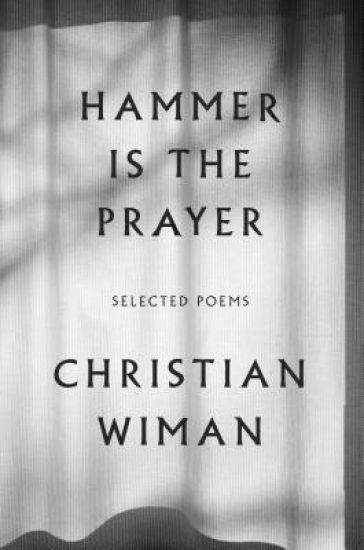
A visionary selection from one of America's foremost poets One of the most distinctive voices in contemporary American poetry, Christian Wiman has forged a singular style that fuses a vivid and propulsive music with clear-eyed realism, wry humor, and visionary lament. In his "daring and urgent" (The New York Times Book Review) memoir, My Bright Abyss, he asks, "What is poetry's role when the world is burning?" Hammer Is the Prayer: Selected Poems might be read as an answer to that question. From the taut forms of his first book to the darker, more jagged fluencies of his second, into the bold and pathbreaking poems of his last two collections, Hammer Is the Prayer bears the reckless, restless interrogations and the slashing lyric intensity that distinguish Wiman's verse. But it also reveals the dramatic and narrative abilities for which he has been widely praised--the junkyard man in "Five Houses Down" with his "wonder-cluttered porch" and "the eyesore opulence / of his five partial cars," or the tragicomic character in "Being Serious" who suffers "the world's idiocy / like a saint its pains." Hammer Is the Prayer brings together three decades of Wiman's acclaimed poetry. Selected by the author, these poems reveal the singular music and metaphysical urgency that have attracted so many readers to his work and firmly assert his place as one of the most essential poets of our time.
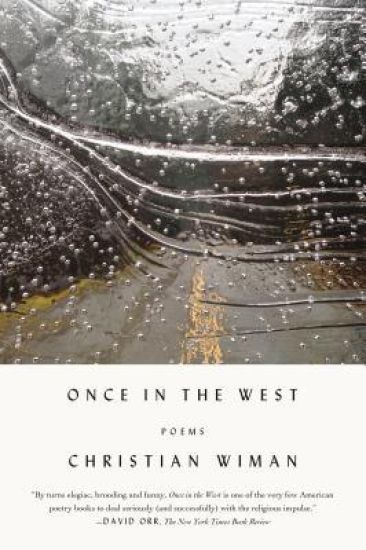
One of The New York Times' 10 Favorite Poetry Books of 2014 National Book Critics Circle Award Finalist Winner of the 2015 Philosophical Society of Texas Award of Merit in Poetry A searing new collection from one of our country's most important poets Memories mercies mostly aren't but there were I swear days veined with grace --from "Memory's Mercies" Once in the West, Christian Wiman's fourth collection, is as intense and intimate as poetry gets--from the "suffering of primal silence" that it plumbs to the "rockshriek of joy" that it achieves and enables. Readers of Wiman's earlier books will recognize the sharp characterizations and humor--"From her I learned the earthworm's exemplary open-mindedness, / its engine of discriminate shit"--as well as his particular brand of reverent rage: "Lord if I implore you please just please leave me alone / is that a prayer that's every instant answered?" But there is something new here, too: moving love poems to his wife, tender glimpses of his children, and, amid the onslaughts of illness and fear and failures, "a trace / of peace."
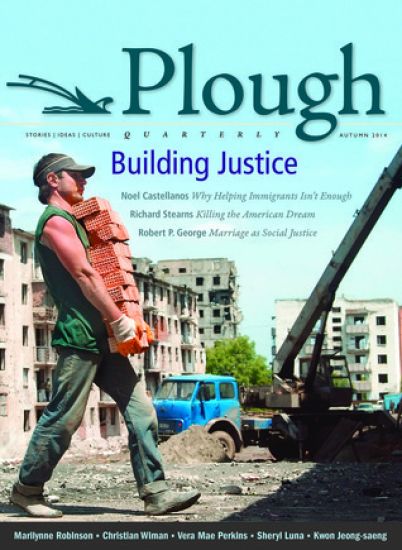
Christian Wiman; Johann Christoph Arnold; Fred Bahnson; Noel Castellanos; Robert P. George; Sheryl Luna; Jeong-saeng Kwon; Elizabeth Stoker Bruenig; Krish Kandiah; Eberhard Arnold; Richard Stearns; Charles Moore; Michael Lapsley; Maximilian Probst
“Justice” has become a rallying cry for many Christians today. And for good reason: justice is at the heart of the kingdom of God, as the Bible makes abundantly clear. Yet when our eyes are opened to the many injustices of today’s world, it’s easy to feel overwhelmed. Where is a person to start? And more fundamentally, what is the nature of the justice we ought to be pursuing? In this second issue, we explore how to build the justice that Jesus and the Hebrew prophets call for – not as a vague ideal, but as a way of life. Bold, hope-filled, and down-to-earth, Plough Quarterly features thought-provoking articles, commentary, interviews, short fiction, book reviews, poetry and artwork to inspire everyday faith and action. Each issue brings together essential voices from many traditions to give you fresh insights on a core theme such as peacemaking, biblical justice, children and family, building community, man and woman, nature and the environment, nonviolence, or simple living. Starting from the conviction that the teachings and example of Jesus can transform and renew our world, it aims to apply them to all aspects of life, seeking common ground with all people of goodwill regardless of creed.
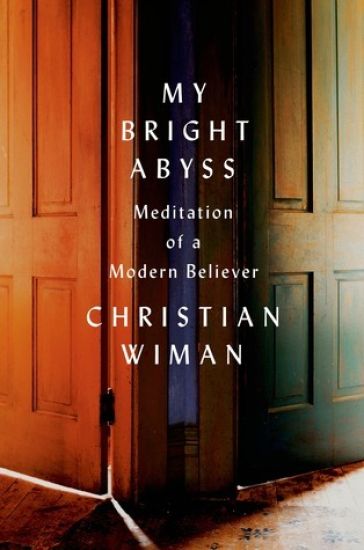
Eight years ago, Christian Wiman, a well-known poet and the editor of Poetry magazine, wrote a now-famous essay about having faith in the face of death. My Bright Abyss, composed in the difficult years since and completed in the wake of a bone marrow transplant, is a moving meditation on what a viable contemporary faith--responsive not only to modern thought and science but also to religious tradition--might look like. Joyful, sorrowful, and beautifully written, My Bright Abyss is destined to become a spiritual classic, useful not only to believers but to anyone whose experience of life and art seems at times to overbrim its boundaries. How do we answer this "burn of being"? Wiman asks. What might it mean for our lives--and for our deaths--if we acknowledge the "insistent, persistent ghost" that some of us call God? One of Publishers Weekly's Best Religion Books of 2013
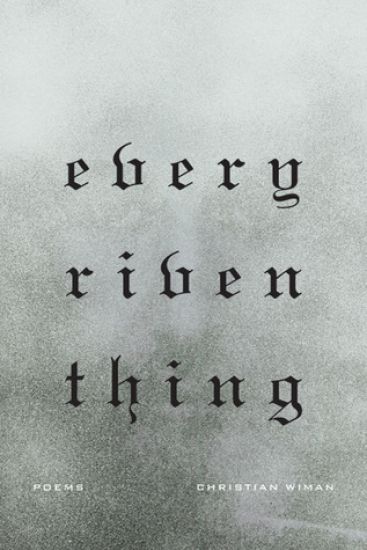
A vibrant new collection from one of America's most talented young poets Every Riven Thing is Christian Wiman's first collection in seven years, and rarely has a book of poetry so borne the stamp of necessity. Whether in stark, haiku-like descriptions of a cancer ward, surrealistic depictions of a social order coming apart, or fluent, defiant outpourings of praise, Wiman pushes his language and forms until they break open, revealing startling new truths within. The poems are joyful and sorrowful at the same time, abrasive and beautiful, densely physical and credibly mystical. They attest to the human hunger to feel existence, even at its most harrowing, and the power of art to make our most intense experiences not only apprehensible but transfiguring.
"Blazing high style" is how The New York Times describes the prose of Christian Wiman, the young editor who transformed Poetry, the country's oldest literary magazine.Ambition and Survival is a collection of stirring personal essays and critical prose on a wide range of subjects: reading Milton in Guatemala, recalling violent episodes of his youth, and traveling in Africa with his eccentric father, as well as a series of penetrating essays on writers as diverse as Thomas Hardy and Janet Lewis. The book concludes with a portrait of Wiman's diagnosis of a rare form of incurable and lethal cancer, and how mortality reignited his religious passions.When I was twenty years old I set out to be a poet. That sounds like I was a sort of frigate raising anchor, and in a way I guess I was, though susceptible to the lightest of winds. . . . When I read Samuel Johnson's comment that any young man could compensate for his poor education by reading five hours a day for five years, that's exactly what I tried to do, practically setting a timer every afternoon to let me know when the little egg of my brain was boiled. It's a small miracle that I didn't take to wearing a cape.Praise for Ambition and SurvivalThat calling, at once religious, ethical, and aesthetic, is one that only a genuine poet can hear--and very few poets can explain it as compellingly as Mr. Wiman does. That gift is what makes Ambition and Survival, not just one of the best books of poetry criticism in a generation, but a spiritual memoir of the first order.--New York SunThis weighty first prose collection should inspire wide attention, partly because of Wiman's current job, partly because of his astute insights and partly because he mixes poetry criticism with sometimes shocking memoir...The collection's greatest strength comes in general ruminations on the writing, reading and judging poetry. --Publishers Weekly Wiman is] a terrific personal essayist, as this new collection illustrates, with the command and instincts of the popular memoirist ... This is a brave and bracing book. --BooklistChristian Wiman's poems often spoke of a void, and then they stopped. In Ambition and Survival, Poetry magazine's editor rediscovers his spirituality and his voice.--Chicago Sun-TimesChristian Wiman is the editor of Poetry magazine. His poems and essays appear regularly in The New Yorker, The Atlantic Monthly, Harper's, and The New York Times Book Review. He is the author of several books of poetry, including The Long Home (isbn 9781556592690) and Hard Night (isbn 9781556592201).
Make no mistake: Christian Wiman's poetic endeavors are ambitious. From the personal lyrics of solitude and loss to "Being Serious," the long poem that concludes Hard Night, his poems examine emotions clearly, without sentimentality. A profound reverence for form and passion for poetry are evident in these artfully shaped poems that contain and find meaning in the unwieldy and inexplicable. Just as he is doing as the new editor of Poetry, Wiman makes intellectually and emotionally engaged writing accessible to an expanding audience of readers.Christian Wiman is the author of two books and a widely published essayist and critic. He lives in Chicago, where he is editor of Poetry magazine.