Kirjojen hintavertailu. Mukana 12 390 323 kirjaa ja 12 kauppaa.

Kirjailija

Christina Petterson

Kirjat ja teokset yhdessä paikassa: 11 kirjaa, julkaisuja vuosilta 2014-2025, suosituimpien joukossa Apostles of Revolution? Marxism and Biblical Studies. Vertaile teosten hintoja ja tarkista saatavuus suomalaisista kirjakaupoista.

11 kirjaa

Kirjojen julkaisuhaarukka 2014-2025.

Early Capitalism in Colonial Missions

Early Capitalism in Colonial Missions

Christina Petterson

BLOOMSBURY PUBLISHING PLC
2025
nidottu
Drawing on unpublished archival material, this volume compares Moravian economic practice in three different mission-settings, to demonstrate how Moravian practices evolved during the 18th century as part of a globalizing world and economy. Delivering in-depth analysis of the far-reaching and deep seated effects of missionary activity on indigenous communities and social relations, it explores how different economic contexts had an impact on the missionaries’ relations with Indigenous and slave-populations in empire.Petterson provides an insight how the missionaries worked, lived among various non-European peoples, and how they organised themselves and their surroundings at a time of changing identities and socio economic change. Analysing how missionary practice developed over this period, it also demonstrates how the Moravian leadership’s priorities and how this affected attitudes to non-European peoples on the ground. Standing outside of national and imperial boundaries, and ambivalent about the political notion of imperialism as well as colonisation itself, Moravian missionaries nonetheless functioned in parallel with colonial structures, and were part of a broadly culturally colonial mission. So, even on the outskirts of imperial organisation, they were often a crucial part of colonial practice and took part in normalising capitalist relations in many—but not all—settings, as this book demonstrates.
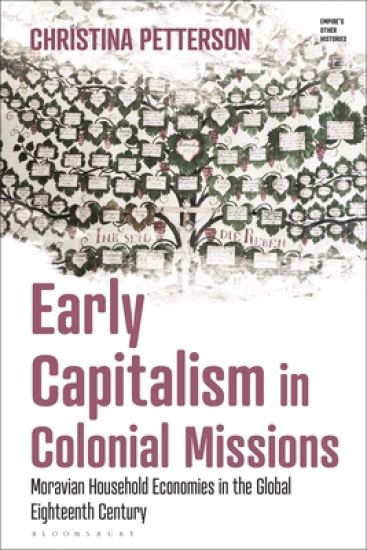
Early Capitalism in Colonial Missions

Early Capitalism in Colonial Missions

Christina Petterson

BLOOMSBURY PUBLISHING PLC
2024
sidottu
Drawing on unpublished archival material, this volume compares Moravian economic practice in three different mission-settings, to demonstrate how Moravian practices evolved during the 18th century as part of a globalizing world and economy. Delivering in-depth analysis of the far-reaching and deep seated effects of missionary activity on indigenous communities and social relations, it explores how different economic contexts had an impact on the missionaries’ relations with Indigenous and slave-populations in empire.Petterson provides an insight how the missionaries worked, lived among various non-European peoples, and how they organised themselves and their surroundings at a time of changing identities and socio economic change. Analysing how missionary practice developed over this period, it also demonstrates how the Moravian leadership’s priorities and how this affected attitudes to non-European peoples on the ground. Standing outside of national and imperial boundaries, and ambivalent about the political notion of imperialism as well as colonisation itself, Moravian missionaries nonetheless functioned in parallel with colonial structures, and were part of a broadly culturally colonial mission. So, even on the outskirts of imperial organisation, they were often a crucial part of colonial practice and took part in normalising capitalist relations in many—but not all—settings, as this book demonstrates.
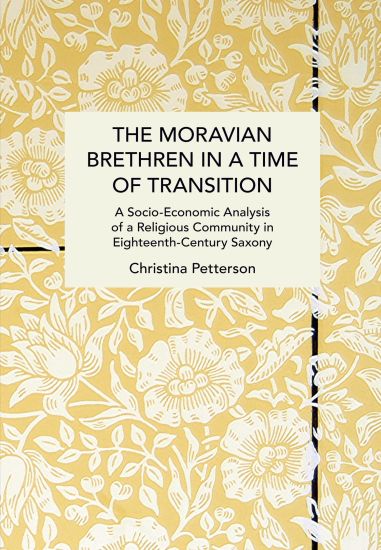
The Moravian Brethren in a Time of Transition

The Moravian Brethren in a Time of Transition

Christina Petterson

Haymarket Books
2022
pokkari
Based on hundreds of archival documents, Christina Petterson offers an in-depth analysis of the community building process and individual and collective subjectification practices of the Moravian Brethren in eighteenth-century Herrnhut, Eastern Germany, between 1740 and 1760. The Moravian Brethren are a Protestant group, but Petterson demonstrates the relevance of their social experiments and practices for early modernity by drawing out the socio-economic layers of the archival material. In doing so, she provides a non-religious reading of categories that became central to liberal ideology, corresponding to the Moravian negotiation of the transition from feudal society to early capitalism.
Apostles of Revolution? Marxism and Biblical Studies
In Apostles of Revolution? Marxism and Biblical Studies Christina Petterson sheds light on the collaboration between Biblical studies and liberal ideology. Marxist analysis of the bible is spreading, but clarity about what constitutes Marxist readings and Marxist categories of analysis is lacking – a lack of clarity compounded by the different strands within Marxist politics, and its subtle resonances in biblical scholarship. The author examines the interplay between Biblical studies and liberal ideology in two ways. First, by presenting and discussing some of the central Marxist categories of analysis, namely history, ideology and class, and how these categories have been co-opted into biblical studies and in the process lost their radical edge. Second, by discussing the emergence of the discipline of biblical studies during the Enlightenment, and to what extent the containment strategies of biblical studies overlap with those of capitalism.
Acts of Empire, Second Edition

Acts of Empire, Second Edition

Christina Petterson

Cascade Books
2020
sidottu
This book combines New Testament studies and cultural theory, and analyzes Acts of the Apostles as a product of imperial discourse. In five chapters, Christina Petterson engages Acts with ideology, gender, class, and empire with different emphases. All of these analyses argue that Christianity can never be set outside discourses of exploitation, discrimination, and hierarchies, but must always be set within them.
From Tomb to Text

From Tomb to Text

Christina Petterson

T. T.Clark Ltd
2018
nidottu
The idea of writing plays a central role in John. Apart from the many references to scriptural texts, John emphasizes the role of writing in the inscription on the cross and in its own production. Petterson’s From Tomb to Text examines what this means for the understanding of the Johannine Jesus in two interrelated ways. First Petterson takes these claims to revelation through writing seriously, noting the immense effort expended by biblical scholars in order to dismiss them and to produce a canonically palatable John. With few exceptions, Johannine studies have consistently attempted to domesticate or tame John’s book through reference to, and in harmony with, an externalized historical reality or with a synoptic pattern. Second, the study suggests alternative ways of understanding John once this synoptic compulsion has been dissolved. Petterson argues that John’s Jesus is unacceptable to the project for the recovery of ‘Early Christianity’ as imagined in Johannine research over the last 70 years or so. Instead, she shows how John produces itself as the vehicle of Jesus’ revelation in place of a body. This takes place through its use of writing, its characteristic use of verbs and syntax, and its mode of revelation. The book thus situates John in a context that does not begin with, and thus attempts to be, unconstrained by fixed categories of Christ, gnosticism, Eucharist, body and flesh, and shows how such readings curtail the fullness of the text in favour of a more familiar earthly Jesus. Petterson concludes by outlining ways in which John can be read if these containment strategies are disregarded.
The Missionary, The Catechist And The Hunter: Foucault, Protestantism And Colonialism
The Missionary, the Catechist and the Hunter examines the role of Protestantism in the Danish colonisation of Greenland and shows how the process of colonisation entails a process of subjectification where the identity of indigenous population is transformed. The figure of the hunter, commonly regarded as quintessential Inuit figure, is traced back to the efforts of the Greenlandic intelligentsia to distance themselves from the hunting lifestyle by producing an abstract hunter identity in Greenlandic literature.
Time of Troubles

Time of Troubles

Roland Boer; Christina Petterson

Fortress Press,U.S.
2017
pokkari
Economic realities have been increasingly at the center of discussion of the New Testament and early church. Studies have tended to be either apologetic in tone, or haphazard with regard to economic theory, or both--either imagining the ancients as involved in "primitive" economic relationships, or else projecting the modern capitalist preoccupation with markets and the enterprising individual back onto first-century realities. Boer and Petterson blaze a new trail, relying on the expansive work on the Roman economy of G. E. M. de Ste. Croi and on the theoretical framework of the Regulation school. Theoretically flexible and responsive to historical data, Regulation theory gives appropriate regard to the centrality of agriculture in the ancient world and finds economic instability to be the norm, except for brief episodes of imposed stability. Boer and Petterson find the Roman world in crisis as slavery expands, transforming the agricultural economy so that slave estates could supply the needs of the polis. Successive chapters describe aspects of the economic crisis in the first century and turn at last to understand the ideological role played by nascent Christianity.
From Tomb to Text

From Tomb to Text

Christina Petterson

T. T.Clark Ltd
2016
sidottu
The idea of writing plays a central role in John. Apart from the many references to scriptural texts, John emphasizes the role of writing in the inscription on the cross and in its own production. Petterson’s From Tomb to Text examines what this means for the understanding of the Johannine Jesus in two interrelated ways. First Petterson takes these claims to revelation through writing seriously, noting the immense effort expended by biblical scholars in order to dismiss them and to produce a canonically palatable John. With few exceptions, Johannine studies have consistently attempted to domesticate or tame John’s book through reference to, and in harmony with, an externalized historical reality or with a synoptic pattern. Second, the study suggests alternative ways of understanding John once this synoptic compulsion has been dissolved. Petterson argues that John’s Jesus is unacceptable to the project for the recovery of ‘Early Christianity’ as imagined in Johannine research over the last 70 years or so. Instead, she shows how John produces itself as the vehicle of Jesus’ revelation in place of a body. This takes place through its use of writing, its characteristic use of verbs and syntax, and its mode of revelation. The book thus situates John in a context that does not begin with, and thus attempts to be, unconstrained by fixed categories of Christ, gnosticism, Eucharist, body and flesh, and shows how such readings curtail the fullness of the text in favour of a more familiar earthly Jesus. Petterson concludes by outlining ways in which John can be read if these containment strategies are disregarded.
Idols of Nations

Idols of Nations

Roland Boer; Christina Petterson

Fortress Press,U.S.
2014
pokkari
Roland Boer and Christina Petterson here produce a critical survey showing that the rise of capitalist theory was shaped by the way different economic philosophers - Smith, Hobbes, Grotius, Malthus, Locke - - read the Bible. Invoking Jeremiah (14:22) and Adam Smith - who took the title of his Wealth of Nations from Isaiah (61:6, 66:12) - they show that early theories of capitalism were shaped by particular assumptions that these theorists brought to their readings of the story of Eden in particular. They examine those assumptions and evaluate what has changed in subsequent centuries. Idols of Nations shows that the Bible was central to the theorization and economic thought of these key thinkers as it explores the distinct problems each sought to overcome.