Kirjojen hintavertailu. Mukana 12 595 353 kirjaa ja 12 kauppaa.

Kirjailija

Christoffer Noring

Kirjat ja teokset yhdessä paikassa: 5 kirjaa, julkaisuja vuosilta 2018-2025, suosituimpien joukossa Learn Model Context Protocol with TypeScript. Vertaile teosten hintoja ja tarkista saatavuus suomalaisista kirjakaupoista.

5 kirjaa

Kirjojen julkaisuhaarukka 2018-2025.

Learn Model Context Protocol with TypeScript

Learn Model Context Protocol with TypeScript

Christoffer Noring; Dan Wahlin

PACKT PUBLISHING LIMITED
2025
nidottu
Get to grips with the Model Context Protocol (MCP) and learn how to build scalable, intelligent web applications with AI-ready architecture in TypeScript Free with your book: DRM-free PDF version + access to Packt's next-gen Reader* Key Features The only resource you'll need to build, test, and deploy MCP servers and clients Take a modern approach toward building, testing, and securing distributed agentic AI apps Get clear, professional guidance on developing for both LLM and non-LLM clients Purchase of the print or Kindle book includes a free PDF eBook Book DescriptionLearn Model Context Protocol with TypeScript introduces developers, architects, and AI practitioners to the transformative capabilities of Model Context Protocol (MCP), an emerging protocol designed to standardize, distribute, and scale AI-driven applications. Through the lens of a practical project, the book tackles the modern challenges of resource management, client-server interaction, and deployment at scale. Drawing from Christoffer's expertise as a published author and tutor at the University of Oxford, you’ll explore the components of MCP and how they streamline server and client development. After that, you’ll progress from building robust backends and integrating LLMs into intelligent clients to interacting with servers via tools such as Claude for desktop and Visual Studio Code agents. The chapters help you understand the capabilities of hosts, clients, and servers, facilitating better interoperability, easier integration, and clearer communication between different components. The book also covers security best practices and building for the cloud, ensuring that you're ready to deploy your MCP-based apps. Each chapter enables you to develop hands-on skills for building and operating MCP-based agentic apps. *Email sign-up and proof of purchase requiredWhat you will learn Understand the MCP protocol and its core components Build MCP servers that expose tools and resources to a variety of clients Test and debug servers using the interactive inspector tools Consume servers using Claude for desktop and Visual Studio Code agents Secure MCP apps, as well as managing and mitigating common threats Build and deploy MCP apps using cloud-based strategies Who this book is forThis book is ideal for web developers, software architects, AI practitioners, and tech leads looking to build scalable AI-integrated applications using MCP. Product managers overseeing AI initiatives will also find this book valuable. A basic understanding of web development and AI concepts is needed to make the most of this book.
Learn Model Context Protocol with Python

Learn Model Context Protocol with Python

Christoffer Noring; Dan Wahlin

PACKT PUBLISHING LIMITED
2025
nidottu
Get to grips with the Model Context Protocol (MCP) and learn how to build scalable, intelligent web applications with AI-ready architecture in Python Key Features The only resource you'll need to build, test, and deploy MCP servers and clients Take a modern approach toward building, testing, and securing distributed agentic AI apps Get clear, professional guidance on developing for both LLM and non-LLM clients Purchase of the print or Kindle book includes a free PDF eBook Book DescriptionLearn Model Context Protocol with Python introduces developers, architects, and AI practitioners to the transformative capabilities of Model Context Protocol (MCP), an emerging protocol designed to standardize, distribute, and scale AI-driven applications. Through the lens of a practical project, the book tackles the modern challenges of resource management, client-server interaction, and deployment at scale. Drawing from Christoffer's expertise as a published author and tutor at the University of Oxford, you’ll explore the components of MCP and how they streamline server and client development. Next, you’ll progress from building robust backends and integrating LLMs into intelligent clients to interacting with servers via tools such as Claude for desktop and Visual Studio Code agents. The chapters help you understand how to describe the capabilities of hosts, clients, and servers, facilitating better interoperability, easier integration, and clearer communication between different components. The book also covers security best practices and building for the cloud, ensuring that you're ready to deploy your MCP-based apps. Each chapter enables you to develop hands-on skills for building and operating MCP-based agentic apps. The Python primer at the end rounds out the practical toolkit, making this book essential for any team building AI-native applications today.What you will learn Understand the MCP protocol and its core components Build MCP servers that expose tools and resources to a variety of clients Test and debug servers using the interactive inspector tools Consume servers using Claude Desktop and Visual Studio Code Agents Secure MCP apps, as well as managing and mitigating common threats Build and deploy MCP apps using cloud-based strategies Who this book is forThis book is ideal for web developers, software architects, AI practitioners, and tech leads looking to build scalable AI-integrated applications using MCP. Product managers overseeing AI initiatives will also find this book valuable. A basic understanding of web development and AI concepts is needed to make the most of this book.
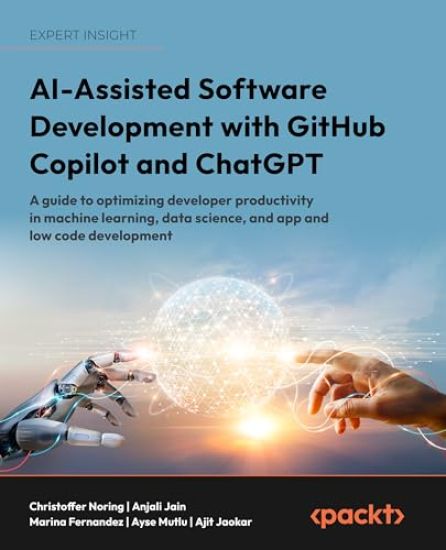
AI-Assisted Programming for Web and Machine Learning

AI-Assisted Programming for Web and Machine Learning

Christoffer Noring; Anjali Jain; Marina Fernandez; Ayse Mutlu; Ajit Jaokar

PACKT PUBLISHING LIMITED
2024
nidottu
Speed up your development processes and improve your productivity by writing practical and relevant prompts to build web applications and Machine Learning (ML) models Purchase of the print or Kindle book includes a free PDF copy Key Features Utilize prompts to enhance frontend and backend web development Develop prompt strategies to build robust machine learning models Use GitHub Copilot for data exploration, maintaining existing code bases, and augmenting ML models into web applications Book DescriptionAI-Assisted Programming for Web and Machine Learning shows you how to build applications and machine learning models and automate repetitive tasks. Part 1 focuses on coding, from building a user interface to the backend. You’ll use prompts to create the appearance of an app using HTML, styling with CSS, adding behavior with JavaScript, and working with multiple viewports. Next, you’ll build a web API with Python and Flask and refactor the code to improve code readability. Part 1 ends with using GitHub Copilot to improve the maintainability and performance of existing code. Part 2 provides a prompting toolkit for data science from data checking (inspecting data and creating distribution graphs and correlation matrices) to building and optimizing a neural network. You’ll use different prompt strategies for data preprocessing, feature engineering, model selection, training, hyperparameter optimization, and model evaluation for various machine learning models and use cases. The book closes with chapters on advanced techniques on GitHub Copilot and software agents. There are tips on code generation, debugging, and troubleshooting code. You’ll see how simpler and AI-powered agents work and discover tool calling.What you will learn Speed up your coding and machine learning workflows with GitHub Copilot and ChatGPT Use an AI-assisted approach across the development lifecycle Implement prompt engineering techniques in the data science lifecycle Develop the frontend and backend of a web application with AI assistance Build machine learning models with GitHub Copilot and ChatGPT Refactor code and fix faults for better efficiency and readability Improve your codebase with rich documentation and enhanced workflows Who this book is forExperienced developers new to GitHub Copilot and ChatGPT can discover the best strategies to improve productivity and deliver projects quicker than traditional methods. This book is ideal for software engineers working on web or machine learning projects. It is also a useful resource for web developers, data scientists, and analysts who want to improve their efficiency with the help of prompting. This book does not teach web development or how different machine learning models work.
Building  Large-Scale Web Applications with Angular

Building Large-Scale Web Applications with Angular

Chandermani Arora; Kevin Hennessy; Christoffer Noring; Doguhan Uluca

Packt Publishing Limited
2018
nidottu
A definitive guide on frontend development with Angular from design to deploymentKey FeaturesDevelop web applications from scratch using Angular and TypeScriptExplore reactive programming principles and RxJS to develop and test apps easilyStudy continuous integration and deployment on the AWS cloudBook DescriptionIf you have been burnt by unreliable JavaScript frameworks before, you will be amazed by the maturity of the Angular platform. Angular enables you to build fast, efficient, and real-world web apps. In this Learning Path, you'll learn Angular and to deliver high-quality and production-grade Angular apps from design to deployment. You will begin by creating a simple fitness app, using the building blocks of Angular, and make your final app, Personal Trainer, by morphing the workout app into a full-fledged personal workout builder and runner with an advanced directive building - the most fundamental and powerful feature of Angular. You will learn the different ways of architecting Angular applications using RxJS, and some of the patterns that are involved in it. Later you’ll be introduced to the router-first architecture, a seven-step approach to designing and developing mid-to-large line-of-business apps, along with popular recipes. By the end of this book, you will be familiar with the scope of web development using Angular, Swagger, and Docker, learning patterns and practices to be successful as an individual developer on the web or as a team in the Enterprise. This Learning Path includes content from the following Packt products: Angular 6 by Example by Chandermani Arora, Kevin HennessyArchitecting Angular Applications with Redux, RxJS, and NgRx by Christoffer NoringAngular 6 for Enterprise-Ready Web Applications by Doguhan UlucaWhat you will learnDevelop web applications from scratch using Angular and TypeScriptExplore reactive programming principles, RxJS to develop and test apps efficientlyStudy continuous integration and deployment your Angular app on the AWS cloudWho this book is forIf you're a JavaScript or frontend developer looking to gain comprehensive experience of using Angular for end-to-end enterprise-ready applications, this Learning Path is for you.
Architecting Angular Applications with Redux, RxJS, and NgRx

Architecting Angular Applications with Redux, RxJS, and NgRx

Christoffer Noring

Packt Publishing Limited
2018
nidottu
Manage state in Angular to write high performing web apps by combining the power of Flux, RxJS, and NgRx About This Book • Learn what makes an excellent Angular application architecture • Use Redux to write performant, consistent Angular applications • Incorporate Reactive Programming principles and RxJS to make it easier to develop, test, and debug your Angular applications Who This Book Is For If you have been developing Angular applications and want to dive deeper into the Angular architecture with Redux, RxJS, and NgRx to write robust web apps, then this book is for you. What You Will Learn • Understand the one-way data flow and Flux pattern • Work with functional programming and asynchronous data streams • Figure out how RxJS can help us address the flaws in promises • Set up different versions of cascading calls • Explore advanced operators • Get familiar with the Redux pattern and its principles • Test and debug different features of your application • Build your own lightweight app using Flux, Redux, and NgRx In Detail Managing the state of large-scale web applications is a highly challenging task with the need to align different components, backends, and web workers harmoniously. When it comes to Angular, you can use NgRx, which combines the simplicity of Redux with the reactive programming power of RxJS to build your application architecture, making your code elegant and easy to reason about, debug, and test. In this book, we start by looking at the different ways of architecting Angular applications and some of the patterns that are involved in it. This will be followed by a discussion on one-way data flow, the Flux pattern, and the origin of Redux. The book introduces you to declarative programming or, more precisely, functional programming and talks about its advantages. We then move on to the reactive programming paradigm. Reactive programming is a concept heavily used in Angular and is at the core of NgRx. Later, we look at RxJS, as a library and master it. We thoroughly describe how Redux works and how to implement it from scratch. The two last chapters of the book cover everything NgRx has to offer in terms of core functionality and supporting libraries, including how to build a micro implementation of NgRx. This book will empower you to not only use Redux and NgRx to the fullest, but also feel confident in building your own version, should you need it. Style and approach This book covers everything there is to know to get well-acquainted with Angular without bogging you down. Everything is neatly laid out under clear headings for quick consultation, giving you the information required to understand a concept immediately.