

Kirjailija
Christoph Safferling
Kirjat ja teokset yhdessä paikassa: 13 kirjaa, julkaisuja vuosilta 2001-2025, suosituimpien joukossa 30 Probleme aus dem Strafprozessrecht. Vertaile teosten hintoja ja tarkista saatavuus suomalaisista kirjakaupoista.
13 kirjaa
Kirjojen julkaisuhaarukka 2001-2025.
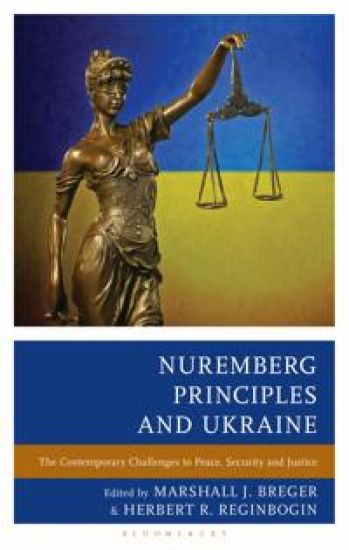
Nuremberg Principles and Ukraine
Christoph Safferling; Eli Rosenbaum
BLOOMSBURY PUBLISHING PLC
2025
sidottu
In this book, contributors go in-depth to analyze the ‘crime of aggression', 'crimes against humanity’ and their applicability in the context of the invasion of Ukraine. The ongoing Russian invasion of Ukraine brings the principles of Nuremberg to the forefront of discussions on justice, raising questions about the feasibility of Nuremberg-style accountability. The book touches upon the abduction of Ukrainian children and the destruction of Ukrainian cultural heritage. Contributors also discuss the topic of war crime tribunals after Nuremberg, including Timor and former Yugoslavia, as well as tribunals in Rwanda, Sierra Leone, and others leading up to the International Criminal Court (ICC). Including essays by Oleksandra Matviichuk, the Ukrainian Nobel Laureate, and Ambassador Dr. Anton Korynevych, Ukrainian minister and specialist in international law, this book considers the contemporary relevance of the Nuremberg principles in the context of the Russian invasion of Ukraine.


Victims Before the International Criminal Court
Christoph Safferling; Gurgen Petrossian
Springer Nature Switzerland AG
2022
nidottu
The book analyses the difficulties the International Criminal Court faces with the definition of those persons who are eligible for participating in the proceedings. Establishing justice for victims is one of the most important aims of the court. It therefore created a unique system of victim participation. Since its first trial the court struggles to live up to the expectancies its statute has generated. The book offers a new approach of how to define victimhood by looking at the different international crimes. It seeks to offer guidance for the right to participate in the different stages of the proceedings by looking at the practice in national jurisdictions. Lastly the book offers insights into the functioning of the reparation regime at the ICC by virtue of the Trust Fund for Victim and its different mandates. The critical analysis of the ICC-practice with regard to definition, participation and reparation aims at promoting a realistic approach, which will avoid the disappointing of expectations and thus help to enhance the acceptance of the ICC.

Staatsschutz im Kalten Krieg
Friedrich Kießling; Christoph Safferling
dtv Verlagsgesellschaft
2021
sidottu
Victims Before the International Criminal Court
Christoph Safferling; Gurgen Petrossian
Springer Nature Switzerland AG
2021
sidottu
The book analyses the difficulties the International Criminal Court faces with the definition of those persons who are eligible for participating in the proceedings. Establishing justice for victims is one of the most important aims of the court. It therefore created a unique system of victim participation. Since its first trial the court struggles to live up to the expectancies its statute has generated. The book offers a new approach of how to define victimhood by looking at the different international crimes. It seeks to offer guidance for the right to participate in the different stages of the proceedings by looking at the practice in national jurisdictions. Lastly the book offers insights into the functioning of the reparation regime at the ICC by virtue of the Trust Fund for Victim and its different mandates. The critical analysis of the ICC-practice with regard to definition, participation and reparation aims at promoting a realistic approach, which will avoid the disappointing of expectations and thus help to enhance the acceptance of the ICC.

30 Probleme aus dem Strafprozessrecht
Dieter Rössner; Christoph Safferling
Klausurprobleme
2020
nidottu
This book sets out and analyses the procedural law applied by international criminal tribunals and the International Criminal Court (ICC). It traces the development of international criminal procedure from its roots in the International Military Tribunal at Nuremberg to its current application by the Yugoslav and Rwanda Tribunals, the Special Court for Sierra Leone, the Extraordinary Chamber in the Courts of Cambodia, and the International Criminal Court. All of these tribunals apply a different set of rules. The focus of this book, however, lies on the ICC and its procedural regime as contained in the Rome Statute, the Rules of Procedure and Evidence, and the different Regulations of the Court and of the Prosecutor. The exceptional compromise between common and civil law which formed the basis of the ICC's Statute created a unique procedural order. This book systematically analyses the Court's organisational structure, overall procedural setting, and the individual procedural regulations, and compares and contrasts these to other international criminal tribunals. Amongst the many unresolved procedural issues are the rights of the accused before, during, and after the trial, the disclosure of evidence, the presentation of evidence, the participation of victims, the protection of witnesses, and the cooperation between the ICC and individual states. Through looking at these issues, the book develops a concise and fitting theoretical underpinning for the ICC's procedural order that is not founded on any specific legal culture.
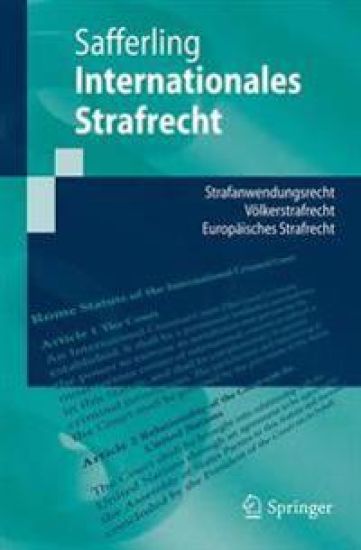
Internationales Strafrecht
Christoph Safferling
Springer-Verlag Berlin and Heidelberg GmbH Co. K
2011
nidottu
Das vorliegende Buch bietet eine systematische Einführung in das Strafanwendungsrecht, das Europäische Strafrecht nach dem Lissabon-Vertrag und das Völkerstrafrecht auf der Grundlage des Internationalen Strafgerichtshofs; zahlreiche Übersichten und Prüfungsschemata veranschaulichen den Stoff. Ein besonderes Augenmerk liegt auf der Darstellung der historischen und kriminalpolitischen Rahmenbedingungen sowie auf der methodischen Herleitung.

Vorsatz und Schuld sind elementare Begriffe des Strafrechts, die von einem erheblichen gesellschaftlichen Vorverständnis geprägt sind. Als wesentlicher Teil der jeweiligen Rechtskultur unterscheiden sich sowohl das soziale Vorverständnis wie die professionelle Verwendung der Begriffe Vorsatz und Schuld in den verschiedenen Rechtssystemen erheblich. Christoph Safferling greift das deutsche und englische Strafrechtssystem heraus und untersucht diese hinsichtlich der subjektiven Täterelemente. Strafrechtstheorie und Philosophie im 19. und 20. Jahrhundert verursachten teilweise dramatische Umorientierungen im Verständnis von Vorsatz und Schuld, beispielsweise durch die Versubjektivierung des Unrechtsbegriffs, die durch die finale Handlungslehre ausgelöst wurde. Diese Entwicklungen wurden jedoch in der terminologischen Verwendung der Begriffe nicht konsequent umgesetzt, was sich besonders an großen Unsicherheiten in der Irrtumslehre zeigt. Die Begriffsverwendung im englischen Strafrecht wirkt dagegen undifferenziert und kaum auf Systematisierung ausgerichtet. Die starke Einzelfallbeziehung führt zu teilweise schwer handhabbaren Parametern und undurchsichtigen Differenzierungen in bezug auf die subjektiven Voraussetzungen der Straftat. Beim Vergleich hinsichtlich der Fragen Vorsatz und Schuld zeigt der Autor eine unterschiedliche Ausgeprägtheit der systematischen Durchdringung beider Strafrechtsordnungen und ein teilweise sehr unterschiedliches Verständnis von Strafbedürfnis.
Towards an International Criminal Procedure
Christoph Safferling
Oxford University Press
2003
nidottu
The aim of this book is to develop an international criminal procedural order. The Statute of the International Criminal Court (ICC) was agreed in 1998. This provides a rough outline of a procedure, but it still needs to be made workable for the prosecution of international criminals. Such a procedural order would need to reconcile Continental and Anglo--American approaches. The book therefore contains a comparison between German (i.e. one of the main leading Continental legal systems) criminal procedure and English and US criminal procedure, how they developed historically and philosophically, and where they stand today. It covers the criminal process from the first steps of the investigation up to the imprisonment of the convicted. In addition to this comparative perspective, this study also analyses international human rights law as the basis of an international procedural order. For this purpose the contents of the relevant human rights law is extracted from international agreements and international bodies such as the Human Right Committee or the European Court of Human Rights and applied to the procedure of the existing International Tribunal for the Former Yugoslavia and that of the ICC Statute. As a contribution to the fast-growing field of international criminal law, this book will be of use to all academics, practitioners, and government officials involved with the new International Criminal Court.
Towards an International Criminal Procedure
Christoph Safferling
Oxford University Press
2001
sidottu
The aim of this book is to develop an international criminal procedural order. It contains a comparison between German criminal procedure and English and US criminal procedure, examining how they developed historically and philosophically, and where they stand today.