Kirjojen hintavertailu. Mukana 12 559 212 kirjaa ja 12 kauppaa.

Kirjailija

Christopher B. Balme

Kirjat ja teokset yhdessä paikassa: 6 kirjaa, julkaisuja vuosilta 1995-2021, suosituimpien joukossa The Globalization of Theatre 1870–1930. Vertaile teosten hintoja ja tarkista saatavuus suomalaisista kirjakaupoista.

Mukana myös kirjoitusasut: Christopher B Balme

6 kirjaa

Kirjojen julkaisuhaarukka 1995-2021.

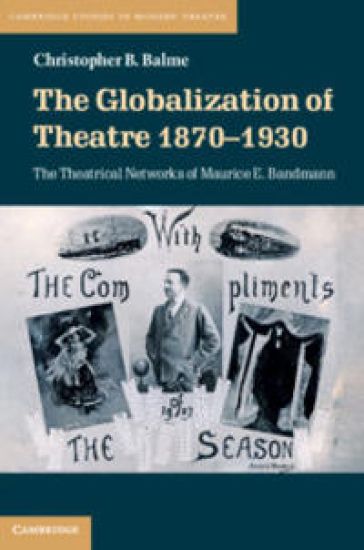
The Globalization of Theatre 1870–1930

The Globalization of Theatre 1870–1930

Christopher B. Balme

Cambridge University Press
2021
pokkari
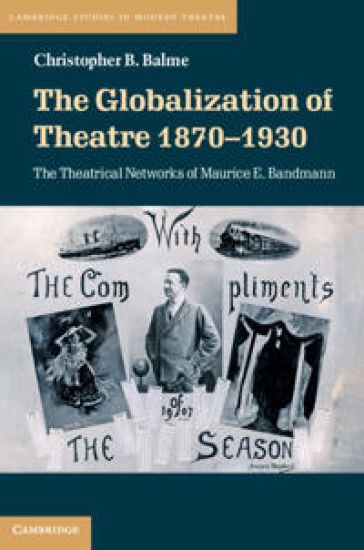
Between 1895 and 1922 the Anglo-American actor and manager, Maurice E. Bandmann (1872–1922) created a theatrical circuit that extended from Gibraltar to Tokyo and included regular tours to the West Indies and South America. With headquarters in Calcutta and Cairo and companies listed on the Indian stock exchange, his operations represent a significant shift towards the globalization of theatre. This study focuses on seven key areas: family networks; the business of theatrical touring; the politics of locality; repertoire and publics; an ethnography of itinerant acting; legal disputes and the provision of theatrical infrastructure. It draws on global and transnational history, network theory and analysis as well as in-depth archival research to provide a new approach to studying theatre in the age of empire.
The Globalization of Theatre 1870–1930

The Globalization of Theatre 1870–1930

Christopher B. Balme

Cambridge University Press
2019
sidottu
Between 1895 and 1922 the Anglo-American actor and manager, Maurice E. Bandmann (1872–1922) created a theatrical circuit that extended from Gibraltar to Tokyo and included regular tours to the West Indies and South America. With headquarters in Calcutta and Cairo and companies listed on the Indian stock exchange, his operations represent a significant shift towards the globalization of theatre. This study focuses on seven key areas: family networks; the business of theatrical touring; the politics of locality; repertoire and publics; an ethnography of itinerant acting; legal disputes and the provision of theatrical infrastructure. It draws on global and transnational history, network theory and analysis as well as in-depth archival research to provide a new approach to studying theatre in the age of empire.
The Theatrical Public Sphere

The Theatrical Public Sphere

Christopher B. Balme

Cambridge University Press
2014
sidottu
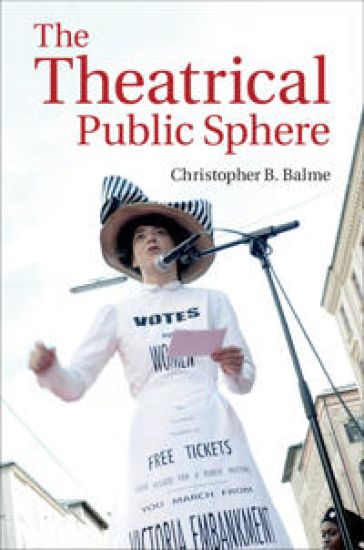
The concept of the public sphere, as first outlined by German philosopher Jürgen Habermas, refers to the right of all citizens to engage in debate on public issues on equal terms. In this book, Christopher B. Balme explores theatre's role in this crucial political and social function. He traces its origins and argues that the theatrical public sphere invariably focuses attention on theatre as an institution between the shifting borders of the private and public, reasoned debate and agonistic intervention. Chapters explore this concept in a variety of contexts, including the debates that led to the closure of British theatres in 1642, theatre's use of media, controversies surrounding race, religion and blasphemy, and theatre's place in a new age of globalised aesthetics. Balme concludes by addressing the relationship of theatre today with the public sphere and whether theatre's transformation into an art form has made it increasingly irrelevant for contemporary society.
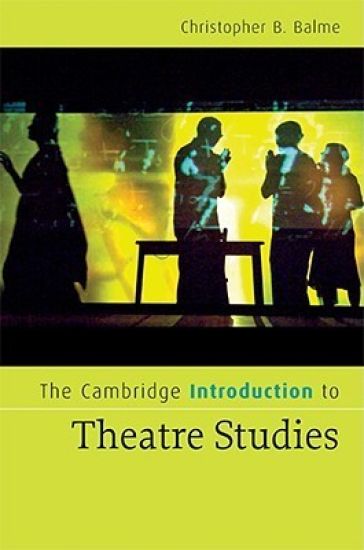
The Cambridge Introduction to Theatre Studies

The Cambridge Introduction to Theatre Studies

Christopher B. Balme

Cambridge University Press
2008
sidottu
Providing thorough coverage of the methods and tools required in studying historical and contemporary theatre, this Introduction examines the complexities of a rapidly changing and dynamic discipline. Following a cross-cultural perspective, the book surveys the ways theatre and performance are studied by looking initially at key elements such as performers, spectators and space. The central focus is on methodology, which is divided into sections covering theatre theory, historiography and textual and performance analysis. The book covers all the main theatrical genres - drama, opera and dance - providing students with a comparative, integrated perspective. Designed to guide students through the academic dimension of the discipline, the volume emphasizes questions of methodology, research techniques and approaches, and will therefore be relevant for a wide variety of theatre studies courses. Informative textboxes provide background on key topics, and suggestions for further reading are included at the end of each chapter.
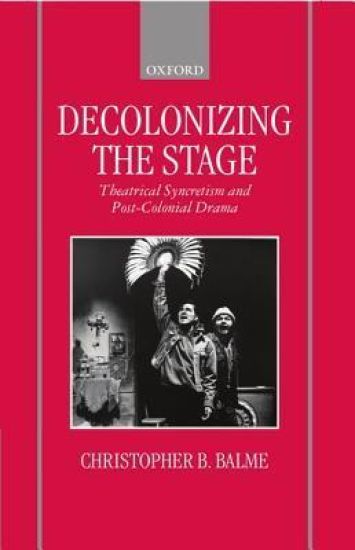
Decolonizing the Stage

Decolonizing the Stage

Christopher B. Balme

Clarendon Press
1999
sidottu
Decolonizing the Stage is a major study devoted to post-colonial drama and theatre. It examines the way dramatists and directors from various countries and societies have attempted to fuse the performance idioms of their indigenous traditions with the Western dramatic form. These experiments are termed 'syncretic theatre'. The study provides a theoretically sophisticated, cross-cultural comparative approach to a wide number of writers, regions, and theatre movements, ranging from Maori, Aboriginal, and native American theatre to Township theatre in South Africa. Writers studied include Nobel Prize-winning authors such as Wole Soyinka, Derek Walcott, and Rabindranath Tagore, along with others such as Ngugi wa Thiong'o, Jack Davis, Girish Karnad, and Tomson Highway. Decolonizing the Stage demonstrates how the dynamics of syncretic theatrical texts function in performance. It combines cultural semiotics with performance analysis to provide an important contribution to the growing field of post-colonial drama and intercultural performance.
Theater im postkolonialen Zeitalter

Theater im postkolonialen Zeitalter

Christopher B Balme

de Gruyter
1995
sidottu
This book studies the phenomenon of aesthetic mixing evident in much theatre in postcolonial countries, i.e. in the countries of the former British Empire. The central focus of this study is on the concept of theatrical syncretism. This is defined as a theatre form where the cultural and performative elements of an indigenous culture are mixed with European theatrical concepts. Examples of plays and theatre forms are taken from Nigeria, South Africa, the Caribbean, Australia, New Zealand and Canada.