Kirjojen hintavertailu. Mukana 12 595 353 kirjaa ja 12 kauppaa.

Kirjailija

Christopher Clark

Kirjat ja teokset yhdessä paikassa: 46 kirjaa, julkaisuja vuosilta 1992-2026, suosituimpien joukossa Frühling der Revolution. Vertaile teosten hintoja ja tarkista saatavuus suomalaisista kirjakaupoista.

46 kirjaa

Kirjojen julkaisuhaarukka 1992-2026.

Iron Kingdom: The Rise and Downfall of Prussia, 1600-1947
In the aftermath of World War II, Prussia--a centuries-old state pivotal to Europe's development--ceased to exist. In their eagerness to erase all traces of the Third Reich from the earth, the Allies believed that Prussia, the very embodiment of German militarism, had to be abolished. But as Christopher Clark reveals in this pioneering history, Prussia's legacy is far more complex. Though now a fading memory in Europe's heartland, the true story of Prussia offers a remarkable glimpse into the dynamic rise of modern Europe. What we find is a kingdom that existed nearly half a millennium ago as a patchwork of territorial fragments, with neither significant resources nor a coherent culture. With its capital in Berlin, Prussia grew from being a small, poor, disregarded medieval state into one of the most vigorous and powerful nations in Europe. Iron Kingdom traces Prussia's involvement in the continent's foundational religious and political conflagrations: from the devastations of the Thirty Years War through centuries of political machinations to the dissolution of the Holy Roman Empire, from the enlightenment of Frederick the Great to the destructive conquests of Napoleon, and from the "iron and blood" policies of Bismarck to the creation of the German Empire in 1871, and all that implied for the tumultuous twentieth century. By 1947, Prussia was deemed an intolerable threat to the safety of Europe; what is often forgotten, Clark argues, is that it had also been an exemplar of the European humanistic tradition, boasting a formidable government administration, an incorruptible civil service, and religious tolerance. Clark demonstrates how a state deemed the bane of twentieth-century Europe has played an incalculable role in Western civilization's fortunes. Iron Kingdom is a definitive, gripping account of Prussia's fascinating, influential, and critical role in modern times.
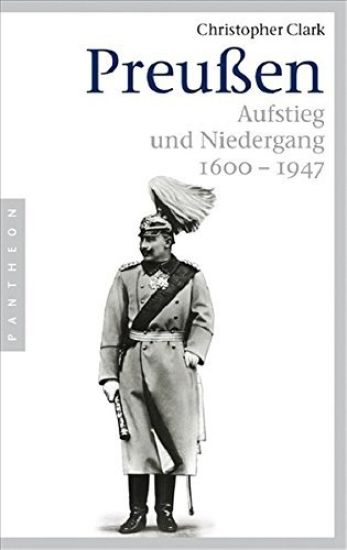
Preußen

Preußen

Christopher Clark

PANTHEON
2008
nidottu
Die Geschichte Preußens - ein brillant erzähltes Standardwerk Christopher Clark schildert den Aufstieg Preußens vom kleinen, an Bodenschätzen armen Territorium um Berlin zur dominierenden Macht auf dem europäischen Kontinent. Seine brillante Darstellung von über 300 Jahren preußischer Historie ist ein Meisterwerk der Geschichtsschreibung. Die Auflösung Preußens durch ein alliiertes Kontrollratsgesetz am 25. Februar 1947 setzte einen Schlusspunkt unter eine Jahrhunderte alte wechselvolle Geschichte. Der Name Preußen ist untrennbar verbunden mit Aufklärung und Toleranz, verkörpert etwa in Friedrich dem Großen, verbunden aber auch mit Militarismus, Maßlosigkeit und Selbstüberschätzung Wilhelms II. Das Nachdenken über Preußen stand in den letzten Jahrzehnten im Schatten der hitzigen Debatten über die deutsche Geschichte. Doch die Zeit ist reif für einen distanzierten, sensibel wägenden Blick auf dieses große Kapitel der deutschen und europäischen Vergangenheit. Christopher Clark schildert den Aufstieg Preußens vom kleinen, an Bodenschätzen armen Territorium um Berlin zur dominierenden Macht auf dem europäischen Festland und schließlich die Auflösung nach dem Zusammenbruch des Deutschen Reiches. Seine brillante Darstellung von über 300 Jahren preußischer Historie ist ein Meisterwerk angelsächsischer Geschichtsschreibung. * 60. Jahrestag: Auflösung Preußens am 25. Februar 1947 * Unabhängiger, britischer Blick auf die ambivalente preußisch-deutsche Geschichte "Die beste Darstellung der Geschichte Preußens, die es derzeit gibt ... Eine virtuose Leistung." Sunday Times "Sein Werk ist eine historiografische Meisterleistung - und noch dazu hervorragend geschrieben." die tageszeitung "Der britische Historiker Christopher Clark zeigt seinen deutschen Kollegen, was eine preußische Geschichte ist". Frankfurter Allgemeine Zeitung
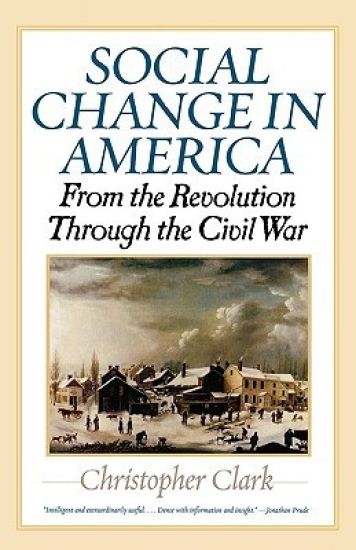
Social Change in America

Social Change in America

Christopher Clark

Ivan R Dee, Inc
2007
pokkari
The processes of social change in the late colonial period and early years of the new Republic made a dramatic imprint on the character of American society. These changes over a century or more were rooted in the origins of the United States, its rapid expansion of people and territory, its patterns of economic change and development, and the conflicts that led to its cataclysmic division and reunification through the Civil War. Christopher Clark's brilliant account of these changes in the social relationships of Americans breaks new ground in its emphasis on the connections between the crucial importance of free and unfree labor, regional characteristics, and the sustained tension between arguments for geographic expansion versus economic development. Mr. Clark traces the significance of families and households throughout the period, showing how work and different kinds of labor produced a varied access to power and wealth among free and unfree, male and female, and how the character of social elites was confronted by democratic pressures. He shows how the features of the different regions exercised long-term influences in American society and politics and were modified by pressures for change. And he explains how the widening gap between the claims of free labor and those of slavery fueled the continuing dispute over the best economic course for the nation's future and led ultimately to the Civil War. Like other long-running divisions in American society, however, this dispute was not fully resolved by the war's outcome. Social Change in America is a compelling new overview of the social dynamics of America's early years.
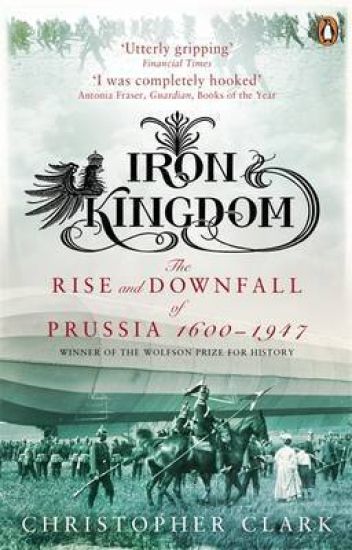
Iron Kingdom

Iron Kingdom

Christopher Clark

Penguin Books Ltd
2007
pokkari
Winner of the Wolfson History Prize, Christopher Clark's Iron Kingdom: The Rise and Downfall of Prussia 1600-1947 is a compelling account of a country that played a pivotal role in Europe's fortunes and fundamentally shaped our world. Prussia began as a medieval backwater, but transformed itself into a major European power and the force behind the creation of the German empire, until it was finally abolished by the Allies after the Second World War. With great flair and authority, Christopher Clark describes Prussia's great battles, dynastic marriages and astonishing reversals of fortune, its brilliant and charismatic leaders from the Hohenzollerns of Brandenburg to Bismarck and Frederick the Great, the military machine and the progressive, enlightened values on which it was built. 'Fascinating ... masterly ... littered with intriguing detail and wry observation' Richard Overy, Daily Telegraph 'A terrific book ... the definitive history of this much-maligned state' Daily Telegraph Books of the Year 'You couldn't have the triumph and the tragedy of Prussia better told' Observer 'A magisterial history of Europe's only extinct power' Financial Times 'Exemplary ... an illuminating, profoundly satisfying work of history' The New York Times Christopher Clark is a lecturer in Modern European History at St Catharine's College, University of Cambridge. He is also the author of Kaiser Wilhelm II: A Life in Power.
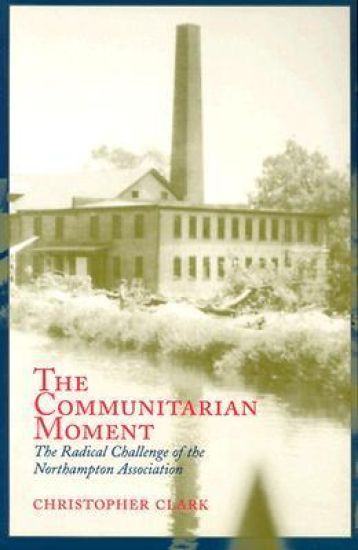
The Communitarian Moment

The Communitarian Moment

Christopher Clark

University of Massachusetts Press
2003
nidottu
Piecing together the often tantalizingly obscure history of the Northampton Association, Dr Clark's study provides an insight into a remarkable group of utopian reformers - women and men, black and white - in antebellum Massachusetts, and into the history of communitarianism.
The Roots of Rural Capitalism

The Roots of Rural Capitalism

Christopher Clark

Cornell University Press
1992
pokkari
Between the late colonial period and the Civil War, the countryside of the American northeast was largely transformed. Rural New England changed from a society of independent farmers relatively isolated from international markets into a capitalist economy closely linked to the national market, an economy in which much farming and manufacturing output was produced by wage labor. Using the Connecticut Valley as an example, The Roots of Rural Capitalism demonstrates how this important change came about. Christopher Clark joins the active debate on the "transition to capitalism" with a fresh interpretation that integrates the insights of previous studies with the results of his detailed research. Largely rejecting the assumption of recent scholars that economic change can be explained principally in terms of markets, he constructs a broader social history of the rural economy and traces the complex interactions of social structure, household strategies, gender relations, and cultural values that propelled the countryside from one economic system to another. Above all, he shows that people of rural Massachusetts were not passive victims of changes forced upon them, but actively created a new economic world as they tried to secure their livelihoods under changing demographic and economic circumstances. The emergence of rural capitalism, Clark maintains, was not the result of a single "transition"; rather, it was an accretion of new institutions and practices that occurred over two generations, and in two broad chronological phases. It is his singular contribution to demonstrate the coexistence of a family-based household economy (persisting well into the nineteenth century) and the market-oriented system of production and exchange that is generally held to have emerged full-blown by the eighteenth century. He is adept at describing the clash of values sustaining both economies, and the ways in which the rural household-based economy, through a process he calls "involution," ultimately gave way to a new order. His analysis of the distinctive role of rural women in this transition constitutes a strong new element in the study of gender as a factor in the economic, social, and cultural shifts of the period. Sophisticated in argument and engaging in presentation, this book will be recognized as a major contribution to the history of capitalism and society in nineteenth-century America.