Kirjojen hintavertailu. Mukana 12 595 353 kirjaa ja 12 kauppaa.

Kirjailija

Christopher D. Stanley

Kirjat ja teokset yhdessä paikassa: 7 kirjaa, julkaisuja vuosilta 2004-2024, suosituimpien joukossa Scripture, Texts, and Tracings in 1 Corinthians. Vertaile teosten hintoja ja tarkista saatavuus suomalaisista kirjakaupoista.

Mukana myös kirjoitusasut: Christopher D Stanley

7 kirjaa

Kirjojen julkaisuhaarukka 2004-2024.

Paul and Asklepios

Paul and Asklepios

Christopher D. Stanley

BLOOMSBURY PUBLISHING PLC
2024
nidottu
What role did offers of physical healing (or the hope of receiving it) play in the missionary program of the apostle Paul? What did he do to treat the many illnesses and injuries that he endured while pursuing his mission? What did he advise his followers to do regarding their health problems? Such questions have been broadly neglected in studies of Paul and his churches, but Christopher D. Stanley shows how vital they truly become once we recognize how thoroughly “pagan” religion was implicated in all aspects of Greco-Roman health care. What did Paul approve, and what did he reject?Given Paul’s silence on these subjects, Stanley relies on a cross-cultural and interdisciplinary approach to develop informed judgments about what Paul might have thought, said, and done with regard to his own and his followers’ health care. He begins by exploring the nature and extent of sickness in the Roman world and the four overlapping health care systems that were available to Paul and his followers: home remedies, “magical” treatments, religious healing, and medical care. He then examines how Judeans and Christians in the centuries before and after Paul viewed and engaged with these systems. Finally, he speculates on what kinds of treatments Paul might have approved or rejected and whether he might have used promises of healing to attract people to his movement. The result is a thorough and nuanced analysis of a vital dimension of Greco-Roman social life and Paul’s place within it.
Paul and Asklepios

Paul and Asklepios

Christopher D. Stanley

BLOOMSBURY PUBLISHING PLC
2022
sidottu
What role did offers of physical healing (or the hope of receiving it) play in the missionary program of the apostle Paul? What did he do to treat the many illnesses and injuries that he endured while pursuing his mission? What did he advise his followers to do regarding their health problems? Such questions have been broadly neglected in studies of Paul and his churches, but Christopher D. Stanley shows how vital they truly become once we recognize how thoroughly “pagan” religion was implicated in all aspects of Greco-Roman health care. What did Paul approve, and what did he reject?Given Paul’s silence on these subjects, Stanley relies on a cross-cultural and interdisciplinary approach to develop informed judgments about what Paul might have thought, said, and done with regard to his own and his followers’ health care. He begins by exploring the nature and extent of sickness in the Roman world and the four overlapping health care systems that were available to Paul and his followers: home remedies, “magical” treatments, religious healing, and medical care. He then examines how Judeans and Christians in the centuries before and after Paul viewed and engaged with these systems. Finally, he speculates on what kinds of treatments Paul might have approved or rejected and whether he might have used promises of healing to attract people to his movement. The result is a thorough and nuanced analysis of a vital dimension of Greco-Roman social life and Paul’s place within it.
A Rooster for Asklepios

A Rooster for Asklepios

Christopher D Stanley

Nfb Publishing
2020
pokkari
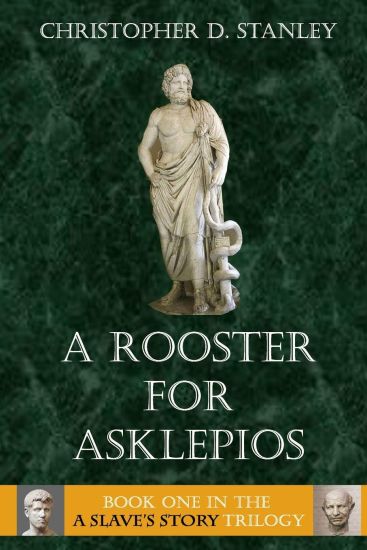
A slave without a past. A master without a future. A journey of discovery that will forever change the lives of both men. The ancient world comes alive in this vivid and engaging trilogy by an expert on Roman social history. What if you suddenly discovered that you were not who you thought you were-that your true family history had been hidden from you since birth? What if the truth about your origins would cause others to despise you? What if the man who had arranged the deception was seriously ill and needed your help? What if you were a slave and that man held your life in his hands-and you his? These are some of the questions explored in the first two volumes of the new historical trilogy, A Slave's Story. The story centers on a slave named Marcus who manages the business affairs of a wealthy Roman citizen in central Asia Minor in the first century AD. The first volume, A Rooster for Asklepios, narrates his eventful journey to a famous healing center in western Turkey following a dream in which the god Asklepios appears to promise that his master will be cured there of a nagging illness. The second volume, A Bull for Pluto, relates the aftermath of this journey. . Along the way, both men encounter people and ideas that undermine everything that they have ever believed about themselves, one another, and the world around them. Societal norms are challenged, personal loyalties tested, and identities transformed in this engaging story that brings to life a unique corner of the Roman world that has been neglected by previous storytellers. Christopher D. Stanley is a professor at St. Bonaventure University who studies the social history of early Christianity and the Greco-Roman world. He has written or edited six books and dozens of professional articles on the subject and presents papers regularly at conferences around the world. The trilogy A Slave's Story, which grew out of his historical research on first-century Asia Minor, is his first work of fiction. . For more information please visit https: //www.amazon.com/-/e/B001H6EUCA PRAISE FOR THE FIRST TWO VOLUMES"This compelling and enjoyable story offers the reader a superb 'insider' view of life in the first-century Greco-Roman world. I enjoyed traipsing around Anatolia with Lucius and Marcus "-Dr. Terence Donaldson, Academic Dean and Professor of New Testament, Wycliffe College, Canada"The realism of this story reflects the author's deep first-hand knowledge of the landscape and culture where the narrative takes place." -Dr. Mark Wilson, Director, Asia Minor Research Center, Antalya, Turkey"This well-researched book really brings the Roman world to life " -Dr. Alanna Nobbs, Professor of Ancient History, Macquarie University, Australia"The amount of research, imagination, and effort involved in crafting this story earned my admiration, and stirred my curiosity, too." -Dr. Mark Nanos, Lecturer, University of Kansas, USA
Scripture, Texts, and Tracings in 1 Corinthians

Scripture, Texts, and Tracings in 1 Corinthians

Christopher D. Stanley

Lexington Books/Fortress Academic
2019
sidottu
This book advances the interpretation of 1 Corinthians by exploring the ways the apostle Paul quoted or “echoed” Jewish scriptures more indirectly in his letter, by metonymy or allusion. Criteria and methods for identifying echoes are brought to the fore, as are questions of the texture of Paul’s theology and his understanding of scripture. Important topics in 1 Corinthians addressed here include Paul’s use of the Law, monotheism, Christology, wisdom and mystery language, punishment of the incestuous man, baptism for the dead, eschatology, and resurrection.
Paul and the Language of Scripture

Paul and the Language of Scripture

Christopher D. Stanley

Cambridge University Press
2008
pokkari
Explicit quotations from the Jewish Scriptures play a vital role in several of the apostle Paul's letters to struggling Christian congregations. In most cases the wording of these quotations differs markedly from all known versions of the biblical text. Studies of Paul's use of scripture routinely note the problem and suggest possible solutions, but none to date has made this phenomenon the primary object of investigation. The present study aims to remedy this deficiency with a careful examination of the way Paul and other ancient authors handled the wording of their explicit quotations. In drawing general conclusions, Dr Stanley examines the broader social environment that made 'interpretive renderings' a normal and accepted part of the literary landscape of antiquity.
Arguing With Scripture

Arguing With Scripture

Christopher D. Stanley

T. T.Clark Ltd
2004
nidottu
Drawing on recent discussions of quotations in the fields of rhetorics, linguistics, and literary studies, Stanley argues that Paul's explicit appeals to Jewish Scriptures must be analyzed as rhetorical devices that seek to influence the thoughts, feelings, and actions of a first-century audience, an approach that requires a different set of questions and methods than scholars have typically used in their studies of Paul's quotations. Key questions include why Paul quoted words of Scripture to support some of his arguments and not others; how quotations help to advance the developing arguments of Paul's letters; and how a mostly illiterate first-century audience from a variety of backgrounds might have viewed these sudden intrusions of material from a Jewish religious text. Answering these questions requires paying careful attention to the affective and poetic dimensions as well as the intellectual aspects of the original audience's encounter with the Holy Scriptures of Israel.