Kirjojen hintavertailu. Mukana 12 595 353 kirjaa ja 12 kauppaa.

Kirjailija

Christopher Dawson

Kirjat ja teokset yhdessä paikassa: 24 kirjaa, julkaisuja vuosilta 1991-2026, suosituimpien joukossa Progress and Religion. Vertaile teosten hintoja ja tarkista saatavuus suomalaisista kirjakaupoista.

24 kirjaa

Kirjojen julkaisuhaarukka 1991-2026.

The Formation of Christendom

The Formation of Christendom

Christopher Dawson; Joseph T. Stuart

THE CATHOLIC UNIVERSITY OF AMERICA PRESS
2026
pokkari
Together with its sequel The Dividing of Christendom, this book was the fruit of the Harvard lectures that Christopher Dawson delivered as the first occupant of the Charles Chauncey Stillman Chair of Roman Catholic Studies from 1958-1962. Here, as in all his works, he sees religion as the dynamic element of culture. This work traces the formation of Christian culture from its roots in the Judeo-Christian tradition through the rise and fall of medieval Christendom, and ends with an epilogue in which the author reflects on the defining characteristics of Christianity in general and the Catholic Church in particular. In the introductory section of this work, Dawson highlights the importance of language in the origin and development of civilization. Christina Scott, the author’s daughter and first biographer, summarises Dawson’s ideas on this point in her work A Historian and his World: "In the beginning was the word: language was the gateway to the human world and was the single factor that distinguished man from the animal kingdom." Language, as Dawson wrote, "enables man to think, to create a new world of imagination and reason." In parts two and three Dawson traces the beginnings of Christian culture in the first centuries after Christ through to the decline of medieval unity. Some of the tantalizing chapter headings include The Christian and Jewish Idea of Revelation, The Foundation of Europe: The Monks of the West, The Carolingian Age, Feudal Europe and the Age of Anarchy, The Achievement of Medieval Thought, and East and West in the Middle Ages. Dawson shared with Arnold Toynbee the ideal of a universal spiritual society as the goal of history; but whereas Dr. Toynbee saw this as achievable by a consensus of the great world religions, Dawson concludes his work with a clear exposition of the Catholic ideal of a universal spiritual society. It provides an excellent summary of the author’s view of the uniqueness and universality of the Catholic Church, as well as its fundamentally non-sectarian basis. His concluding words demonstrate his commitment to the concept of unity: "On the other hand, if Christianity were to lead the nations still further apart from one another into spiritual disunity, it would defeat the central purpose of the Church’s institution."
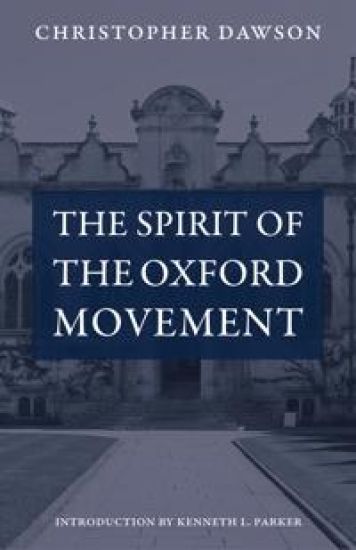
The Spirit of the Oxford Movement

The Spirit of the Oxford Movement

Christopher Dawson

THE CATHOLIC UNIVERSITY OF AMERICA PRESS
2023
nidottu
This is the book we have been waiting for . . . a permanent enrichment of our understanding of the Oxford Movement" proclaimed The Downside Review upon the publication of Christopher Dawson's masterwork in 1933, exactly 100 years after John Keble's sermon National Apostasy stirred a nation. Dawson himself regarded the book as one of his two greatest intellectual accomplishments.Dawson and John Henry Newman were Oxonians and both were converts to Catholicism; both stood against progressive and liberal movements within society. In both ideologies, Dawson saw a pathway that had once led to the French Revolution. Newman, for Dawson, was a kindred spirit.In The Spirit of the Oxford Movement, Dawson goes beyond a mere retelling of the events of 1833–1845. He shows us the prime movers who sought a deeper understanding of the Anglican tradition: the quixotic Hurrell Froude, for instance, who "had none of the English genius for compromise or the Anglican faculty of shutting the eyes to unpleasant facts." It was Froude who brought Newman and Keble together and who helped them understand each other. In many ways, Dawson sees these three as the true embodiment of the Tractarian ethos.Dawson probes deeply, though, to provide a richer, clearer understanding of the intellectual underpinnings of the Oxford Movement, revealing its spiritual raison d'être. We meet a group of gifted like-minded thinkers, albeit with sharp disagreements, who mock outsiders and each other, who pepper their letters with Latin, and forever urge each other on. Newman came to believe, as did Dawson, that the only intellectually coherent bastion against secular culture was religion, and the "on" to which they were urged was the Catholic church. The Spirit of the Oxford Movement provides insights into why Newman, and Dawson, came to this understanding.
Making of Europe

Making of Europe

Christopher Dawson

Hassell Street Press
2021
nidottu
This work has been selected by scholars as being culturally important and is part of the knowledge base of civilization as we know it.This work is in the public domain in the United States of America, and possibly other nations. Within the United States, you may freely copy and distribute this work, as no entity (individual or corporate) has a copyright on the body of the work.Scholars believe, and we concur, that this work is important enough to be preserved, reproduced, and made generally available to the public. To ensure a quality reading experience, this work has been proofread and republished using a format that seamlessly blends the original graphical elements with text in an easy-to-read typeface.We appreciate your support of the preservation process, and thank you for being an important part of keeping this knowledge alive and relevant.
Making of Europe

Making of Europe

Christopher Dawson

Hassell Street Press
2021
sidottu
This work has been selected by scholars as being culturally important and is part of the knowledge base of civilization as we know it.This work is in the public domain in the United States of America, and possibly other nations. Within the United States, you may freely copy and distribute this work, as no entity (individual or corporate) has a copyright on the body of the work.Scholars believe, and we concur, that this work is important enough to be preserved, reproduced, and made generally available to the public. To ensure a quality reading experience, this work has been proofread and republished using a format that seamlessly blends the original graphical elements with text in an easy-to-read typeface.We appreciate your support of the preservation process, and thank you for being an important part of keeping this knowledge alive and relevant.
Christianity and the New Age

Christianity and the New Age

Christopher Dawson; Bradley J Birzer

Angelico Press
2021
sidottu
First published in 1931, Christianity and the New Age offered a hard and inspired look at a world being torn apart by fascisms, communisms, materialisms, and the Great Depression. Since the Renaissance, Dawson feared, western culture and society had embraced an arrogant form of humanism, one that place too much emphasis on the goodness of the human person without recognizing his innate failings or his dependence upon God. With the loss of the Medieval beliefs in the Economy of Grace and the Great Chain of Being (each of which placed man higher than the animals but lower than the angels), culture had adopted two radically dangerous institutions: 1) the machine; and 2) bureaucracy. If, however, Dawson could convince the world to reshape and hone its understanding of humanism, it would have to become a Christian humanism, a humanism that recognized the dignity of the human person, made in the Image of God, born unique in time and space, and armed with the freely-given grace of the Holy Spirit. As Dawson wrote: "Every Christian mind is a seed of change so long as it is a living mind, not enervated by custom or ossified by prejudice. A Christian has only to be in order to change the world, for in that act of being there is contained all the mystery of supernatural life. It is the function of the Church to sow the divine seed, to produce not merely good men, but spiritual men-that is, to say, supermen." (from the Foreword)
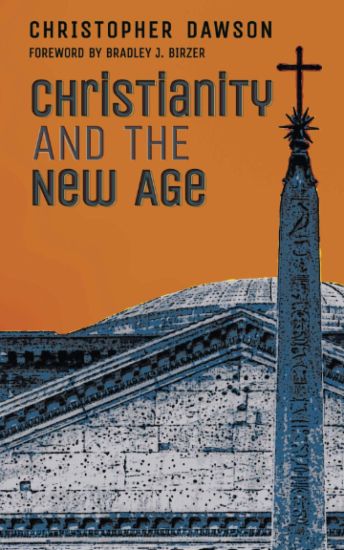
Christianity and the New Age

Christianity and the New Age

Christopher Dawson; Bradley J Birzer

Angelico Press
2021
pokkari
First published in 1931, Christianity and the New Age offered a hard and inspired look at a world being torn apart by fascisms, communisms, materialisms, and the Great Depression. Since the Renaissance, Dawson feared, western culture and society had embraced an arrogant form of humanism, one that place too much emphasis on the goodness of the human person without recognizing his innate failings or his dependence upon God. With the loss of the Medieval beliefs in the Economy of Grace and the Great Chain of Being (each of which placed man higher than the animals but lower than the angels), culture had adopted two radically dangerous institutions: 1) the machine; and 2) bureaucracy. If, however, Dawson could convince the world to reshape and hone its understanding of humanism, it would have to become a Christian humanism, a humanism that recognized the dignity of the human person, made in the Image of God, born unique in time and space, and armed with the freely-given grace of the Holy Spirit. As Dawson wrote: "Every Christian mind is a seed of change so long as it is a living mind, not enervated by custom or ossified by prejudice. A Christian has only to be in order to change the world, for in that act of being there is contained all the mystery of supernatural life. It is the function of the Church to sow the divine seed, to produce not merely good men, but spiritual men-that is, to say, supermen." (from the Foreword)
The Gods of Revolution

The Gods of Revolution

Christopher Dawson

The Catholic University of America Press
2015
nidottu
In The Gods of Revolution, Christopher Dawson brought to bear, as Glanmor Williams said, “his brilliantly perceptive powers of analysis on the French Revolution. . . . In so doing he reversed the trends of recent historiography which has concentrated primarily on examining the social and economic context of that great upheaval.”Dawson underlines the fact that the Revolution was not animated by democratic ideals but rather reflected an authoritarian liberalism often marked by a fundamental contempt for the populace, described by Voltaire as “the ‘canaille’ that is not worthy of enlightenment and which deserves its yoke.” The old Christian order had stressed a common faith and common service shared by nobles and peasants alike but Rousseau“pleads the cause of the individual against society, the poor against the rich, and the people against the privileged classes.” It is Rousseau whom Dawson describes as the spiritual father of the new age in disclosing a new spirit of revolutionary idealism expressed in liberalism, socialism and anarchism. But the old unity was not replaced by a new form. Dawson insists the whole period following the Revolution is “characterized by a continual struggle between conflicting ideologies,” and the periods of relative stabilization such as the Napoleonic restoration, Victorian liberalism in England, and capitalist imperialism in the second German empire “have been compromises or temporary truces between two periods of conquest.” This leads to his assertion that “the survival of westernculture demands unity as well as freedom, and the great problem of our time is how these two essentials are to be reconciled.”This reconciliation will require more than technological e”fficiency for “a free society requires a higher degree of spiritual unity than a totalitarian one. Hence the spiritual integration of western culture is essential to its temporal survival.” It is to Christianity alone that western culture “must look for leadership and help in restoring the moral and spiritual unity of our civilization,” for it alone has the influence, “in ethics, in education, in literature, and in social action” su”ciently strong to achieve this end.
Internet Security You Can Afford

Internet Security You Can Afford

Christopher Dawson

Cengage Learning, Inc
2014
nidottu
Untangle is an Internet gateway and firewall that provides a powerful solution for protecting computer networks, whether at home or on the job-stopping viruses, hackers, and other unwanted Internet traffic from interfering with your life. In its basic form, Untangle is free, so getting started is easy on the budget. Although the software is available in a variety of configurations, the free version of the Untangle Next Generation Firewall (Untangle NG) and its accompanying software modules can handily meet the Internet security needs of just about any home or small business. With INTERNET SECURITY YOU CAN AFFORD: USING UNTANGLE AS YOUR INTERNET GATEWAY, you will learn everything you need to know to secure your network, including downloading and installing Untangle, implementing network and user-protection best practices, scaling up your Untangle installation, and much more. Protect your network and its users without wrecking your budget-get INTERNET SECURITY YOU CAN AFFORD: USING UNTANGLE AS YOUR INTERNET GATEWAY.
Religion and Culture

Religion and Culture

Christopher Dawson

The Catholic University of America Press
2013
nidottu
Religion and Culture was first presented by historian Christopher Dawson as part of the prestigious Gifford Lecture series in 1947. It sets out the thesis for which he became famous: religion is the key of history. The book makes two parallel arguments. First, Dawson argues that religion is, and should be treated as, a separate category of human experience. Second, Dawson claims that religion has a unique place in human culture and has defined and developed different cultures in identifiable ways. Without understanding both premises, he argues, one cannot understand cultural development. Drawing on his profound and sympathetic reading in anthropology, sociology, comparative religion and the literatures of Western and non-Western cultures, Dawson seeks to bridge the gap between religion and the sciences through the tradition of natural theology. His approach respects the natural sciences and their power to plumb the mysteries of the natural world, while recognising that they cannot, alone, explain religious intimations of the transcendent. Religion and Culture was written and published in a time not unlike our own, when the very distinctiveness of religious experience has been denigrated, and religious belief is considered in some circles as an atavistic holdover. And yet, the existence of a purely technocratic culture and its ability to embody and transmit moral or cultural norms remains in doubt. Dawson, who in his day was respected well outside Catholic circles, is an important voice in this continuing debate.
The Movement of World Revolution

The Movement of World Revolution

Christopher Dawson

The Catholic University of America Press
2013
nidottu
Christopher Dawson was one of the most profound historians of his day, with an acute understanding of the ideas and culture movements behind the making of Western society. The Movement of World Revolution, originally published in 1959, explores many of the themes Dawson considered most important in his lifetime: the religious foundation of human culture, the central importance of education for the recovery of Christian humanism, the myth of progress, and the dangers of nationalism and secular ideologies. Dawson’s concern was not so much a solution to the political, social, or economic problems of his day, but rather an understanding of the present as it had evolved from the past as well as the charting of a path into the future. In this work, Dawson argued that the modern period was “not a metaphysical age, and in the East no less than in the West men are more interested in subsistence and coexistence than in essence and existence.” Dawson believed a reduction of culture to material and technological preoccupations would ultimately end in an impoverishment of life. His solution was a return to a renewed Christendom, one not marked by an alliance with secular powers but rather arising out of an organic, spiritual foundation. The Movement of World Revolution is remarkably prophetic in anticipating many of the contemporary struggles about the role of religion in the modern state.
The Age of the Gods

The Age of the Gods

Christopher Dawson

The Catholic University of America Press
2012
nidottu
When first published in 1928, The Age of the Gods was hailed as the best short account of what is known of pre-historic man and culture. In it, Christopher Dawson synthesised modern scholarship on human cultures in Europe and the East from the Stone Age to the beginnings of the Iron Age. His focus was not merely on the material development of early society but more intently on the social and spiritual development of man that accompanied it. Piece by piece, Dawson fit together the varied influences that brought into being the ancient foundations on which modern civilisation was built. Published soon after World War I, the book uncovered the common tradition and unity of culture of European civilisation in hope of bringing cooperation and peace to the people of Europe. It defined what a culture is, how cultures change, and what constitutes progress. Dawson consulted the studies of archaeologists, early historians, anthropologists, and ethnologists, and presented an uncommonly balanced and greatly admired survey of the whole. Presented here with a new introduction by Dermot Quinn, The Age of the Gods continues the popular Works of Christopher Dawson series. Among other topics, the book sketches the glacial age and the beginnings of human life, the Paleolithic and Neolithic cultures and the rise of the peasant culture in Europe, the development of Sumerian culture, the archaic culture of Egypt, the megalithic culture in Western Europe, the age of empire in the Near East, the Bronze Age in Central Europe, the formation of the Indo-European peoples, the Mycenaean culture of Greece, and the beginnings of the Iron Age in Europe.
Religion and the Rise of Western Culture

Religion and the Rise of Western Culture

Christopher Dawson

Literary Licensing, LLC
2012
sidottu
Religion and the Rise of Western Culture is a comprehensive exploration of the role of religion in shaping Western civilization. Written by acclaimed historian Christopher Dawson, this book examines the impact of Christianity on the development of Western culture, from the early days of the Roman Empire to the modern era.Dawson argues that religion has been a driving force behind many of the cultural and intellectual achievements of the West. He traces the evolution of Christianity from its origins in the Middle East to its spread throughout Europe and the Americas, and shows how it has influenced everything from art and literature to politics and philosophy.The book also explores the relationship between religion and other cultural forces, such as science and technology, and how these interactions have shaped the course of Western history. Dawson argues that religion has played a key role in the development of Western democracy, individualism, and human rights, and that it continues to be a vital force in shaping our world today.Written in clear, accessible language, Religion and the Rise of Western Culture is an essential read for anyone interested in understanding the historical and cultural roots of Western civilization.This scarce antiquarian book is a facsimile reprint of the old original and may contain some imperfections such as library marks and notations. Because we believe this work is culturally important, we have made it available as part of our commitment for protecting, preserving, and promoting the world's literature in affordable, high quality, modern editions, that are true to their original work.
The Judgement of the Nations

The Judgement of the Nations

Christopher Dawson

The Catholic University of America Press
2011
nidottu
Christopher Dawson wrote The Judgment of the Nations in 1943, in the midst of the horrors of World War II. He took four years in the writing of it, years, he claimed, “more disastrous than any that Europe had known since the fourteenth century.” By his own admission it had cost him greater labour and thought than any other book he had written. It is, perhaps, his most characteristic work.Dawson argues in compressed form for what he laid out more systematically in other books: his view that the West was at an hour of crisis and was fighting for its life as a civilisation. He did not view the disasters of the two World Wars as the cause of that disintegration; they were rather symptoms of a much deeper malaise, that of the loss of the spiritual vision that had created and sustained Western culture through the centuries. He lays out his understanding of what might be necessary for the West to reengage its spiritual and cultural roots and find a new way forward. For Dawson, such a restoration could not be coercive, but needed rather to be based upon a new perception of the inherent cultural creativity of Christianity.The Judgment of the Nations was widely praised upon publication. The Guardian called it “an appraisement of the contemporary situation by an historical thinker of the first importance,” and the Irish Independent “a monument, alike of historical and of philosophical erudition.” It was Dawson’s hope in this work to describe the nature of the spiritual struggle Europe was facing, to map out its true lines, and to point the way through an impending and perhaps probable disaster to a renewal of European life, a renewal whose success or failure would have a decisive impact on the entire world.
The Crisis of Western Education

The Crisis of Western Education

Christopher Dawson

The Catholic University of America Press
2010
nidottu
This title presents works of Christopher Dawson. ""The Crisis of Western Education"", originally published in 1961, served as a capstone of Christopher Dawson's thought on the Western educational system. Long out of print, the book has now been updated with a new introduction by Glenn W. Olsen and is included in the ongoing ""Works of Christopher Dawson"" series. In all of his writings, Dawson masterfully brings various disciplinary perspectives and historical sources into a complex unity of expression and applies them to concrete conditions of modern society. Dawson argued that Western culture had become increasingly defined by a set of economic and political preoccupations ultimately hostile to its larger spiritual end. Inevitably, its educational systems also became increasingly technological and pragmatic, undermining the long standing emphasis on liberal learning and spiritual reflection which were hallmarks of the Christian humanism that created it. In this important work on the Western educational system, Dawson traces the history of these developments and argues that Western civilization can only be saved by redirecting its entire educational system from its increasing vocationalism and specialization. He insists that the Christian college must be the cornerstone of such an educational reform. However, he argued that this redirection would require a much more organic and comprehensive study of the living Christian tradition than had been attempted in the past. Dawson had reservations about educational initiatives that had been developed in response to this crisis of education. Among them, he expressed doubts about newly emerging great books programs fearing that they would reduce the great tradition of a living culture to a set of central texts or great ideas. In contrast, he insisted that a Christian education had to be concerned with 'how spiritual forces are transmitted and how they change culture, often in unexpected ways'. This would require an understanding of the living and vital character of culture. As Dawson saw it, 'culture is essentially a network of relations, and it is only by studying a number of personalities that you can trace this network'. Dawson offers a diagnosis of modern education and proposes the retrieval of an organic and living culture which alone has the power to renew Western culture.
Enquiries Into Religion and Culture

Enquiries Into Religion and Culture

Christopher Dawson

The Catholic University of America Press
2009
nidottu
The essays presented in this volume are among the most wide-ranging, intellectually rich, and diverse of Christopher Dawson's reflections on the relations of faith and culture. In them, he explores the contact between the spiritual life of the individual and the social and economic organization of modern culture. His focus ranges from the passing of industrialism to the Catholic understanding of the human person, to Islamic mysticism, to a Christian account of sexuality.Dawson argues that modern Western culture is unique in its tendency to ignore its spiritual roots and its once close contact with nature and tradition, and to substitute for them an impersonal economic and materialist organization of mass society. In these essays, he warns against the increasingly secular preoccupations of modern sociological accounts of European culture and insists that they require the supplement and corrective of theology and philosophy. But he is equally insistent on the dangers of a false spiritualism that ignores emerging sociological insights.Widely praised as one of the most important Catholic historians of the twentieth century, Christopher Dawson, in all of his writings, masterfully brings various disciplinary perspectives and historical sources into a complex unity of expression and applies them to concrete conditions of modern society. ""Enquiries into Religion and Culture"" includes an introduction by Robert Royal.