Kirjojen hintavertailu. Mukana 12 595 353 kirjaa ja 12 kauppaa.

Kirjailija

Christopher Duffy

Kirjat ja teokset yhdessä paikassa: 27 kirjaa, julkaisuja vuosilta 1987-2026, suosituimpien joukossa The Wild Goose and the Eagle. Vertaile teosten hintoja ja tarkista saatavuus suomalaisista kirjakaupoista.

27 kirjaa

Kirjojen julkaisuhaarukka 1987-2026.

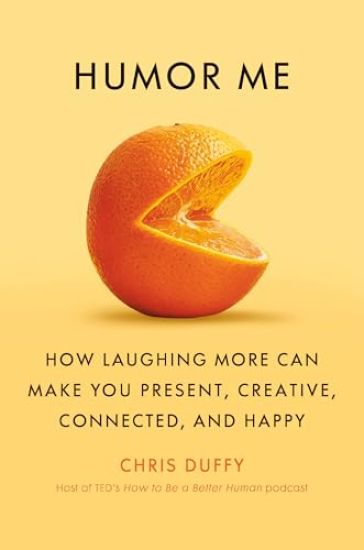
Humor Me: How Laughing More Can Make You Present, Creative, Connected, and Happy
From a comedian and host of a hit TED podcast, a hilarious and enlightening guide to laughing your way into a fuller life. Ten years ago, when Chris Duffy was an exhausted fifth grade teacher, he taught the funniest person he's ever met: 11-year-old Gary C. Gary was the school newspaper's official food critic, blasting cafeteria pizza for looking like cardboard and alleging that the baked beans weren't "beany" enough. These days, Duffy is a comedian and the host of a podcast with millions of listeners, but he's never forgotten the joy of laughing with Gary during that bleak Boston winter. Gary taught him that a life without a sense of humor isn't much of a life at all. With curiosity and wit, Duffy takes us on a journey to learn how a good laugh can bring us closer to the good life. When he endeavors to pay more attention to the world around him, he discovers that his once-dreary commute is laugh-out-loud funny: think a rider catching a pigeon with his bare hands and Duffy's very own Russian mystic doppelganger. Using psychology and the wisdom of fellow comedians, Duffy reveals that a sense of humor can turn you into the kind of person others want to be around, someone who can be honest about their flaws without beating themselves up. It can teach us how to show up more generously in our most important relationships and how to handle the most painful parts of life without giving into despair. For anyone who has tried out meditation, a new year's resolution or gratitude practice as a self-improvement strategy, HUMOR ME offers a fresh and exciting path to greater presence, creativity, connection and joy.
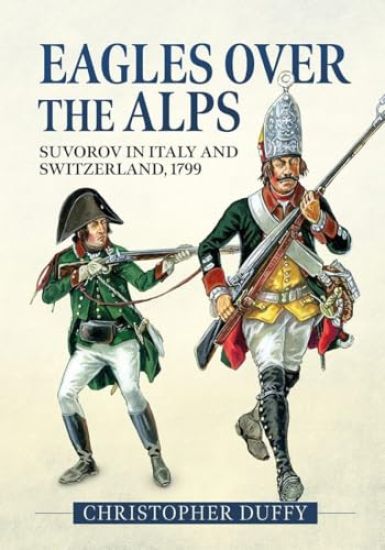
Eagles Over the Alps

Eagles Over the Alps

Christopher Duffy

HELION COMPANY
2024
nidottu
Russia's greatest soldier was at war in Italy and Switzerland. Led by Suvorov, believed by many to be the equal of Napoleon, the Russian and Austrian troops claimed one victory after another against the French. Much more than strategy and tactics, this a story of adventure as a Russian army fights desperate rearguard actions, and tries to escape through cruel mountain passes in the night. Suvorov's memory is still treasured in the Russian armed forces today. The last and greatest campaign of this legendary soldier has found a fitting narrator in Christopher Duffy. Suvorov's marches and battles can be traced on the many maps, photographs, and original artwork recreates the appearance of the troops.
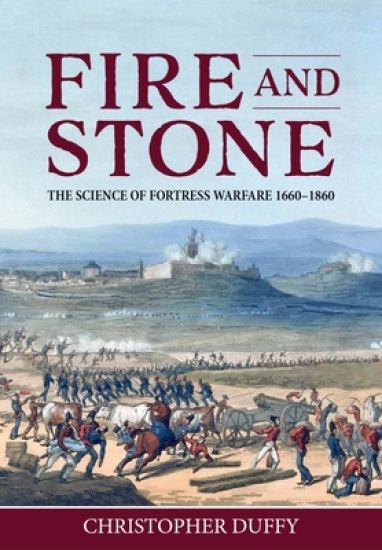
Fire and Stone

Fire and Stone

Christopher Duffy

HELION COMPANY
2023
sidottu
Christopher Duffy's brilliant history of fortifications and siegecraft is the best general work available on the subject. It covers the classic age of military engineering, which was heralded by the work of Vauban, chief engineer to the French King Louis XIV. There was astonishingly little change in the way fortresses were perceived and used for the next 200 years, until the advent of rifled artillery brought dramatic new ideas into play. Duffy examines the purpose of fortresses across Europe, and the debates of the time concerning their offensive and defensive uses. He analyses the strategic and structural considerations that dictated their locations, and describes how they were planned, designed and built, and by whom. He then explains how a siege progressed from start to finish: plans and preparations; the investment of the fortress; the ways in which a fortress could be reduced short of a formal siege; and the siege itself at every stage, from the choice of the frontal attack to the storm of the breaches and capitulation. The differences in siting, design and techniques of attack and defense for coastal fortifications are also covered. Using excerpts from the accounts of people who took part in actual sieges or were themselves besieged, Duffy brings out the human side of siege warfare as well as its purely technical aspects. In order to give the overall picture he traces four great sieges in their entirety: Namur in 1692 and again in 1695, with Vauban and his Dutch counterpart Coehoorn pitting their wits against one another; the French attack on Antwerp in 1832, which showed how little siegecraft had changed since Namur; and the Anglo-Dutch naval bombardment of Algiers in 1816. Duffy's clear perspective, and his skillful handling of details, make Fire and Stone and enthralling book to read as well as an invaluable source of information.
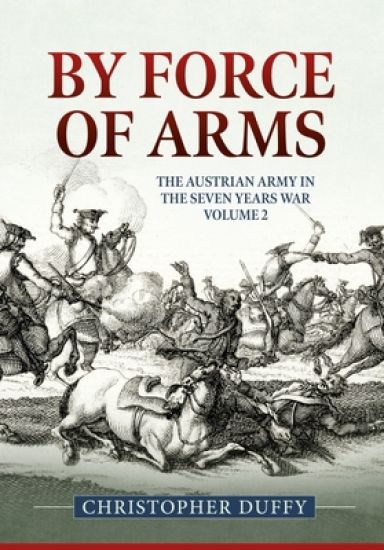
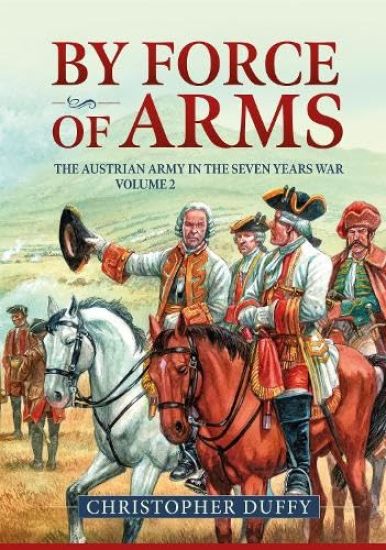
By Force of Arms

By Force of Arms

Christopher Duffy

Helion Company
2022
sidottu
To avenge defeats in a former war, Austria assembled a massive superiority in forces thanks to powerful alliances, and an army reformed and far more effective than ever before. But Prussia hung on, to force a long war and a bloody draw. The brilliance of Frederick the Great and the Prussian army have been given credit for this outcome, but Austria had more than its fair share of good soldiers and skilled generals. Wars never turn out as expected when there are formidable foes, and this book tells what went wrong. This is more than an account of battles and marches. The story of the Seven Years War in Central Europe has been long neglected, and yet it was there that the Austrians (followed closely by the Prussians) broke with the former rigidity of the armies of monarchical Europe, and not just foreshadowed but put into actual effect initiatives that are normally associated with the campaigns of the Revolution and Napoleon. The myth of a limited war leading to indecisive battles is no longer tenable. Not that it lacks a good story of excellent soldiers, some of them left in the limelight when Frederick the Great’s legend was created, and of battles long forgotten. A wealth of maps and as many eyewitness accounts as possible have been used to explain what actually happened. This is a superb account of the war in central Europe, with its emphasis and focus on the operations of the Austrian army, based firmly on primary sources, the majority never before fully explored.
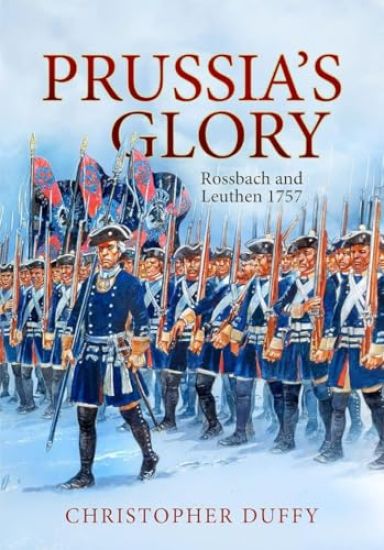
Prussia'S Glory

Prussia'S Glory

Christopher Duffy

Helion Company
2022
sidottu
Rossbach and Leuthen are included in the Great Battles of History. Frederick made himself one of the Great Captains by these victories. Prussian military prowess became legendary. But, the Franco German army swept away at Rossbach, and the Austrian army routed at Leuthen, were not only larger and had a fair share of professional soldiers, but the Austrians had beaten the Prussians not long before. So how were they so humiliated? What made Frederick Great? For more than a century people believed it was because the Prussians were just naturally suited for war. Until 1945 many Germans, and their foes, remembered how Frederick miraculously saved Prussia against overwhelming odds, by marching through the snow towards Leuthen church. As always it was not so simple. The expert on 18th-century armies, Christopher Duffy, shows why French, Austrian and Reichsarmee soldiers, though often enough brave and skilful, marched to defeat, and how Frederick, often unaware of the legend he was creating, won these famous battles. But it is no longer left to myth, but to reliable accounts of hard fighting, quick decisions, and the fate of the soldiers and civilians swept up by the fighting.
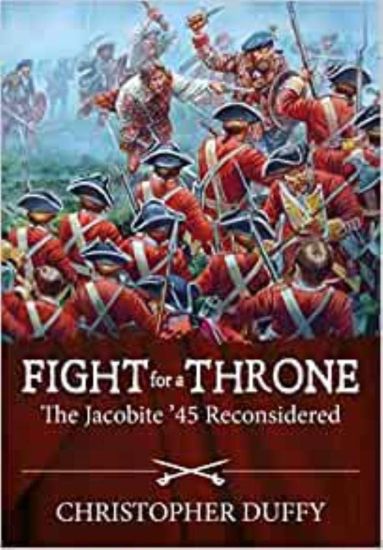
Fight for a Throne

Fight for a Throne

Christopher Duffy

Helion Company
2021
nidottu
The bid of Bonnie Prince Charlie and his Jacobites for the throne of Britain has never lost its grip on the popular imagination. In July 1745 he and a tiny group of companions arrived in Scotland. They came unannounced and unsupported, and yet within less than five months Charles was able to lead an army to within marching distance of London and make King George II fear for this throne. Afterwards the Highland Army continued to out-fight the redcoats in every encounter, except its very last. These were not the achievements of a backward-looking cause, and this ground-breaking study is the first to explain exactly why. Almost to the very end the Jacobites had the literal and metaphorical ‘edge’ over their enemies, thanks to the terror-inspiring highland charge, and also, as this book as this book is the first to reveal, to the highly-advanced organisation of their forces in 'divisions' - miniature armies that allowed them to out-manoeuvre their enemies on the strategic plane. At the same time Prince Charles made a credible bid for the political and ideological high ground, an appeal based on religious toleration, and a monarchy working in cooperation with an empowered and accountable Parliament. The Prince therefore not only drew on traditional loyalties, but attracted the support of heavyweights of the new 'Enlightenment'. It all made a telling contrast to the demeaning nature of the Hanoverian government in Britain, which was mired deep in corruption. The Hanoverian politicians in London and Scotland, who had honed their skills in petty advantage, were now all of a sudden called upon to act as strategists, and they failed completely. The prime minister lost the Carlisle to the Jacobites simply because he refused to pay the cost of a courier. These revelations, which show the Jacobite enterprise of 1745 as a potent and modernising force, turn the accepted interpretation of this episode on its head. As an impartial historian Christopher Duffy deals comprehensively with the reasons for ultimate triumph of the Hanoverian cause in 1746. Due credit is given to the Duke of Cumberland. He was an inspirational leader. He had the measure of the strength and weaknesses of the British Army, and he evolved the cautious and systematic kind of war that helped to bring him victory at Culloden on 16 April 1746. Conversely the Jacobites had been dogged even from the start of the Rising by their failure to reconcile two perspectives - that of Prince Charles, who was striving to reclaim the crown for the Stuarts in London, and the narrower visions of the more overtly Scottish party. It led to the contentious turn-around of the Jacobites at Derby, and finally and fatally to the dispersal and exhaustion of the Highland Army before Culloden. These assertions rest on the recent advances by other historians in 'Jacobite studies', and the author's continuing researches in to unexploited primary sources. His documentary finds extend to the autobiography of Lieutenant-General Hawley, Lord George Murray’s explanations of key episodes of the Rising (and his detailed accompanying map of Culloden), the material collected by the restored Whig administration in Edinburgh towards an ‘official’ history of the Rising, the Reverend John Home’s detailed questioning of survivors, and much more. Lastly Duffy returns to his starting point, the enduring appeal of the '45 to our instincts. He concludes that it comes from the elusive nature of the episode, recognised by tough-minded men of the time as something 'epick' and 'miraculous' - literally beyond rational explanation, and capable ever since of being re-fashioned according to our imaginings.
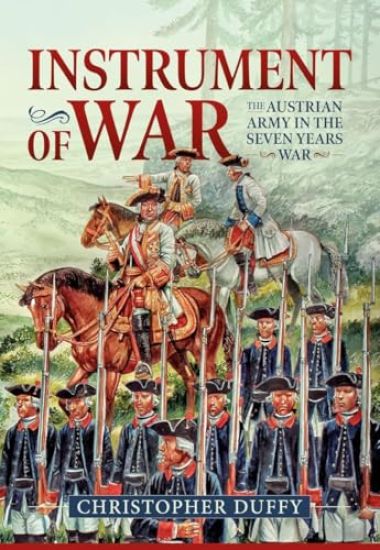
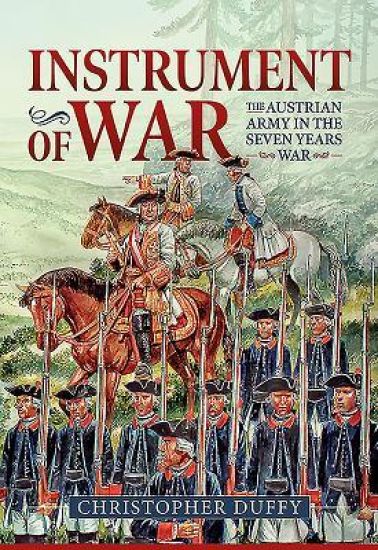
Instrument of War

Instrument of War

Christopher Duffy

Helion Company
2020
sidottu
How did an 18th Century army work? This book is the most important examination of such an army yet done, written by the premier military historian of the era. Maria Theresa had seen her inheritance almost lost to unprovoked attacks from her neighbours. Her army had stood by her then, and was now trying desperately to improve, as it had to face Frederick the Great, the master-soldier of the era. But she and her ministers soon faced the dilemma of how to fight a war without sacrificing what they were fighting for. The structure of the army, the life of its soldiers, its strengths and weaknesses, the personalities that gave it such a unique character, from top to bottom, are all considered. Not only is the Austria of Maria Theresa examined, but fascinating views appear of Prussian opponents and French, Swedish and Russian armies. Efforts were made to reshape the army, the state, and the world of diplomacy. Maria Theresa wanted to be a mother to her army, to serve it as faithfully as it served her. This is a study of what problems they faced. The army and its needs affected all around it. Conscription, taxation, constitutional change, bureaucracy, logistics, all of these dominated countries that never witnessed a campaign. To most of the inhabitants of Central Europe the army was the state, and their lives cannot be understood without examining it. Conscription tells us much about the homelands of the soldiers — the languages they spoke, the professions they served, their willingness to serve what to many was an alien monarch. The army provides an important view of 18th Century Bohemia, Hungary, Croatia, Lombardy, Belgium and Austria. Even the distant Irish played an important role in this army. But this is no dry commentary. The 18th Century is brought to life not only in the words of Christopher Duffy, but also of the perceptive diplomat Kaunitz, experienced generals like Daun and Loudon, Prussian spies and foreign attachés, a cynical Belgian prince and a young Italian officer, and many others. Their first-hand accounts explain the successes and failures of Austria at war. The battles and campaigns of the Seven Years War cannot be understood without knowledge of the instruments necessary to conduct such a war. Every serious military historian should read this book.
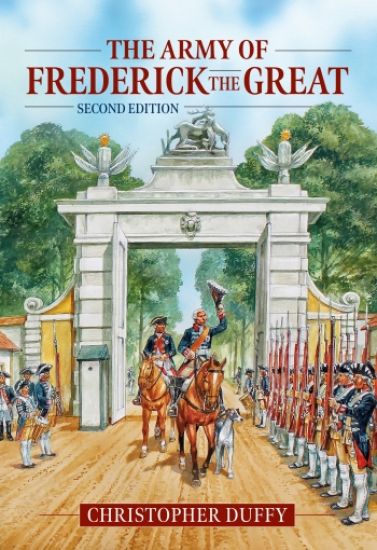
The Army of Frederick the Great

The Army of Frederick the Great

Christopher Duffy

Helion Company
2020
sidottu
It was a famous army, but it is not always understood. It was praised for introducing a revolution in the art of war and notorious for the brutality of its discipline, but how did this really work? This is a study of the greatest army of its time by the finest historian of the wars of the 18th Century. The Prussian military machine is analysed in detail, from top to bottom, from the mentality of the Junkers who led it to the way the men were clothed. The tactics, the recruitment, the finances of the military are laid bare. This is much more than a technical study, as we see how these regiments stood up to the test of the bloody battles of the Seven Years War and the long years of virtual imprisonment in barracks. The image of a formidable army forged by fear rather than leadership proves to be only partly true, but the tribulations of serving a hard taskmaster like Frederick the Great are well described by soldiers and observers of all ranks. We see the rise of the cavalry from the ridiculous to the superb; the once invincible infantry bled white, and the light forces change from being negligible to being the terror of their enemies. A great army is made flesh and blood.
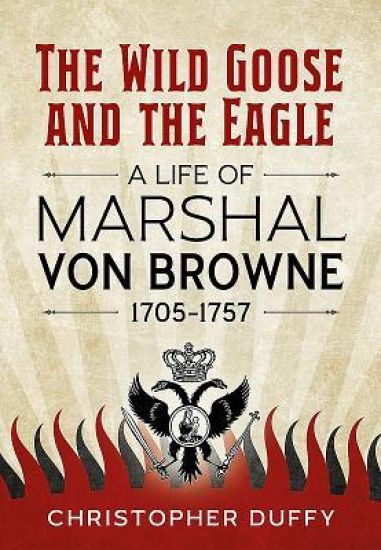
The Wild Goose and the Eagle

The Wild Goose and the Eagle

Christopher Duffy

Helion Company
2019
sidottu
Although little known in this country, Maximilian von Browne is counted among the finest soldiers of the old Imperial Austrian Army. As the present biography sets out to show, he was outstanding in his time for his vigorous conduct of war, and his extremely advanced idea of leadership and responsibility. Few commanders have taken so literally the phrase `to share the hardships of his men’. A son of that generation of Irishmen who fled from a penal regime to take service in Catholic Europe, Browne rose in the Army of the Empress Maria Theresa. In 1746, he could take the greater part of the credit for driving the French and Spanish forces from Italy, and in the next year he carried the war onto French soil by a celebrated invasion of Provence. Following an interval of peacetime, though far from uneventful, administration in the Imperial provinces, Browne checked and outwitted Frederick of Prussia in the first campaign of the Seven Years War. Already in the grip of a mortal illness, Browne was taken unawares when the Prussians resumed the attack in 1757, and of May 6 of that year he received a last wound, among his grenadiers on the field of Prague. The Wild Goose and the Eagle is founded on a thorough investigation of the Viennese archives and of the terrain of the Marshal’s battles. It explores not just the life of a single commander, but the warfare of an age which holds many lessons for the present century.
The Fortress in the Age of Vauban and Frederick the Great 1660-1789
The later seventeenth and eighteenth centuries have been acclaimed as the classic period of artillery fortification. This was an era when fortresses and fortress systems shaped the calculations of strategists and statesmen, and often dictated the course of campaigns. The age was one of almost constant conflict and this book, originally published in 1985, explores the influence of the fortress in the dynastic wars of Bourbon, Habsburg and Hohenzollern, the contest for influence in the Baltic, the last crusades of the West against the Turks, and in the peculiar conditions of colonial campaigning and the War of the American Independence.
Frederick the Great

Frederick the Great

Christopher Duffy

Routledge
2017
nidottu
For tactical and strategic ingenuity, for daring and ruthless determination and the capacity to inspire troops, Frederick the Great was without equal. In this detailed life of ‘Old Fritz’, Christopher Duffy, who has written widely on the army of Frederick and on the armies of his adversaries, Austria and Russia, has produced a definitive account of his military genius.
Russia's Military Way to the West

Russia's Military Way to the West

Christopher Duffy

Routledge
2017
nidottu
This book provides an historical perspective on the growth of Russian military power, studying the emergence of the Russian regular army from 1700 until the end of the eighteenth century. In the process he evaluates the relative importance of Western and native influences on the creation of this formidable military machine, and indicates the ways in which Russian power was projected in the West. The book includes general discussions of the Russian soldier, the Russian officer and the rapacious Cossacks, and concludes by identifying certain important continuities between the Russian past and present.
Python: Penetration Testing for Developers

Python: Penetration Testing for Developers

Christopher Duffy; Cameron Buchanan; Terry Ip; Andrew Mabbitt; Benjamin May; Dave Mound

Packt Publishing Limited
2016
nidottu
Unleash the power of Python scripting to execute effective and efficient penetration tests About This Book * Sharpen your pentesting skills with Python * Develop your fluency with Python to write sharper scripts for rigorous security testing * Get stuck into some of the most powerful tools in the security world Who This Book Is For If you are a Python programmer or a security researcher who has basic knowledge of Python programming and wants to learn about penetration testing with the help of Python, this course is ideal for you. Even if you are new to the field of ethical hacking, this course can help you find the vulnerabilities in your system so that you are ready to tackle any kind of attack or intrusion. What You Will Learn * Familiarize yourself with the generation of Metasploit resource files and use the Metasploit Remote Procedure Call to automate exploit generation and execution * Exploit the Remote File Inclusion to gain administrative access to systems with Python and other scripting languages * Crack an organization's Internet perimeter and chain exploits to gain deeper access to an organization's resources * Explore wireless traffic with the help of various programs and perform wireless attacks with Python programs * Gather passive information from a website using automated scripts and perform XSS, SQL injection, and parameter tampering attacks * Develop complicated header-based attacks through Python In Detail Cybercriminals are always one step ahead, when it comes to tools and techniques. This means you need to use the same tools and adopt the same mindset to properly secure your software. This course shows you how to do just that, demonstrating how effective Python can be for powerful pentesting that keeps your software safe. Comprising of three key modules, follow each one to push your Python and security skills to the next level. In the first module, we'll show you how to get to grips with the fundamentals. This means you'll quickly find out how to tackle some of the common challenges facing pentesters using custom Python tools designed specifically for your needs. You'll also learn what tools to use and when, giving you complete confidence when deploying your pentester tools to combat any potential threat. In the next module you'll begin hacking into the application layer. Covering everything from parameter tampering, DDoS, XXS and SQL injection, it will build on the knowledge and skills you learned in the first module to make you an even more fluent security expert. Finally in the third module, you'll find more than 60 Python pentesting recipes. We think this will soon become your trusted resource for any pentesting situation. This Learning Path combines some of the best that Packt has to offer in one complete, curated package. It includes content from the following Packt products: * Learning Penetration Testing with Python by Christopher Duffy * Python Penetration Testing Essentials by Mohit * Python Web Penetration Testing Cookbook by Cameron Buchanan,Terry Ip, Andrew Mabbitt, Benjamin May and Dave Mound Style and approach This course provides a quick access to powerful, modern tools, and customizable scripts to kick-start the creation of your own Python web penetration testing toolbox.
Siege Warfare

Siege Warfare

Christopher Duffy

Routledge
2016
sidottu
This classic text is the first integrated survey of the phenomenon of siege warfare during its most creative period. Duffy demonstrates the implications of the fortress for questions of military organization, strategy, geography, law, architectural values, town life and symbolism and imagination. The book is well illustrated, and will be a valuable companion for enthusiasts of military and architectural history, as well as the general medievalist.
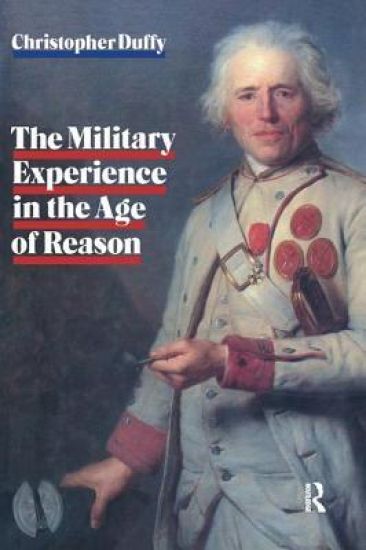
Military Experience in the Age of Reason

Military Experience in the Age of Reason

Christopher Duffy

Routledge
2016
nidottu
First published in 1987. War in the 18th century was a bloody business. A line of infantry would slowly march, to the beat of a drum, into a hail of enemy fire. Whole ranks would be wiped out by cannon fire and musketry. Christopher Duffy's investigates the brutalities of the battlefield and also traces the lives of the officer to the soldier from the formative conditions of their earliest years to their violent deaths or retirement, and shows that, below their well-ordered exteriors, the armies of the Age of Reason underwent a revolutionary change from medieval to modern structures and ways of thinking.
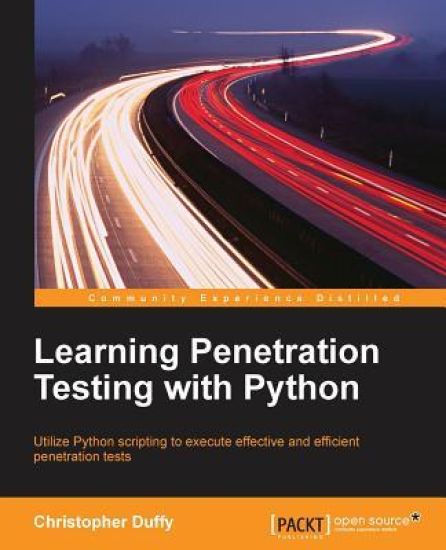
Learning Penetration Testing with Python

Learning Penetration Testing with Python

Christopher Duffy

Packt Publishing Limited
2015
nidottu
Utilize Python scripting to execute effective and efficient penetration tests About This Book • Understand how and where Python scripts meet the need for penetration testing • Familiarise yourself with the process of highlighting a specific methodology to exploit an environment to fetch critical data • Develop your Python and penetration testing skills with real-world examples Who This Book Is For If you are a security professional or researcher, with knowledge of different operating systems and a conceptual idea of penetration testing, and you would like to grow your knowledge in Python, then this book is ideal for you. What You Will Learn • Familiarise yourself with the generation of Metasploit resource files • Use the Metasploit Remote Procedure Call (MSFRPC) to automate exploit generation and execution • Use Python's Scapy, network, socket, office, Nmap libraries, and custom modules • Parse Microsoft Office spreadsheets and eXtensible Markup Language (XML) data files • Write buffer overflows and reverse Metasploit modules to expand capabilities • Exploit Remote File Inclusion (RFI) to gain administrative access to systems with Python and other scripting languages • Crack an organization's Internet perimeter • Chain exploits to gain deeper access to an organization's resources • Interact with web services with Python In Detail Python is a powerful new-age scripting platform that allows you to build exploits, evaluate services, automate, and link solutions with ease. Python is a multi-paradigm programming language well suited to both object-oriented application development as well as functional design patterns. Because of the power and flexibility offered by it, Python has become one of the most popular languages used for penetration testing. This book highlights how you can evaluate an organization methodically and realistically. Specific tradecraft and techniques are covered that show you exactly when and where industry tools can and should be used and when Python fits a need that proprietary and open source solutions do not. Initial methodology, and Python fundamentals are established and then built on. Specific examples are created with vulnerable system images, which are available to the community to test scripts, techniques, and exploits. This book walks you through real-world penetration testing challenges and how Python can help. From start to finish, the book takes you through how to create Python scripts that meet relative needs that can be adapted to particular situations. As chapters progress, the script examples explain new concepts to enhance your foundational knowledge, culminating with you being able to build multi-threaded security tools, link security tools together, automate reports, create custom exploits, and expand Metasploit modules. Style and approach This book is a practical guide that will help you become better penetration testers and/or Python security tool developers. Each chapter builds on concepts and tradecraft using detailed examples in test environments that you can simulate.
Russia's Military Way to the West

Russia's Military Way to the West

Christopher Duffy

Routledge
2015
sidottu
This book provides an historical perspective on the growth of Russian military power, studying the emergence of the Russian regular army from 1700 until the end of the eighteenth century. In the process he evaluates the relative importance of Western and native influences on the creation of this formidable military machine, and indicates the ways in which Russian power was projected in the West. The book includes general discussions of the Russian soldier, the Russian officer and the rapacious Cossacks, and concludes by identifying certain important continuities between the Russian past and present.