Kirjojen hintavertailu. Mukana 12 595 353 kirjaa ja 12 kauppaa.

Kirjailija

Christopher Edwards

Kirjat ja teokset yhdessä paikassa: 9 kirjaa, julkaisuja vuosilta 1998-2018, suosituimpien joukossa Variable Structure Control of Complex Systems. Vertaile teosten hintoja ja tarkista saatavuus suomalaisista kirjakaupoista.

9 kirjaa

Kirjojen julkaisuhaarukka 1998-2018.

Variable Structure Control of Complex Systems

Variable Structure Control of Complex Systems

Xing-Gang Yan; Sarah K. Spurgeon; Christopher Edwards

Springer International Publishing AG
2018
nidottu
This book systematizes recent research work on variable-structure control. It is self-contained, presenting necessary mathematical preliminaries so that the theoretical developments can be easily understood by a broad readership. The text begins with an introduction to the fundamental ideas of variable-structure control pertinent to their application in complex nonlinear systems. In the core of the book, the authors lay out an approach, suitable for a large class of systems, that deals with system uncertainties with nonlinear bounds. Its treatment of complex systems in which limited measurement information is available makes the results developed convenient to implement. Various case-study applications are described, from aerospace, through power systems to river pollution control with supporting simulations to aid the transition from mathematical theory to engineering practicalities. The book addresses systems with nonlinearities, time delays and interconnections and considers issues such as stabilization, observer design, and fault detection and isolation. It makes extensive use of numerical and practical examples to render its ideas more readily absorbed. Variable-Structure Control of Complex Systems will be of interest to academic researchers studying control theory and its application in nonlinear, time-delayed an modular large-scale systems; the robustness of its approach will also be attractive to control engineers working in industries associate with aerospace, electrical and mechanical engineering.
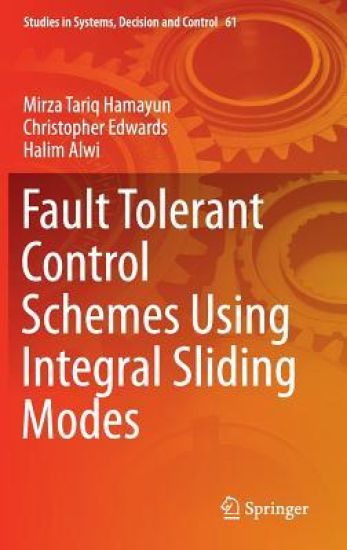
Fault Tolerant Control Schemes Using Integral Sliding Modes

Fault Tolerant Control Schemes Using Integral Sliding Modes

Mirza Tariq Hamayun; Christopher Edwards; Halim Alwi

Springer International Publishing AG
2018
nidottu
The key attribute of a Fault Tolerant Control (FTC) system is its ability to maintain overall system stability and acceptable performance in the face of faults and failures within the feedback system. In this book Integral Sliding Mode (ISM) Control Allocation (CA) schemes for FTC are described, which have the potential to maintain close to nominal fault-free performance (for the entire system response), in the face of actuator faults and even complete failures of certain actuators. Broadly an ISM controller based around a model of the plant with the aim of creating a nonlinear fault tolerant feedback controller whose closed-loop performance is established during the design process. The second approach involves retro-fitting an ISM scheme to an existing feedback controller to introduce fault tolerance. This may be advantageous from an industrial perspective, because fault tolerance can be introduced without changing the existing control loops. A high fidelity benchmark model of a large transport aircraft is used to demonstrate the efficacy of the FTC schemes. In particular a scheme based on an LPV representation has been implemented and tested on a motion flight simulator.
Variable Structure Control of Complex Systems

Variable Structure Control of Complex Systems

Xing-Gang Yan; Sarah K. Spurgeon; Christopher Edwards

Springer International Publishing AG
2016
sidottu
This book systematizes recent research work on variable-structure control. It is self-contained, presenting necessary mathematical preliminaries so that the theoretical developments can be easily understood by a broad readership. The text begins with an introduction to the fundamental ideas of variable-structure control pertinent to their application in complex nonlinear systems. In the core of the book, the authors lay out an approach, suitable for a large class of systems, that deals with system uncertainties with nonlinear bounds. Its treatment of complex systems in which limited measurement information is available makes the results developed convenient to implement. Various case-study applications are described, from aerospace, through power systems to river pollution control with supporting simulations to aid the transition from mathematical theory to engineering practicalities. The book addresses systems with nonlinearities, time delays and interconnections and considers issues such as stabilization, observer design, and fault detection and isolation. It makes extensive use of numerical and practical examples to render its ideas more readily absorbed. Variable-Structure Control of Complex Systems will be of interest to academic researchers studying control theory and its application in nonlinear, time-delayed an modular large-scale systems; the robustness of its approach will also be attractive to control engineers working in industries associate with aerospace, electrical and mechanical engineering.
Fault Tolerant Control Schemes Using Integral Sliding Modes

Fault Tolerant Control Schemes Using Integral Sliding Modes

Mirza Tariq Hamayun; Christopher Edwards; Halim Alwi

Springer International Publishing AG
2016
sidottu
The key attribute of a Fault Tolerant Control (FTC) system is its ability to maintain overall system stability and acceptable performance in the face of faults and failures within the feedback system. In this book Integral Sliding Mode (ISM) Control Allocation (CA) schemes for FTC are described, which have the potential to maintain close to nominal fault-free performance (for the entire system response), in the face of actuator faults and even complete failures of certain actuators. Broadly an ISM controller based around a model of the plant with the aim of creating a nonlinear fault tolerant feedback controller whose closed-loop performance is established during the design process. The second approach involves retro-fitting an ISM scheme to an existing feedback controller to introduce fault tolerance. This may be advantageous from an industrial perspective, because fault tolerance can be introduced without changing the existing control loops. A high fidelity benchmark model of a large transport aircraft is used to demonstrate the efficacy of the FTC schemes. In particular a scheme based on an LPV representation has been implemented and tested on a motion flight simulator.
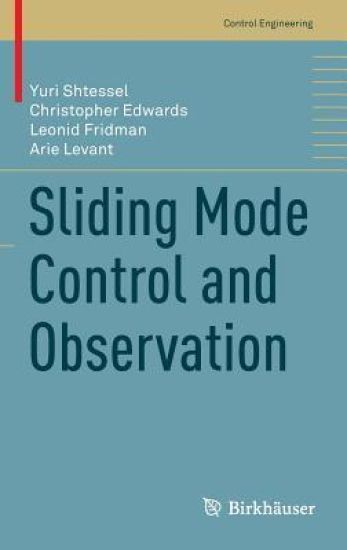
Sliding Mode Control and Observation

Sliding Mode Control and Observation

Yuri Shtessel; Christopher Edwards; Leonid Fridman; Arie Levant

Birkhauser Boston Inc
2015
nidottu
The sliding mode control methodology has proven effective in dealing with complex dynamical systems affected by disturbances, uncertainties and unmodeled dynamics. Robust control technology based on this methodology has been applied to many real-world problems, especially in the areas of aerospace control, electric power systems, electromechanical systems, and robotics. Sliding Mode Control and Observation represents the first textbook that starts with classical sliding mode control techniques and progresses toward newly developed higher-order sliding mode control and observation algorithms and their applications.The present volume addresses a range of sliding mode control issues, including:*Conventional sliding mode controller and observer design*Second-order sliding mode controllers and differentiators*Frequency domain analysis of conventional and second-order sliding mode controllers*Higher-order sliding mode controllers and differentiators*Higher-order sliding mode observers *Sliding mode disturbance observer based control *Numerous applications, including reusable launch vehicle and satellite formation control, blood glucose regulation, and car steering control are used as case studiesSliding Mode Control and Observation is aimed at graduate students with a basic knowledge of classical control theory and some knowledge of state-space methods and nonlinear systems, while being of interest to a wider audience of graduate students in electrical/mechanical/aerospace engineering and applied mathematics, as well as researchers in electrical, computer, chemical, civil, mechanical, aeronautical, and industrial engineering, applied mathematicians, control engineers, and physicists. Sliding Mode Control and Observation provides the necessary tools for graduate students, researchers and engineers to robustly control complex and uncertain nonlinear dynamical systems. Exercises provided at the end of each chapter make this an ideal text for an advanced course taught in control theory.
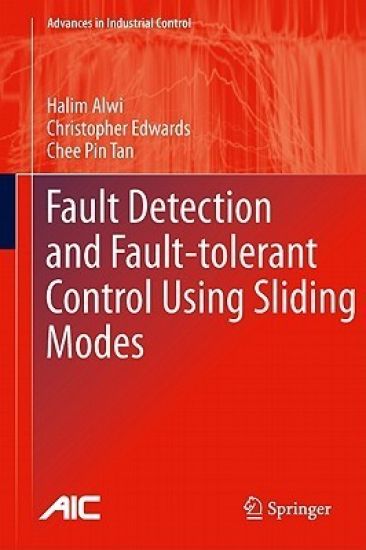
Fault Detection and Fault-Tolerant Control Using Sliding Modes

Fault Detection and Fault-Tolerant Control Using Sliding Modes

Halim Alwi; Christopher Edwards; Chee Pin Tan

Springer London Ltd
2013
nidottu
Fault Detection and Fault-tolerant Control Using Sliding Modes is the first text dedicated to showing the latest developments in the use of sliding-mode concepts for fault detection and isolation (FDI) and fault-tolerant control in dynamical engineering systems. It begins with an introduction to the basic concepts of sliding modes to provide a background to the field. This is followed by chapters that describe the use and design of sliding-mode observers for FDI using robust fault reconstruction. The development of a class of sliding-mode observers is described from first principles through to the latest schemes that circumvent minimum-phase and relative-degree conditions. Recent developments have shown that the field of fault tolerant control is a natural application of the well-known robustness properties of sliding-mode control. A family of sliding-mode control designs incorporating control allocation, which can deal with actuator failures directly by exploiting redundancy, is presented. Various realistic case studies, specifically highlighting aircraft systems and including results from the implementation of these designs on a motion flight simulator, are described. A reference and guide for researchers in fault detection and fault-tolerant control, this book will also be of interest to graduate students working with nonlinear systems and with sliding modes in particular. Advances in Industrial Control aims to report and encourage the transfer of technology in control engineering. The rapid development of control technology has an impact on all areas of the control discipline. The series offers an opportunity for researchers to present an extended exposition of new work in all aspects of industrial control.
Sliding Mode Control and Observation

Sliding Mode Control and Observation

Yuri Shtessel; Christopher Edwards; Leonid Fridman; Arie Levant

Birkhauser Boston Inc
2013
sidottu
The sliding mode control methodology has proven effective in dealing with complex dynamical systems affected by disturbances, uncertainties and unmodeled dynamics. Robust control technology based on this methodology has been applied to many real-world problems, especially in the areas of aerospace control, electric power systems, electromechanical systems, and robotics. Sliding Mode Control and Observation represents the first textbook that starts with classical sliding mode control techniques and progresses toward newly developed higher-order sliding mode control and observation algorithms and their applications.The present volume addresses a range of sliding mode control issues, including:*Conventional sliding mode controller and observer design*Second-order sliding mode controllers and differentiators*Frequency domain analysis of conventional and second-order sliding mode controllers*Higher-order sliding mode controllers and differentiators*Higher-order sliding mode observers *Sliding mode disturbance observer based control *Numerous applications, including reusable launch vehicle and satellite formation control, blood glucose regulation, and car steering control are used as case studiesSliding Mode Control and Observation is aimed at graduate students with a basic knowledge of classical control theory and some knowledge of state-space methods and nonlinear systems, while being of interest to a wider audience of graduate students in electrical/mechanical/aerospace engineering and applied mathematics, as well as researchers in electrical, computer, chemical, civil, mechanical, aeronautical, and industrial engineering, applied mathematicians, control engineers, and physicists. Sliding Mode Control and Observation provides the necessary tools for graduate students, researchers and engineers to robustly control complex and uncertain nonlinear dynamical systems. Exercises provided at the end of each chapter make this an ideal text for an advanced course taught in control theory.
Fault Detection and Fault-Tolerant Control Using Sliding Modes

Fault Detection and Fault-Tolerant Control Using Sliding Modes

Halim Alwi; Christopher Edwards; Chee Pin Tan

Springer London Ltd
2011
sidottu
Fault Detection and Fault-tolerant Control Using Sliding Modes is the first text dedicated to showing the latest developments in the use of sliding-mode concepts for fault detection and isolation (FDI) and fault-tolerant control in dynamical engineering systems. It begins with an introduction to the basic concepts of sliding modes to provide a background to the field. This is followed by chapters that describe the use and design of sliding-mode observers for FDI using robust fault reconstruction. The development of a class of sliding-mode observers is described from first principles through to the latest schemes that circumvent minimum-phase and relative-degree conditions. Recent developments have shown that the field of fault tolerant control is a natural application of the well-known robustness properties of sliding-mode control. A family of sliding-mode control designs incorporating control allocation, which can deal with actuator failures directly by exploiting redundancy, is presented. Various realistic case studies, specifically highlighting aircraft systems and including results from the implementation of these designs on a motion flight simulator, are described. A reference and guide for researchers in fault detection and fault-tolerant control, this book will also be of interest to graduate students working with nonlinear systems and with sliding modes in particular. Advances in Industrial Control aims to report and encourage the transfer of technology in control engineering. The rapid development of control technology has an impact on all areas of the control discipline. The series offers an opportunity for researchers to present an extended exposition of new work in all aspects of industrial control.
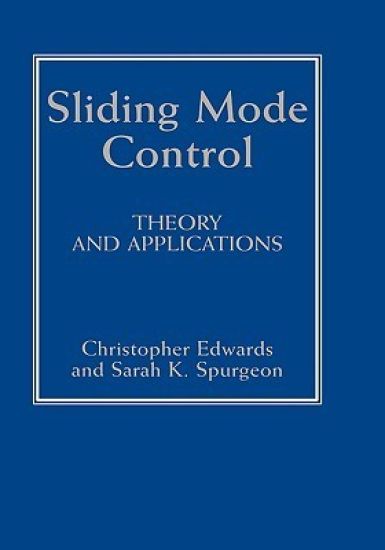
Sliding Mode Control

Sliding Mode Control

Christopher Edwards; Sarah K. Spurgeon

Taylor Francis Ltd
1998
sidottu
In the formation of any control problem there will be discrepancies between the actual plant and the mathematical model for controller design. Sliding mode control theory seeks to produce controllers to over some such mismatches. This text provides the reader with a grounding in sliding mode control and is appropriate for the graduate with a basic knowledge of classical control theory and some knowledge of state-space methods. From this basis, more advanced theoretical results are developed. Two industrial case studies, which present the results of sliding mode controller implementations, are used to illustrate the successful practical application theory.