
Kirjailija
Christopher Fry
Kirjat ja teokset yhdessä paikassa: 14 kirjaa, julkaisuja vuosilta 1981-2025, suosituimpien joukossa Hare. Vertaile teosten hintoja ja tarkista saatavuus suomalaisista kirjakaupoista.
14 kirjaa
Kirjojen julkaisuhaarukka 1981-2025.

This work has been selected by scholars as being culturally important and is part of the knowledge base of civilization as we know it.This work is in the public domain in the United States of America, and possibly other nations. Within the United States, you may freely copy and distribute this work, as no entity (individual or corporate) has a copyright on the body of the work.Scholars believe, and we concur, that this work is important enough to be preserved, reproduced, and made generally available to the public. To ensure a quality reading experience, this work has been proofread and republished using a format that seamlessly blends the original graphical elements with text in an easy-to-read typeface.We appreciate your support of the preservation process, and thank you for being an important part of keeping this knowledge alive and relevant.

This work has been selected by scholars as being culturally important and is part of the knowledge base of civilization as we know it.This work is in the public domain in the United States of America, and possibly other nations. Within the United States, you may freely copy and distribute this work, as no entity (individual or corporate) has a copyright on the body of the work.Scholars believe, and we concur, that this work is important enough to be preserved, reproduced, and made generally available to the public. To ensure a quality reading experience, this work has been proofread and republished using a format that seamlessly blends the original graphical elements with text in an easy-to-read typeface.We appreciate your support of the preservation process, and thank you for being an important part of keeping this knowledge alive and relevant.

This work has been selected by scholars as being culturally important and is part of the knowledge base of civilization as we know it.This work is in the public domain in the United States of America, and possibly other nations. Within the United States, you may freely copy and distribute this work, as no entity (individual or corporate) has a copyright on the body of the work.Scholars believe, and we concur, that this work is important enough to be preserved, reproduced, and made generally available to the public. To ensure a quality reading experience, this work has been proofread and republished using a format that seamlessly blends the original graphical elements with text in an easy-to-read typeface.We appreciate your support of the preservation process, and thank you for being an important part of keeping this knowledge alive and relevant.

This work has been selected by scholars as being culturally important and is part of the knowledge base of civilization as we know it.This work is in the public domain in the United States of America, and possibly other nations. Within the United States, you may freely copy and distribute this work, as no entity (individual or corporate) has a copyright on the body of the work.Scholars believe, and we concur, that this work is important enough to be preserved, reproduced, and made generally available to the public. To ensure a quality reading experience, this work has been proofread and republished using a format that seamlessly blends the original graphical elements with text in an easy-to-read typeface.We appreciate your support of the preservation process, and thank you for being an important part of keeping this knowledge alive and relevant.

Ion-Selective Electrodes for Biological Systems
Christopher Fry; Stephen Langley E N; Stephen Langley
TAYLOR FRANCIS LTD
2020
sidottu

Why Can't We All Just Get Along?: How Science Can Enable a More Cooperative Future.
Christopher Fry; Lieberman Henry
Henry Lieberman
2018
nidottu
Our goal is outrageous: solve the world's major social problems. Our strategy starts with bringing you on an exploration that includes identifying the big problems, analyzing underlying causes, recognizing commonalities, and providing solutions that address root causes.We hope you'll find insightful solutions that are, at least unconventional, perhaps even innovative. This means they are, by and large, not proven. If you said we're skating on thin ice, you'd be correct; but we're going to lace up anyway. The temporary band-aids of conventional wisdom are not working. Band-aids may simply fill a niche precluding real solutions. All that's necessary for the bad guys to win is for the good guys to be distracted with the insufficient. The clock is ticking.The first part, What keeps us from getting along? presents our fundamental argument, drawing from mathematics, psychology, and evolutionary theory. It gives you the tools for thinking about the rest of the issues we will cover.The second part, Does human nature allow us to get along? debunks arguments that say that aggression, conflict, greed, and war are inevitable. This stance of inevitability is perhaps the biggest obstacle we have, since if you believe something is inevitable, you won't be motivated to change it. Sure, there's plenty of history that might make you pessimistic. But we claim that these negative tendencies are due to scarcity and societal conditions. We now have the technology to change them.The third part is Can we get along economically?. The economy has been an unending source of conflict, as, after thousands of years, we still struggle to provide enough for everybody. Today's economic systems, Capitalism and Communism, were the economic technologies of the Industrial Revolution era. That era is drawing to a close, and those systems are now obsolete. If we play our cards right, AI and personal manufacturing will usher in the next era, which we call Makerism.In Can government help us get along? we rethink the role of governments as a vehicle for making collective decisions in society. Representative democracy as practiced in the USA is considered the "gold standard", but like the gold standard for money, maybe there's now another way. We present a proposal which we call Reasonocracy, inspired by the collaborative processes of the scientific community instead of the competitive, power-based processes of today's governments. Finally, in How can we get along in....? we give our prescriptions for making a more cooperative society in a number of specific areas. Education. Justice. Guns. Transportation. Infrastructure. These flesh out some concrete solutions to contemporary issues, inspired by our principles.We are not on a sustainable path. Whether current trends end in chaos or not is up to us. Join us on a journey through solution-space, where we challenge the assumption that adversarial and competitive structures are necessary to get things done.
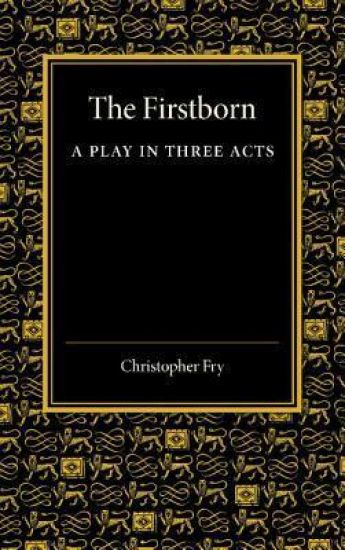
Christopher Fry (1907–2005) was an English playwright, particularly well known for verse dramas such as The Lady's Not for Burning. First published in 1946, this book contains the complete text of The Firstborn, a three act play by Fry set during the summer of 1200 BC in Ancient Egypt. This book will be of value to anyone with an interest in British theatre and verse drama.
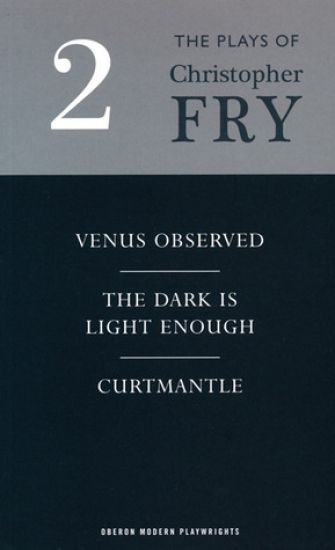
To coincide with the centenary of his birth in December 1907, Oberon is pleased to be publishing three volumes of plays by Christopher Fry, one of the most influential playwrights of Britain in the twentieth century. Fry's autumn and winter plays - "Venus Observed" and "The Dark is Light Enough" - are joined by the historical play "Curtmantle", about Henry II. All three focus on a compelling central character who dominates those around them.
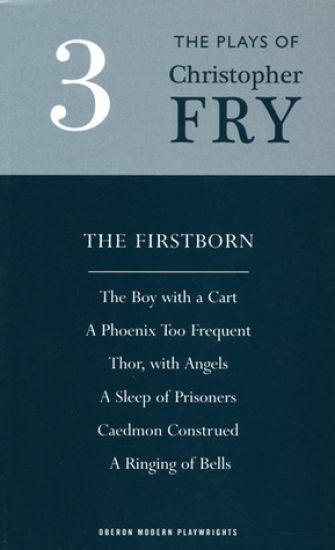
To coincide with the centenary of his birth in December 1907, Oberon is pleased to be publishing three volumes of plays by Christopher Fry, one of the most influential playwrights of Britain in the twentieth century. This third volume of Fry's original plays brings together his only fully-fledged tragedy - "The Firstborn", based on the Biblical story of the plagues of Egypt - and his six one-act plays.
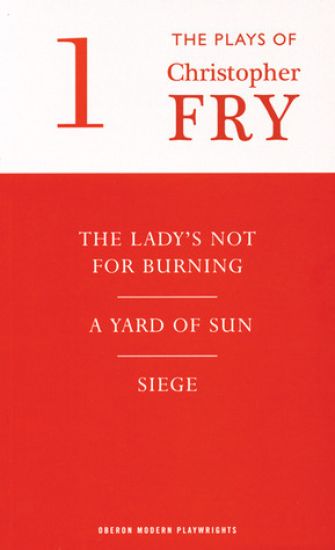
To coincide with the centenary of his birth in December 1907, Oberon is pleased to be publishing three volumes of plays by Christopher Fry, one of the most influential playwrights of Britain in the twentieth century. In this volume Christopher Fry's most famous work, "The Lady's Not for Burning" - spring in his set of 'Seasonal Plays' - is joined by the summer play "A Yard of Sun", and a previously unpublished early play, "Siege", based on the story of Aucassin and Nicolette.

Ion-Selective Electrodes for Biological Systems
Christopher Fry; Stephen Langley E. N.; Stephen Langley
Harwood Academic (Medical, Reference and Social Sc
2002
nidottu

A couple - shall we call them Adam and Eve? - unsure of their whereabouts on Millennium New Year's Eve, come into a hotel, seeking directions while Church bells peal out their message. The receptionist, however, has no quick answers. One's place, he claims, depends on one's vantage point in time.

Resigning himself to the autumn of his life, the Duke prepares to seek a wife from three of his former mistresses, selected by his son, following the tradition of Paris by offering an apple to the chosen one. However when a radiant young girl, Perpetua arrives. The Duke snatches the apple and offers it to her, but she draws on a pistol and shatters it. Her father the agent wishes her to marry the Duke, but the latter resigns himself to marrying the mistress who really loves him.-4 women, 6 men