Kirjojen hintavertailu. Mukana 12 390 323 kirjaa ja 12 kauppaa.

Kirjailija

Christopher G. Small

Kirjat ja teokset yhdessä paikassa: 8 kirjaa, julkaisuja vuosilta 1988-2011, suosituimpien joukossa Expansions and Asymptotics for Statistics. Vertaile teosten hintoja ja tarkista saatavuus suomalaisista kirjakaupoista.

8 kirjaa

Kirjojen julkaisuhaarukka 1988-2011.

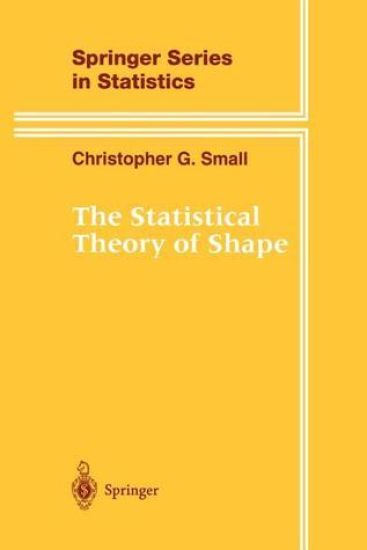
The Statistical Theory of Shape

The Statistical Theory of Shape

Christopher G. Small

Springer-Verlag New York Inc.
2011
nidottu
In general terms, the shape of an object, data set, or image can be de­ fined as the total of all information that is invariant under translations, rotations, and isotropic rescalings. Thus two objects can be said to have the same shape if they are similar in the sense of Euclidean geometry. For example, all equilateral triangles have the same shape, and so do all cubes. In applications, bodies rarely have exactly the same shape within measure­ ment error. In such cases the variation in shape can often be the subject of statistical analysis. The last decade has seen a considerable growth in interest in the statis­ tical theory of shape. This has been the result of a synthesis of a number of different areas and a recognition that there is considerable common ground among these areas in their study of shape variation. Despite this synthesis of disciplines, there are several different schools of statistical shape analysis. One of these, the Kendall school of shape analysis, uses a variety of mathe­ matical tools from differential geometry and probability, and is the subject of this book. The book does not assume a particularly strong background by the reader in these subjects, and so a brief introduction is provided to each of these topics. Anyone who is unfamiliar with this material is advised to consult a more complete reference. As the literature on these subjects is vast, the introductory sections can be used as a brief guide to the literature.
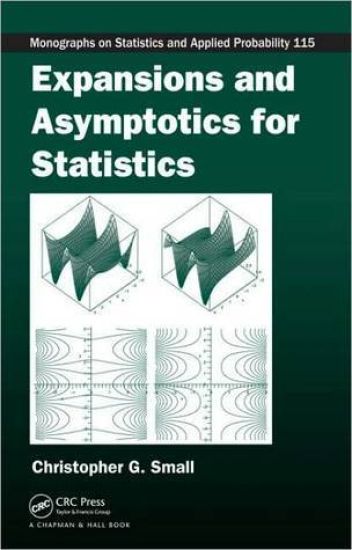
Expansions and Asymptotics for Statistics

Expansions and Asymptotics for Statistics

Christopher G. Small

Chapman Hall/CRC
2010
sidottu
Asymptotic methods provide important tools for approximating and analysing functions that arise in probability and statistics. Moreover, the conclusions of asymptotic analysis often supplement the conclusions obtained by numerical methods. Providing a broad toolkit of analytical methods, Expansions and Asymptotics for Statistics shows how asymptotics, when coupled with numerical methods, becomes a powerful way to acquire a deeper understanding of the techniques used in probability and statistics. The book first discusses the role of expansions and asymptotics in statistics, the basic properties of power series and asymptotic series, and the study of rational approximations to functions. With a focus on asymptotic normality and asymptotic efficiency of standard estimators, it covers various applications, such as the use of the delta method for bias reduction, variance stabilisation, and the construction of normalising transformations, as well as the standard theory derived from the work of R.A. Fisher, H. Cramér, L. Le Cam, and others. The book then examines the close connection between saddle-point approximation and the Laplace method. The final chapter explores series convergence and the acceleration of that convergence.
Functional Equations and How to Solve Them

Functional Equations and How to Solve Them

Christopher G. Small

Springer-Verlag New York Inc.
2007
nidottu
Over the years, a number of books have been written on the theory of functional equations. However, very little has been published which helps readers to solve functional equations in mathematics competitions and mathematical problem solving. This book fills that gap. The student who encounters a functional equation on a mathematics contest will need to investigate solutions to the equation by finding all solutions, or by showing that all solutions have a particular property. The emphasis here will be on the development of those tools which are most useful in assigning a family of solutions to each functional equation in explicit form. At the end of each chapter, readers will find a list of problems associated with the material in that chapter. The problems vary greatly, with the easiest problems being accessible to any high school student who has read the chapter carefully. The most difficult problems will be a reasonable challenge to advanced students studying for the International Mathematical Olympiad at the high school level or the William Lowell Putnam Competition for university undergraduates. The book ends with an appendix containing topics that provide a springboard for further investigation of the concepts of limits, infinite series and continuity.
Functional Equations and How to Solve Them

Functional Equations and How to Solve Them

Christopher G. Small

Springer-Verlag New York Inc.
2006
sidottu
Over the years, a number of books have been written on the theory of functional equations. However, very little has been published which helps readers to solve functional equations in mathematics competitions and mathematical problem solving. This book fills that gap. The student who encounters a functional equation on a mathematics contest will need to investigate solutions to the equation by finding all solutions, or by showing that all solutions have a particular property. The emphasis here will be on the development of those tools which are most useful in assigning a family of solutions to each functional equation in explicit form. At the end of each chapter, readers will find a list of problems associated with the material in that chapter. The problems vary greatly, with the easiest problems being accessible to any high school student who has read the chapter carefully. The most difficult problems will be a reasonable challenge to advanced students studying for the International Mathematical Olympiad at the high school level or the William Lowell Putnam Competition for university undergraduates. The book ends with an appendix containing topics that provide a springboard for further investigation of the concepts of limits, infinite series and continuity.
Numerical Methods for Nonlinear Estimating Equations

Numerical Methods for Nonlinear Estimating Equations

Christopher G. Small; Jinfang Wang

Oxford University Press
2003
sidottu
Nonlinearity arises in statistical inference in various ways, with varying degrees of severity, as an obstacle to statistical analysis. More entrenched forms of nonlinearity often require intensive numerical methods to construct estimators, and the use of root search algorithms, or one-step estimators, is a standard method of solution. This book provides a comprehensive study of nonlinear estimating equations and artificial likelihoods for statistical inference. It provides extensive coverage and comparison of hill climbing algorithms, which, when started at points of nonconcavity often have very poor convergence properties, and for additional flexibility proposes a number of modifications to the standard methods for solving these algorithms. The book also extends beyond simple root search algorithms to include a discussion of the testing of roots for consistency, and the modification of available estimating functions to provide greater stability in inference. A variety of examples from practical applications are included to illustrate the problems and possibilities thus making this text ideal for the research statistician and graduate student. This is the latest in the well-established and authoritative Oxford Statistical Science Series, which includes texts and monographs covering many topics of current research interest in pure and applied statistics. Each title has an original slant even if the material included is not specifically original. The authors are leading researchers and the topics covered will be of interest to all professional statisticians, whether they be in industry, government department or research institute. Other books in the series include 23. W.J.Krzanowski: Principles of multivariate analysis: a user's perspective updated edition 24. J.Durbin and S.J.Koopman: Time series analysis by State Space Models 25. Peter J. Diggle, Patrick Heagerty, Kung-Yee Liang, Scott L. Zeger: Analysis of Longitudinal Data 2/e 26. J.K. Lindsey: Nonlinear Models in Medical Statistics 27. Peter J. Green, Nils L. Hjort & Sylvia Richardson: Highly Structured Stochastic Systems 28. Margaret S. Pepe: The Statistical Evaluation of Medical Tests for Classification and Prediction
The Statistical Theory of Shape

The Statistical Theory of Shape

Christopher G. Small

Springer-Verlag New York Inc.
1996
sidottu
In general terms, the shape of an object, data set, or image can be de­ fined as the total of all information that is invariant under translations, rotations, and isotropic rescalings. Thus two objects can be said to have the same shape if they are similar in the sense of Euclidean geometry. For example, all equilateral triangles have the same shape, and so do all cubes. In applications, bodies rarely have exactly the same shape within measure­ ment error. In such cases the variation in shape can often be the subject of statistical analysis. The last decade has seen a considerable growth in interest in the statis­ tical theory of shape. This has been the result of a synthesis of a number of different areas and a recognition that there is considerable common ground among these areas in their study of shape variation. Despite this synthesis of disciplines, there are several different schools of statistical shape analysis. One of these, the Kendall school of shape analysis, uses a variety of mathe­ matical tools from differential geometry and probability, and is the subject of this book. The book does not assume a particularly strong background by the reader in these subjects, and so a brief introduction is provided to each of these topics. Anyone who is unfamiliar with this material is advised to consult a more complete reference. As the literature on these subjects is vast, the introductory sections can be used as a brief guide to the literature.
The Theory and Applications of Statistical Interference Functions

The Theory and Applications of Statistical Interference Functions

D.L. McLeish; Christopher G. Small

Springer-Verlag New York Inc.
1988
nidottu
This monograph arose out of a desire to develop an approach to statistical infer­ ence that would be both comprehensive in its treatment of statistical principles and sufficiently powerful to be applicable to a variety of important practical problems. In the latter category, the problems of inference for stochastic processes (which arise com­ monly in engineering and biological applications) come to mind. Classes of estimating functions seem to be promising in this respect. The monograph examines some of the consequences of extending standard concepts of ancillarity, sufficiency and complete­ ness into this setting. The reader should note that the development is mathematically "mature" in its use of Hilbert space methods but not, we believe, mathematically difficult. This is in keeping with our desire to construct a theory that is rich in statistical tools for infer­ ence without the difficulties found in modern developments, such as likelihood analysis of stochastic processes or higher order methods, to name but two. The fundamental notions of orthogonality and projection are accessible to a good undergraduate or beginning graduate student. We hope that the monograph will serve the purpose of enriching the methods available to statisticians of various interests.