Kirjojen hintavertailu. Mukana 12 390 323 kirjaa ja 12 kauppaa.

Kirjailija

Christopher Hay-Jahans

Kirjat ja teokset yhdessä paikassa: 6 kirjaa, julkaisuja vuosilta 2011-2026, suosituimpien joukossa An R Companion to Linear Statistical Models. Vertaile teosten hintoja ja tarkista saatavuus suomalaisista kirjakaupoista.

6 kirjaa

Kirjojen julkaisuhaarukka 2011-2026.

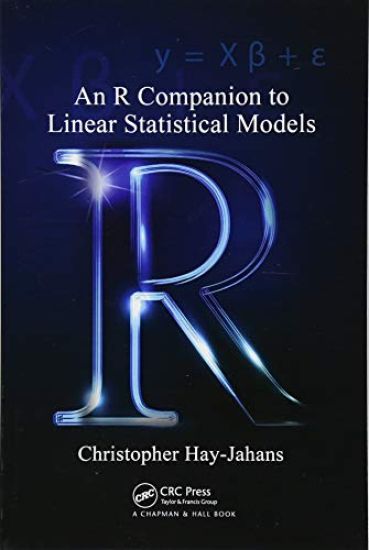
An R Companion to Linear Statistical Models

An R Companion to Linear Statistical Models

Christopher Hay-Jahans

TAYLOR FRANCIS LTD
2026
nidottu
Taking advantage of both user-developed code and specialized functions, this second edition of An R Companion to Linear Statistical Models again targets two primary audiences: Those who are familiar with the introductory theory and applications of linear statistical models and who wish to learn how to use R in this area, or explore further ideas that might appear in this Companion; and those who are enrolled in an intermediate to advanced level course on linear statistical models for which R is the computational platform. This Companion includes accessible introductions to writing R code as well as making use of functions through relevant examples. These examples cover methods used for linear regression and designed experiments with up to two fixed-effects factors, including blocking variables and covariates. Also included in this edition is a new part containing chapters that revisit the one-factor fixed-effects model from alternative points of view, and provide introductions to applying R to nonstandard linear contrasts, one-factor random-effects and repeated-measures designs, weighted least squares, and modelling with binary response data. Key Features Demonstrates how to create user-defined functions, and how to use pre-packaged functions from the Comprehensive R Archive Network (CRAN) as well as functions prepared specifically for this Companion. Has carefully documented accompanying R script files that follow along with the discussions in the book, and also contain additional exploratory code. Makes use of a relevant collection of examples to demonstrate both the statistical methods being discussed, as well as the R code used implement the methods. Provides detailed interpretations and explanations of graphical tools used, computed model parameter estimates, associated tests, and common “rules of thumb” used in interpreting graphs and computational output. Limits statistical and mathematical background theory to that which aids in following computational methods.
Biomathematical Modeling

Biomathematical Modeling

Olcay Akman; Christopher Hay-Jahans

De Gruyter
2025
isokokoinen pokkari
Welcome to the fascinating intersection of mathematics, biology, and ecology! This book is intended primarily as a resource for teachers planning to teach their first introductory course on modeling in mathematical biology and/or ecology. This being said, it can also be used by students preparing to embark on an independent studies project in one of these fields; or, by researchers unfamiliar with the methods or software introduced who are seeking an accessible and quick introduction to one of the methods and/or software presented here; or, by curious biologists, ecologists, or mathematicians who may be unfamiliar with "the other side;" or, maybe, by the perpetual learner who is intrigued by the dynamics of living ecosystems. For each of the above, this book is designed to be an accessible introduction to the captivating landscape of biomathematics. The approach used in this book takes advantage of technology in leading readers on a journey that bridges seemingly distinct fields through introductions to three methods and software platforms: Compartmental models with Berkeley Madonna; agent-based models with NetLogo; and cluster analysis through selforganizing maps using an R Shiny app. This is not intended to be a textbook (though it may be used as one), nor is it a purely mathematics book or one purely about deeper aspects of biology or ecology. It focuses on three selected ways in which the intersection of mathematics and biology (and mathematics and ecology) can be explored with the help of software. Moreover, the manner in which the content is presented makes it possible to use this book to help prepare for an introductory course at a wide range of levels, depending on the discipline within which the course is taught and the mathematical prerequisites for the course. There are four chapters, the first of which presents the reader with a bit of background information followed by suggestions on how to get the most out of this book. The three core chapters introduce the three previously mentioned methods and software in a manner envisioned to be accessible to most.
R Companion to Elementary Applied Statistics

R Companion to Elementary Applied Statistics

Christopher Hay-Jahans

CRC Press
2019
sidottu
The R Companion to Elementary Applied Statistics includes traditional applications covered in elementary statistics courses as well as some additional methods that address questions that might arise during or after the application of commonly used methods. Beginning with basic tasks and computations with R, readers are then guided through ways to bring data into R, manipulate the data as needed, perform common statistical computations and elementary exploratory data analysis tasks, prepare customized graphics, and take advantage of R for a wide range of methods that find use in many elementary applications of statistics.Features: Requires no familiarity with R or programming to begin using this book. Can be used as a resource for a project-based elementary applied statistics course, or for researchers and professionals who wish to delve more deeply into R. Contains an extensive array of examples that illustrate ideas on various ways to use pre-packaged routines, as well as on developing individualized code. Presents quite a few methods that may be considered non-traditional, or advanced. Includes accompanying carefully documented script files that contain code for all examples presented, and more.R is a powerful and free product that is gaining popularity across the scientific community in both the professional and academic arenas. Statistical methods discussed in this book are used to introduce the fundamentals of using R functions and provide ideas for developing further skills in writing R code. These ideas are illustrated through an extensive collection of examples. About the Author: Christopher Hay-Jahans received his Doctor of Arts in mathematics from Idaho State University in 1999. After spending three years at University of South Dakota, he moved to Juneau, Alaska, in 2002 where he has taught a wide range of undergraduate courses at University of Alaska Southeast.
R Companion to Elementary Applied Statistics

R Companion to Elementary Applied Statistics

Christopher Hay-Jahans

CRC Press
2019
nidottu
The R Companion to Elementary Applied Statistics includes traditional applications covered in elementary statistics courses as well as some additional methods that address questions that might arise during or after the application of commonly used methods. Beginning with basic tasks and computations with R, readers are then guided through ways to bring data into R, manipulate the data as needed, perform common statistical computations and elementary exploratory data analysis tasks, prepare customized graphics, and take advantage of R for a wide range of methods that find use in many elementary applications of statistics.Features: Requires no familiarity with R or programming to begin using this book. Can be used as a resource for a project-based elementary applied statistics course, or for researchers and professionals who wish to delve more deeply into R. Contains an extensive array of examples that illustrate ideas on various ways to use pre-packaged routines, as well as on developing individualized code. Presents quite a few methods that may be considered non-traditional, or advanced. Includes accompanying carefully documented script files that contain code for all examples presented, and more.R is a powerful and free product that is gaining popularity across the scientific community in both the professional and academic arenas. Statistical methods discussed in this book are used to introduce the fundamentals of using R functions and provide ideas for developing further skills in writing R code. These ideas are illustrated through an extensive collection of examples. About the Author: Christopher Hay-Jahans received his Doctor of Arts in mathematics from Idaho State University in 1999. After spending three years at University of South Dakota, he moved to Juneau, Alaska, in 2002 where he has taught a wide range of undergraduate courses at University of Alaska Southeast.
An R Companion to Linear Statistical Models

An R Companion to Linear Statistical Models

Christopher Hay-Jahans; Chris Hay-Jahans

CRC Press
2017
nidottu
Focusing on user-developed programming, An R Companion to Linear Statistical Models serves two audiences: those who are familiar with the theory and applications of linear statistical models and wish to learn or enhance their skills in R; and those who are enrolled in an R-based course on regression and analysis of variance. For those who have never used R, the book begins with a self-contained introduction to R that lays the foundation for later chapters.This book includes extensive and carefully explained examples of how to write programs using the R programming language. These examples cover methods used for linear regression and designed experiments with up to two fixed-effects factors, including blocking variables and covariates. It also demonstrates applications of several pre-packaged functions for complex computational procedures.
An R Companion to Linear Statistical Models

An R Companion to Linear Statistical Models

Christopher Hay-Jahans; Chris Hay-Jahans

Taylor Francis Inc
2011
sidottu
Focusing on user-developed programming, An R Companion to Linear Statistical Models serves two audiences: those who are familiar with the theory and applications of linear statistical models and wish to learn or enhance their skills in R; and those who are enrolled in an R-based course on regression and analysis of variance. For those who have never used R, the book begins with a self-contained introduction to R that lays the foundation for later chapters.This book includes extensive and carefully explained examples of how to write programs using the R programming language. These examples cover methods used for linear regression and designed experiments with up to two fixed-effects factors, including blocking variables and covariates. It also demonstrates applications of several pre-packaged functions for complex computational procedures.