Kirjojen hintavertailu. Mukana 12 484 719 kirjaa ja 12 kauppaa.

Kirjailija

Christopher Hood

Kirjat ja teokset yhdessä paikassa: 27 kirjaa, julkaisuja vuosilta 1981-2024, suosituimpien joukossa Riigikunst. kultuur, retoorika ja avalik juhtimine. Vertaile teosten hintoja ja tarkista saatavuus suomalaisista kirjakaupoista.

27 kirjaa

Kirjojen julkaisuhaarukka 1981-2024.

The Corporate Klan

The Corporate Klan

Christopher Hood

Book Publishing Solutions
2024
pokkari
In America, we are still a society with the deeply embedded idea that white skin is superior to all others. This idea is not subject to change in the eyes of those who benefit from it. You are about to read a story of lies, determination, anger, and hard-fought victory. What you will find here is a new approach to our nation's sick corporate culture. When an African American executive takes a high-profile position in a major corporation, covert internal racism surfaces among white employees.With an outstanding work ethic, he becomes the envy of the company. However, more than hard work is needed; as he is under attack for no apparent reason. He's targeted, plotted against, and falsely accused of corporate crimes, including embezzlement, taking kickbacks, and forgery. He is angered and outraged by the false charges and demands proof of each allegation.The company, however, offers him nothing but more and more outrageous false charges. The dirty air of racism is all around him and the executive decides to become an industrial spy. His covert undercover efforts were extensive and yielded over 30,000 documents. The undercover spying proved that the company had stolen over $18 million from the nation's Police Departments. This results in a David and Goliath battle with only one winner. The Corporate Klan is a true story that should be a warning to every CEO in America.

Killing Detroit

Killing Detroit

Christopher Hood

Book Publishing Solutions
2023
pokkari
Dealing CIA Cocaine... And A City Dies Killing Detroit pulls the sheets off a well-planned government scheme that left broken neighborhoods, fractured families, and dead bodies in its wake. Over fifty years later, Detroit is still reeling from this scheme of murder and financial destruction. For the first time since before the Civil War, Detroit is no longer among the nation's 20 most populous cities. Detroit's population was 677,116 last summer, a loss of 3,107 residents from the previous year, according to the U.S. Census Bureau. That loss was enough to drop the city to the 21st largest city in the nation, surpassed by Seattle, Denver, and, of all places, El Paso, Texas. At one time, Detroit was the richest and fourth largest city in America, behind New York, Chicago, and Philadelphia. Killing Detroit exposes the critical events behind the rapid decline of this once-great city.About Killing DetroitKilling Detroit is the true story of a black activist searching for justice. Carl, a lifelong resident of Detroit, notices rampant drug dealing on the streets of the city's black neighborhoods. Drug houses and street dealers have the protection of the Detroit Police Department. Carl is outraged and forms a group to expose the corruption inside the FBI and Detroit Police Department. His tireless efforts resulted in a series of unexpected and violent attacks by the federal government. Killing Detroit reveals in detail for the first time the plot to destroy a city and its citizens and the voices of dissent. Learn what transformed this once-thriving city into the nation's most notorious drug den almost overnight. The award-winning screenplay is now in book form order today
The Way the Money Goes

The Way the Money Goes

Christopher Hood; Maia King; Iain McLean; Barbara Maria Piotrowska

Oxford University Press
2023
sidottu
The Way the Money Goes traces out what happened to the UK's fiscal constitution - the framework for planning and controlling public spending - under three different governments (Conservative, Labour, Conservative/Liberal Democrat) from the early 1990s to the mid-2010s. The book tells the story of what happened under each government and combines narrative with vignettes that range from the funding of a new Treasury building to efforts to 'crowdsource' ideas for spending cuts. It also includes chapters devoted to different domains of spending control, namely capital spending, spending by subnational governments, running cost expenditure, fiscal forecasting, and the development of new accounting metrics. This book is based on over 120 in-depth interviews of civil servants and ministers who were involved in public spending over the period, as well as documents from the same timeframe. It explores how and why, despite much talk of change and reform in everything from parliamentary procedure to bureaucratic processes, many of the underlying features of the UK's fiscal constitution persisted, including arrangements for formula-funding of the different countries within the union designed as a temporary stopgap in the transition to devolution. To put UK developments into perspective, the book includes a discussion of how the UK system was rated in reports from international bodies over the period, which suggests that in such exercises the more 'political' parts of the fiscal constitution were rated differently from the more 'technocratic' parts. Given several volcanic-type political eruptions in the UK over recent years, the book concludes by exploring some different possible scenarios for the future of its fiscal constitution in the light of those and other possible eruptions to come.
Riigikunst. kultuur, retoorika ja avalik juhtimine

Riigikunst. kultuur, retoorika ja avalik juhtimine

Christopher Hood

TALLINNA ÜLIKOOL
2022
nidottu
Miks avalik juhtimine - riigikunst - nii sageli ebaõnnestub ning avaliku teenistus muutub fiaskoks ja läbikukkumiste jadaks? Mil moel saab valitsemist kontrollida? Miks on avaliku teenistuse parandamise juhised vastuolulised ja kas moderniseerumine ongi määratud valitsemise korraldamises tootma ülemaailmset ühetaolisust? Christopher Hoodi uurimuse eesmärk on vastata neile avaliku halduse üle peetavate arutelude põhiküsimustele. Raamat ühendab nüüdisaegse ja ajaloolise kogemuse ning kasutab uurimuse raamistiku ja meetodina võrgustike ja rühmade kultuuriteooriat. Eri paikadest ja ajastutest pärit näiteid kasutades püüab Hood tuvastada ikka ja jälle üleskerkivaid ideid riigivalitsemise korralduses. Vastupidiselt laialt levinud väitele, et moderniseerimine toob kaasa globaalse ühtlustumise, väidab ta, et tõenäoliselt ei kao mitmekesisus ei avaliku halduse doktriinist ega praktikast.Cristopher Hoodi "Riigikunst" on üks avaliku halduse ja juhtimise võtmetekste. Raamat analüüsib riigivalitsemist kultuurikeskselt ning on jätkuvalt väga ajakohane lugemine, seda eriti Eesti kontekstis, kus uusliberalismi ja positivistliku lähenemisviisi mõju on suur.
Hijacking Japan

Hijacking Japan

Christopher Hood

Lulu.com
2019
nidottu
It was meant to be a chance to escape the hustle and bustle of Tokyo. Nicola was working hard as an English teacher in Japan; she desperately needed a holiday. A long weekend with her boyfriend, Akira, and two other friends, Mai and Masashi, seemed ideal. The four of them would travel by Japan's safest form of transport, the shinkansen ('bullet train'), before boarding a ferry for the trip across to the quiet island of Sado. However, Nicola and her friends could never imagine that they would become caught up in a hijacking. Why would someone want to hijack this train? How would Nicola and her friends respond to being on a hijacked train? Would the police be able to catch those responsible? Hijacking Japan follows events in a real-time format during a dramatic day that threatens to bring the Japanese government to its knees.
Osutaka

Osutaka

Christopher Hood

Lulu.com
2018
pokkari
The loss of a loved one is a traumatic event. If the loved one is your child, the emotions are further tested. Imagine having to cope with all of these feelings when also adding into the mix the challenges when the death happens on the other side of the planet in a country with a different language and culture. This is what one man had to face when his son died in the world's largest single plane crash. Peter Mathews lost his son Kimble, who was travelling with his fianc e Masako Nishiguchi, in the flight JL123 crash on 12 August 1985. From the time of the first phone call through his trip to Japan until his return back to the UK, Peter kept a diary and took photographs. Using these materials as a basis, this book provides an amazing insight into the events of August 1985. The book also includes details of the experiences and lessons learned by the JAL employee, Keith Haines, who was assigned to accompany the Mathews family to Japan. Their story is as relevant today as it was in 1985.
A Century of Fiscal Squeeze Politics

A Century of Fiscal Squeeze Politics

Christopher Hood; Rozana Himaz

Oxford University Press
2017
sidottu
This volume identifies and compares 'fiscal squeezes' (major efforts to cut public spending and/or raise taxes) in the UK over a century from 1900 to 2015. The authors examine how different the politics of fiscal squeeze and austerity is today from what it was a century ago, how (if at all) fiscal squeezes reshaped the state and the provision of public services, and how political credit and blame played out after austerity episodes. The analysis is both quantitative and qualitative, starting with reported financial outcomes from historical statistics and then going behind those numbers to explore the political choices and processes in play. This analysis identifies some patterns that have not been explained or even recognized in earlier works on retrenchment and austerity. For example, it identifies a long term shift from what it terms a 'surgery without anaesthetics' approach (deep but short-lived episodes of spending restraint or tax increases) in the earlier part of the period towards a 'boiling frogs' approach (episodes in which the pain is spread out over a longer period) in more recent decades. It also identifies a curious reduction of revenue-led squeezes in more recent decades, and a puzzle over why blame-avoidance logic only led to outsourcing painful decisions over squeeze in a minority of cases. Furthermore, the volume's distinctive approach to classifying types of fiscal squeezes and qualitatively assessing their intensity seeks to solve the puzzle as to why voter'punishment' of governments that impose austerity policies seems to be so erratic.
A Government that Worked Better and Cost Less?

A Government that Worked Better and Cost Less?

Christopher Hood; Ruth Dixon

Oxford University Press
2015
sidottu
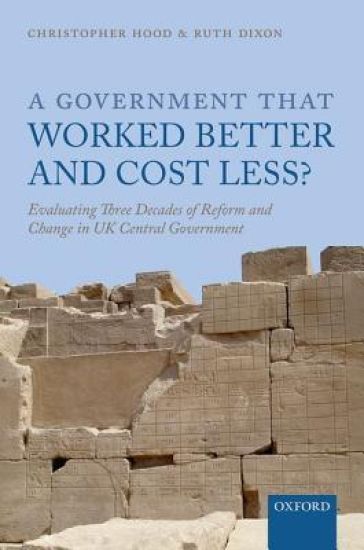
The UK is said to have been one of the most prolific reformers of its public administration. Successive reforms have been accompanied by claims that the changes would make the world a better place by transforming the way government worked. Despite much discussion and debate over government makeovers and reforms, however, there has been remarkably little systematic evaluation of what happened to cost and performance in UK government during the last thirty years. A Government that Worked Better and Cost Less? aims to address that gap, offering a unique evaluation of UK government modernization programmes from 1980 to the present day. The book provides a distinctive framework for evaluating long-term performance in government, bringing together the 'working better' and 'costing less' dimensions, and presents detailed primary evidence within that framework. This book explores the implications of their findings for widely held ideas about public management, the questions they present, and their policy implications for a period in which pressures to make government 'work better and cost less' are unlikely to go away.
The Blame Game

The Blame Game

Christopher Hood

Princeton University Press
2013
pokkari
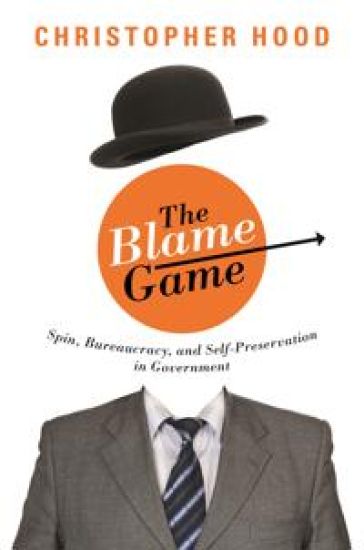
The blame game, with its finger-pointing and mutual buck-passing, is a familiar feature of politics and organizational life, and blame avoidance pervades government and public organizations at every level. Political and bureaucratic blame games and blame avoidance are more often condemned than analyzed. In The Blame Game, Christopher Hood takes a different approach by showing how blame avoidance shapes the workings of government and public services. Arguing that the blaming phenomenon is not all bad, Hood demonstrates that it can actually help to pin down responsibility, and he examines different kinds of blame avoidance, both positive and negative. Hood traces how the main forms of blame avoidance manifest themselves in presentational and "spin" activity, the architecture of organizations, and the shaping of standard operating routines. He analyzes the scope and limits of blame avoidance, and he considers how it plays out in old and new areas, such as those offered by the digital age of websites and e-mail. Hood assesses the effects of this behavior, from high-level problems of democratic accountability trails going cold to the frustrations of dealing with organizations whose procedures seem to ensure that no one is responsible for anything. Delving into the inner workings of complex institutions, The Blame Game proves how a better understanding of blame avoidance can improve the quality of modern governance, management, and organizational design.
Dealing with Disaster in Japan

Dealing with Disaster in Japan

Christopher Hood

Routledge
2013
nidottu
Just as the sinking of the Titanic is embedded in the public consciousness in the English-speaking world, so the crash of JAL flight JL123 is part of the Japanese collective memory. The 1985 crash involved the largest loss of life for any single air crash in the world. 520 people, many of whom had been returning to their ancestral home for the Obon religious festival, were killed; there were only four survivors.This book tells the story of the crash, discusses the many controversial issues surrounding it, and considers why it has come to have such importance for many Japanese. It shows how the Japanese responded to the disaster: trying to comprehend how a faulty repair may have caused the crash, and the fact that rescue services took such a long time to reach the remote crash site; how the bereaved dealt with their loss; how the media in Japan and in the wider world reported the disaster; and how the disaster is remembered and commemorated. The book highlights the media coverage of anniversary events and the Japanese books and films about the crash; the very particular memorialization process in Japan, alongside Japanese attitudes to death and religion; it points out in what ways this crash both reflects typical Japanese behaviour and in what ways the crash is unique.
Dealing with Disaster in Japan

Dealing with Disaster in Japan

Christopher Hood

Routledge
2011
sidottu
Just as the sinking of the Titanic is embedded in the public consciousness in the English-speaking world, so the crash of JAL flight JL123 is part of the Japanese collective memory. The 1985 crash involved the largest loss of life for any single air crash in the world. 520 people, many of whom had been returning to their ancestral home for the Obon religious festival, were killed; there were only four survivors.This book tells the story of the crash, discusses the many controversial issues surrounding it, and considers why it has come to have such importance for many Japanese. It shows how the Japanese responded to the disaster: trying to comprehend how a faulty repair may have caused the crash, and the fact that rescue services took such a long time to reach the remote crash site; how the bereaved dealt with their loss; how the media in Japan and in the wider world reported the disaster; and how the disaster is remembered and commemorated. The book highlights the media coverage of anniversary events and the Japanese books and films about the crash; the very particular memorialization process in Japan, alongside Japanese attitudes to death and religion; it points out in what ways this crash both reflects typical Japanese behaviour and in what ways the crash is unique.
The Blame Game

The Blame Game

Christopher Hood

Princeton University Press
2010
sidottu
The blame game, with its finger-pointing and mutual buck-passing, is a familiar feature of politics and organizational life, and blame avoidance pervades government and public organizations at every level. Political and bureaucratic blame games and blame avoidance are more often condemned than analyzed. In The Blame Game, Christopher Hood takes a different approach by showing how blame avoidance shapes the workings of government and public services. Arguing that the blaming phenomenon is not all bad, Hood demonstrates that it can actually help to pin down responsibility, and he examines different kinds of blame avoidance, both positive and negative. Hood traces how the main forms of blame avoidance manifest themselves in presentational and "spin" activity, the architecture of organizations, and the shaping of standard operating routines. He analyzes the scope and limits of blame avoidance, and he considers how it plays out in old and new areas, such as those offered by the digital age of websites and e-mail. Hood assesses the effects of this behavior, from high-level problems of democratic accountability trails going cold to the frustrations of dealing with organizations whose procedures seem to ensure that no one is responsible for anything. Delving into the inner workings of complex institutions, The Blame Game proves how a better understanding of blame avoidance can improve the quality of modern governance, management, and organizational design.
Cutback Management in Public Bureaucracies

Cutback Management in Public Bureaucracies

Andrew Dunsire; Christopher Hood

Cambridge University Press
2010
pokkari
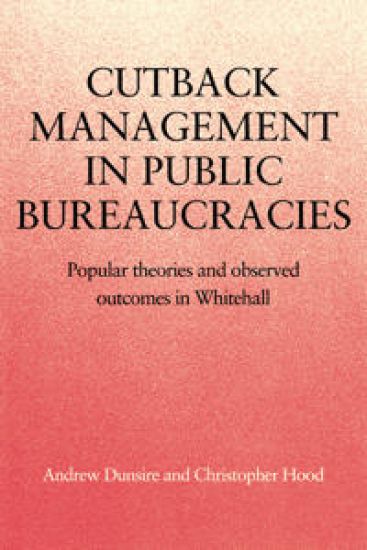
Bureaucratic cutbacks are in the air all over the world. Many people appear sure that taxes are too high and that there are too many bureaucrats. The British government under Margaret Thatcher is generally seen as having been most successful in this regard, particularly on staff reduction. Between 1976 and 1985 there was a drop of nearly 20 per cent, from three-quarters of a million to fewer than 600,000 civil servants in the United Kingdom central government. How were these cutbacks implemented? Did certain civil servants and policy programmes take the brunt, or was the misery shared equally? Or is the entire thing a cosmetic exercise in numbers manipulation? In addressing these issues, Professor Dunsire and Professor Hood set out existing theories on management cutbacks and then test them against what happened in Britain, thus providing a full-length historical study of what actually happened in a decade of cutbacks in one country.
The Tools of Government in the Digital Age

The Tools of Government in the Digital Age

Christopher Hood; Helen Margetts

Red Globe Press
2007
sidottu
This important new work updates the arguments of Christopher Hood's classic work The Tools of Government for the Twenty-First century. Comprehensively revised throughout, it includes increased coverage of how government gets information and an assessment of how the tools available to government have changed over time.
The Tools of Government in the Digital Age

The Tools of Government in the Digital Age

Christopher Hood; Helen Margetts

Red Globe Press
2007
nidottu
This important new work updates the arguments of Christopher Hood's classic work The Tools of Government for the Twenty-First century. Comprehensively revised throughout, it includes increased coverage of how government gets information and an assessment of how the tools available to government have changed over time.
Shinkansen

Shinkansen

Christopher Hood

Routledge
2007
nidottu
The image of the shinkansen – or ‘bullet train’ – passing Mount Fuji is one of the most renowned images of modern Japan. Yet, despite its international reputation for speed and punctuality, little is understood about what makes it work so well and what its impact is.This is a comprehensive account of the history of the shinkansen, from its planning during the Pacific War, to its launch in 1964 and subsequent development. It goes on to analyze the reasons behind the bullet train’s success, and demonstrates how it went from being simply a high-speed rail network to attaining the status of iconic national symbol. It considers the shinkansen’s relationship with national and regional politics and economic development, its financial viability, the environmental challenges it must cope with, and the ways in which it reflects and influences important aspects of Japanese society. It concludes by considering whether the bullet train can be successful in other countries developing high-speed railways. Overall, this book provides a thorough examination of the phenomenon of the shinkansen, and its relationship with Japanese society.
The Politics of Public Service Bargains

The Politics of Public Service Bargains

Christopher Hood; Martin Lodge

Oxford University Press
2006
sidottu
The traditional understandings that structure the relationships between public servants and the wider political system are said to have undergone considerable change. But what are these formalized and implicit understandings? What are the key dimensions of such bargains? In what conditions do bargains rise and fall? And has there been a universal and uniform change in these bargains? The Politics of Public Service Bargains develops a distinct perspective to answer these questions. It develops a unique analytical perspective to account for diverse bargains within systems of executive government. Drawing on comparative experiences from different state traditions, this study examines ideas and contemporary developments along three key dimensions of any Public Service Bargain - reward, competency and loyalty and responsibility. The Politics of Public Service Bargains points to diverse and differentiated developments across national systems of executive government and suggests how different 'bargains' are prone to cheating by their constituent parties. This study explores the context in which managerial bargains - widely seen to be at the heart of contemporary administrative reform movements - are likely to catch on and considers how cheating is likely to destabilize such bargains.
Shinkansen

Shinkansen

Christopher Hood

Routledge
2006
sidottu
The image of the shinkansen – or ‘bullet train’ – passing Mount Fuji is one of the most renowned images of modern Japan. Yet, despite its international reputation for speed and punctuality, little is understood about what makes it work so well and what its impact is.This is a comprehensive account of the history of the shinkansen, from its planning during the Pacific War, to its launch in 1964 and subsequent development. It goes on to analyze the reasons behind the bullet train’s success, and demonstrates how it went from being simply a high-speed rail network to attaining the status of iconic national symbol. It considers the shinkansen’s relationship with national and regional politics and economic development, its financial viability, the environmental challenges it must cope with, and the ways in which it reflects and influences important aspects of Japanese society. It concludes by considering whether the bullet train can be successful in other countries developing high-speed railways. Overall, this book provides a thorough examination of the phenomenon of the shinkansen, and its relationship with Japanese society.