Kirjojen hintavertailu. Mukana 12 293 426 kirjaa ja 12 kauppaa.

Kirjailija

Christopher L. Miller

Kirjat ja teokset yhdessä paikassa: 14 kirjaa, julkaisuja vuosilta 1986-2024, suosituimpien joukossa Thresholds: A ‘Complete’ Table of the Borrowings in Yambo Ouologuem’s Le Devoir de violence, and Why They Matter. Vertaile teosten hintoja ja tarkista saatavuus suomalaisista kirjakaupoista.

14 kirjaa

Kirjojen julkaisuhaarukka 1986-2024.

Thresholds: A ‘Complete’ Table of the Borrowings in Yambo Ouologuem’s Le Devoir de violence, and Why They Matter
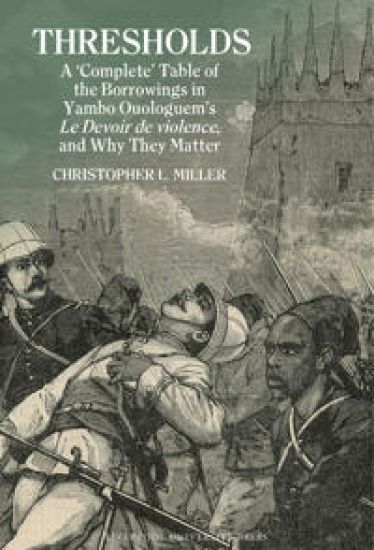
Recent research has revealed that the borrowings in Yambo Ouologuem’s epochal novel Le Devoir de violence (Bound to Violence) are far more extensive than was previously thought. Accused of plagiarism, Ouologuem quit the Parisian literary world and returned to a definitive silence in Mali. This book attempts to provide both a complete table of the borrowings in Le Devoir de Violence and a new theory of their meaning. Miller dispels the myth that the borrowings are minor, negligible, or criminal; he argues that they are artful “thresholds,” openings to a profound reconsideration of African history. Ouologuem set up this system of borrowings as a way to invite readers down unexpected paths of meaning. The borrowings are not mere stunts; they are inseparable from Ouologuem’s radical revision of African history and his rejection of Negritude. The table of borrowings in part three of this book will serve as a resource for readers and scholars.
Thresholds: A ‘Complete’ Table of the Borrowings in Yambo Ouologuem’s Le Devoir de violence, and Why They Matter
Recent research has revealed that the borrowings in Yambo Ouologuem’s epochal novel Le Devoir de violence (Bound to Violence) are far more extensive than was previously thought. Accused of plagiarism, Ouologuem quit the Parisian literary world and returned to a definitive silence in Mali. This book attempts to provide both a complete table of the borrowings in Le Devoir de Violence and a new theory of their meaning. Miller dispels the myth that the borrowings are minor, negligible, or criminal; he argues that they are artful “thresholds,” openings to a profound reconsideration of African history. Ouologuem set up this system of borrowings as a way to invite readers down unexpected paths of meaning. The borrowings are not mere stunts; they are inseparable from Ouologuem’s radical revision of African history and his rejection of Negritude. The table of borrowings in part three of this book will serve as a resource for readers and scholars.

The French Atlantic Triangle

The French Atlantic Triangle

Christopher L. Miller

Duke University Press
2008
sidottu
The French slave trade forced more than one million Africans across the Atlantic to the islands of the Caribbean. It enabled France to establish Saint-Domingue, the single richest colony on earth, and it connected France, Africa, and the Caribbean permanently. Yet the impact of the slave trade on the cultures of France and its colonies has received surprisingly little attention. Until recently, France had not publicly acknowledged its history as a major slave-trading power. The distinguished scholar Christopher L. Miller proposes a thorough assessment of the French slave trade and its cultural ramifications, in a broad, circum-Atlantic inquiry. This magisterial work is the first comprehensive examination of the French Atlantic slave trade and its consequences as represented in the history, literature, and film of France and its former colonies in Africa and the Caribbean.Miller offers a historical introduction to the cultural and economic dynamics of the French slave trade, and he shows how Enlightenment thinkers such as Montesquieu and Voltaire mused about the enslavement of Africans, while Rousseau ignored it. He follows the twists and turns of attitude regarding the slave trade through the works of late-eighteenth- and early-nineteenth-century French writers, including Olympe de Gouges, Madame de StaËl, Madame de Duras, Prosper MÉrimÉe, and EugÈne Sue. For these authors, the slave trade was variously an object of sentiment, a moral conundrum, or an entertaining high-seas “adventure.” Turning to twentieth-century literature and film, Miller describes how artists from Africa and the Caribbean-including the writers AimÉ CÉsaire, Maryse CondÉ, and Edouard Glissant, and the filmmakers Ousmane Sembene, Guy Deslauriers, and Roger Gnoan M’Bala-have confronted the aftermath of France’s slave trade, attempting to bridge the gaps between silence and disclosure, forgetfulness and memory.
The French Atlantic Triangle

The French Atlantic Triangle

Christopher L. Miller

Duke University Press
2008
pokkari
The French slave trade forced more than one million Africans across the Atlantic to the islands of the Caribbean. It enabled France to establish Saint-Domingue, the single richest colony on earth, and it connected France, Africa, and the Caribbean permanently. Yet the impact of the slave trade on the cultures of France and its colonies has received surprisingly little attention. Until recently, France had not publicly acknowledged its history as a major slave-trading power. The distinguished scholar Christopher L. Miller proposes a thorough assessment of the French slave trade and its cultural ramifications, in a broad, circum-Atlantic inquiry. This magisterial work is the first comprehensive examination of the French Atlantic slave trade and its consequences as represented in the history, literature, and film of France and its former colonies in Africa and the Caribbean.Miller offers a historical introduction to the cultural and economic dynamics of the French slave trade, and he shows how Enlightenment thinkers such as Montesquieu and Voltaire mused about the enslavement of Africans, while Rousseau ignored it. He follows the twists and turns of attitude regarding the slave trade through the works of late-eighteenth- and early-nineteenth-century French writers, including Olympe de Gouges, Madame de StaËl, Madame de Duras, Prosper MÉrimÉe, and EugÈne Sue. For these authors, the slave trade was variously an object of sentiment, a moral conundrum, or an entertaining high-seas “adventure.” Turning to twentieth-century literature and film, Miller describes how artists from Africa and the Caribbean-including the writers AimÉ CÉsaire, Maryse CondÉ, and Edouard Glissant, and the filmmakers Ousmane Sembene, Guy Deslauriers, and Roger Gnoan M’Bala-have confronted the aftermath of France’s slave trade, attempting to bridge the gaps between silence and disclosure, forgetfulness and memory.
Prophetic Worlds

Prophetic Worlds

Christopher L. Miller; Chris Friday

University of Washington Press
2003
pokkari
In his provocative ethnohistory, Christopher Miller offers an innovative reinterpretation of relations between Native Americans and Christian settlers on the Columbia Plateau. Miller draws on a wealth of ethnographic resources to show how culturally-derived perceptions and systems of rationality played more of a determining role in the interactions between these two groups than did material forces. Initially, Plateau Indians and the American missionaries who came to convert them perceived each other as crucial to the fulfillment of their own millennial destiny. When these views were contravened, relations quickly and fatally soured. In explaining this devolution, Prophetic Worlds provides a novel and insightful rendering of the cultural understandings that underwrote the mid-nineteenth-century transformation of life on the Plateau.
Nationalists and Nomads

Nationalists and Nomads

Christopher L. Miller

University of Chicago Press
1999
sidottu
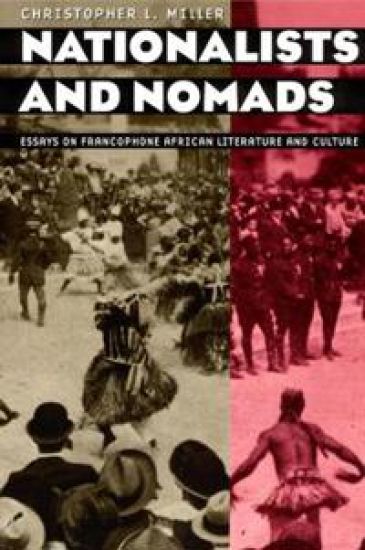
How does African literature written in French change the way we think about nationalism, colonialism, and postcolonialism? How does it imagine the encounter between Africans and French? And what does the study of African literature bring to the fields of literary and cultural studies? This text explores these and other questions in. Christopher Miller ranges from the beginnings of francophone African literature - which he traces not to the 1930s Negritude movement but to the largely unknown, virulently radical writings of Africans in Paris in the 1920s - to the evolving relations between African literature and nationalism in the 1980s and 1990s. Throughout he aims to offset the contemporary emphasis on the postcolonial at the expense of the colonial, arguing that both are equally complex, with powerful ambiguities. Arguing against blanket advocacy of any one model (such as nationalism or hybridity) to explain these ambiguities, Miller instead seeks a form of thought that can read and recognize the realities of both identity and difference.
Nationalists and Nomads

Nationalists and Nomads

Christopher L. Miller

University of Chicago Press
1999
nidottu
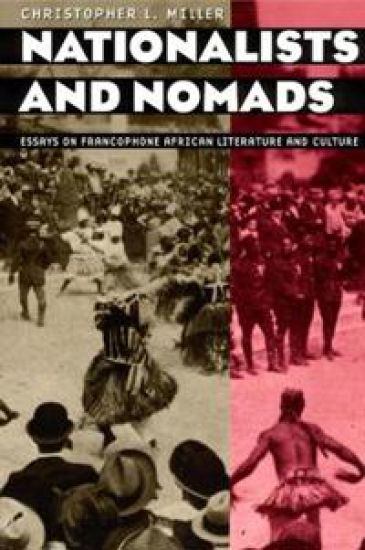
How does African literature written in French change the way we think about nationalism, colonialism, and postcolonialism? How does it imagine the encounter between Africans and French? And what does the study of African literature bring to the fields of literary and cultural studies? This text explores these and other questions in. Christopher Miller ranges from the beginnings of francophone African literature - which he traces not to the 1930s Negritude movement but to the largely unknown, virulently radical writings of Africans in Paris in the 1920s - to the evolving relations between African literature and nationalism in the 1980s and 1990s. Throughout he aims to offset the contemporary emphasis on the postcolonial at the expense of the colonial, arguing that both are equally complex, with powerful ambiguities. Arguing against blanket advocacy of any one model (such as nationalism or hybridity) to explain these ambiguities, Miller instead seeks a form of thought that can read and recognize the realities of both identity and difference.
Theories of Africans

Theories of Africans

Christopher L. Miller

University of Chicago Press
1993
nidottu
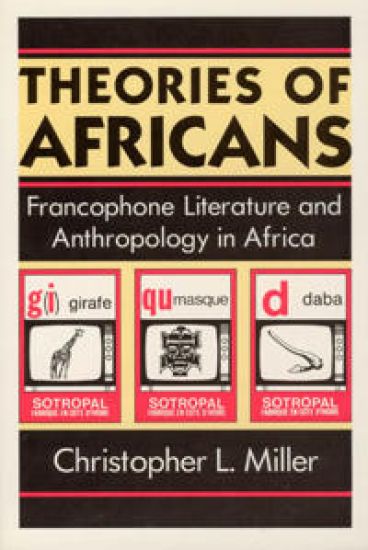
"Situating literature and anthropology in mutual interrogation, Miller's...book actually performs what so many of us only call for. Nowhere have all the crucial issues been brought together with the sort of critical sophistication it displays."—Henry Louis Gates, Jr.". . . a superb cross-disciplinary analysis."—Y. Mudimbe
Theories of Africans

Theories of Africans

Christopher L. Miller

University of Chicago Press
1990
sidottu
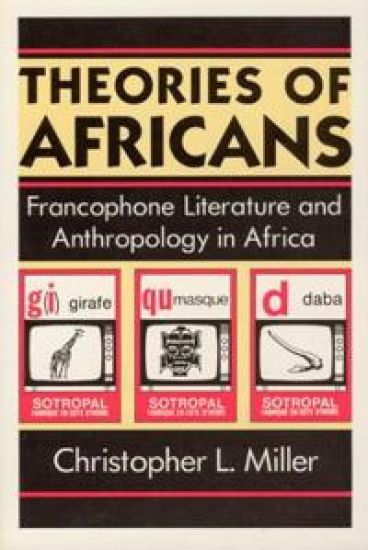
"Situating literature and anthropology in mutual interrogation, Miller's...book actually performs what so many of us only call for. Nowhere have all the crucial issues been brought together with the sort of critical sophistication it displays."—Henry Louis Gates, Jr.". . . a superb cross-disciplinary analysis."—Y. Mudimbe
Blank Darkness

Blank Darkness

Christopher L. Miller

University of Chicago Press
1986
nidottu
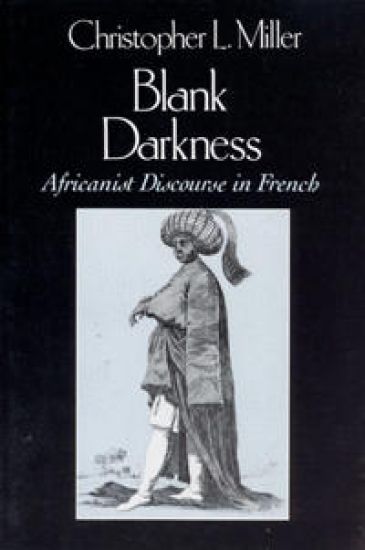
"Blank Darkness: Africanist Discourse in French is a brilliant and altogether convincing analysis of the way in which Western writers, from Homer to the twentieth century have . . . imposed their language of desire on the least-known part of the world and have called it 'Africa.' There are excellent readings here of writers ranging from Baudelaire, Rimbaud, Sade, and Céline to Conrad and Yambo Ouologuem, but even more impressive and important than these individual readings is Mr. Miller's wide-ranging, incisive, and exact analysis of 'Africanist' discourse, what it has been and what it has meant in the literature of the Western world."—James Olney, Louisiana State University
Blank Darkness

Blank Darkness

Christopher L. Miller

University of Chicago Press
1986
sidottu
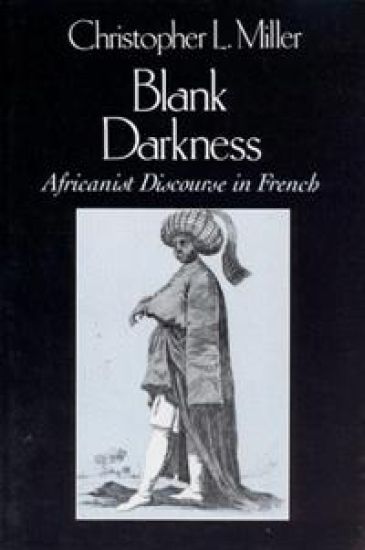
"Blank Darkness: Africanist Discourse in French is a brilliant and altogether convincing analysis of the way in which Western writers, from Homer to the twentieth century have . . . imposed their language of desire on the least-known part of the world and have called it 'Africa.' There are excellent readings here of writers ranging from Baudelaire, Rimbaud, Sade, and Céline to Conrad and Yambo Ouologuem, but even more impressive and important than these individual readings is Mr. Miller's wide-ranging, incisive, and exact analysis of 'Africanist' discourse, what it has been and what it has meant in the literature of the Western world."—James Olney, Louisiana State University