Kirjailija
Christopher Morley
Kirjat ja teokset yhdessä paikassa: 221 kirjaa, julkaisuja vuosilta 1946-2026, suosituimpien joukossa Kathleen. Vertaile teosten hintoja ja tarkista saatavuus suomalaisista kirjakaupoista.
221 kirjaa
Kirjojen julkaisuhaarukka 1946-2026.


Shandygaff by Christopher Morley, Fiction, Classics, Literary
Christopher Morley
Aegypan
2006
pokkari
I wanted to call these exercises "Casual Ablutions," in memory of the immortal sign in the washroom of the British Museum, but my arbiter of elegance forbade it. You remember that George Gissing, homeless and penniless on London streets, used to enjoy the lavatory of the Museum Reading Room as a fountain and a shrine. But the flinty hearted trustees, finding him using the wash-stand for bath-tub and laundry, were exceeding wroth, and set up the noticethese basins are for casual ablutions onlyI would like to issue the same warning to the implacable reader: these fugitive pieces, very casual rinsings in the great basin of letters, must not be too bitterly resented, even by their publishers. To borrow O. Henry's joke, they are more demitasso than Tasso. -- Christopher Morley





Morley was born in Bryn Mawr, Pennsylvania. His father, Frank Morley, was a mathematics professor at Haverford College; his mother, Lilian Janet Bird, was a violinist who provided Christopher with much of his later love for literature and poetry."I warn you," said the funny-looking little man with the red beard, "I?m here to sell this caravan of culture, and by the bones of Swinburne I think your brother's the man to buy it."

This is a suspenseful novel set in Brooklyn around the time of the end of World War I. It continues the story of Roger Mifflin, the book seller in Parnassus on Wheels. It also details an adventure of Miss Titania Chapman and a young advertising man named Aubrey Gilbert.(Jacketless hardcover intended for the library trade.)
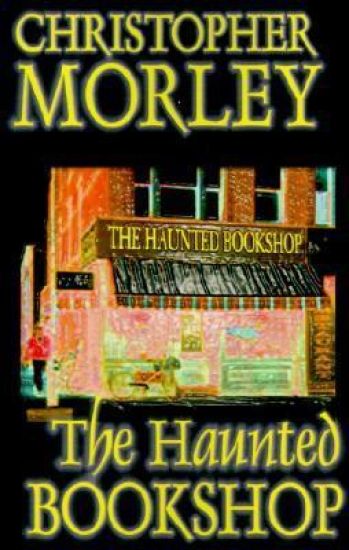
This is a suspenseful novel set in Brooklyn around the time of the end of World War I. It continues the story of Roger Mifflin, the book seller in Parnassus on Wheels. It also details an adventure of Miss Titania Chapman and a young advertising man named Aubrey Gilbert.

A collection of fifty-five essays, written mostly in the mid-twenties but with some later examples as well, Christopher Morley's New York presents in rich, evocative detail New York at the end of World War I – that heady time after the doughboys returned, the Twenties got roaring, the Volstead Act found itself thwarted, and a lot of progressive life got on with its business before running into the wall of the Great Depression. In the first section of the book, East Side, West Side, All Around the Town, we experience New York just as Morley did: through its bookstores, restaurants, taverns, waterfronts, and other locales that lent the city its unique, rough-and-tumble character. But we're also treated to a vivid picture of Christopher Morley himself, particularly in the next section, The Three Hours for Lunch Club, in which Morley's gusto in food, drink, companionship, conversation, and general bonhomie is plainly evident. Finally, in the last section, we experience another, suburban New York: Roslyn, Long Island, where for years Morley lived with his wife and family. Contrasted with the vulgar beauty of the city, the natural splendor Morley encountered on Long Island is particularly affecting. This attractive volume is enhanced by the evocative period illustrations of Walter Jack Duncan, who illustrated so many Morley first editions.

Here, brought together in one volume for the first time, are the best poems of Christopher Morley. Best known to the public as a novelist, Morley considered himself first and last a poet, and it is as a poet that he wished to be remembered. From the span of Morley's work, John Bracker has drawn 132 poems that may be said to represent the high points of the poet's art. In addition, the editor has included a number of the "translations from the Chinese," so much admired by Pearl Buck and Leonard Bacon.