Kirjojen hintavertailu. Mukana 12 390 323 kirjaa ja 12 kauppaa.

Kirjailija

Christopher Stoney

Kirjat ja teokset yhdessä paikassa: 8 kirjaa, julkaisuja vuosilta 2010-2021, suosituimpien joukossa Green-lite. Vertaile teosten hintoja ja tarkista saatavuus suomalaisista kirjakaupoista.

8 kirjaa

Kirjojen julkaisuhaarukka 2010-2021.

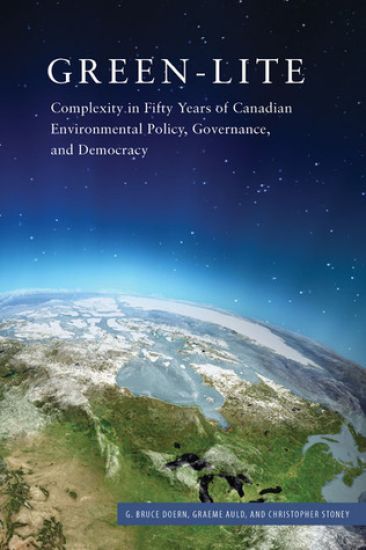
Green-lite

Green-lite

G. Bruce Doern; Graeme Auld; Christopher Stoney

McGill-Queen's University Press
2015
nidottu
Anchored in the core literature on natural resources, energy production, and environmental analysis, Green-lite is a critical examination of Canadian environmental policy, governance, and politics drawing out key policy and governance patterns to show that the Canadian story is one of complexity and often weak performance. Making a compelling argument for deeper historical analysis of environmental policy and situating environmental concerns within political and fiscal agendas, the authors provide extended discussions on three relatively new features of environmental policy: the federal-cities and urban sustainability regime, the federal-municipal infrastructure regime, and the regime of agreements with NGOs and businesses that often relegate governments to observing participants rather than being policy leaders. They probe the Harper era's muzzling of environmental science and scientists, Canada's oil sands energy and resource economy, and the government's core Alberta and Western Canadian political base. The first book to provide an integrated, historical, and conceptual examination of Canadian environmental policy over many decades, Green-lite captures complex notions of what environmental policy and green agendas seek to achieve in a business-dominated economy of diverse energy producing technologies, and their pollution harms and risks.
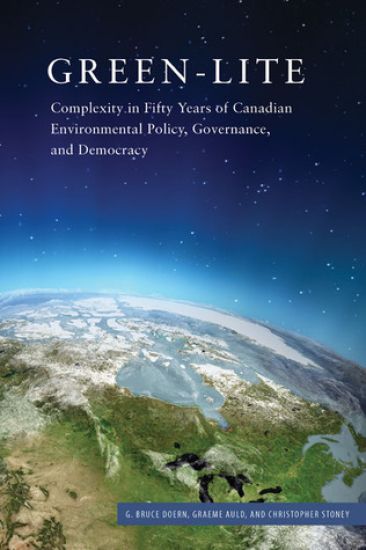
Green-lite

Green-lite

G. Bruce Doern; Graeme Auld; Christopher Stoney

McGill-Queen's University Press
2015
sidottu
Anchored in the core literature on natural resources, energy production, and environmental analysis, Green-lite is a critical examination of Canadian environmental policy, governance, and politics drawing out key policy and governance patterns to show that the Canadian story is one of complexity and often weak performance. Making a compelling argument for deeper historical analysis of environmental policy and situating environmental concerns within political and fiscal agendas, the authors provide extended discussions on three relatively new features of environmental policy: the federal-cities and urban sustainability regime, the federal-municipal infrastructure regime, and the regime of agreements with NGOs and businesses that often relegate governments to observing participants rather than being policy leaders. They probe the Harper era's muzzling of environmental science and scientists, Canada's oil sands energy and resource economy, and the government's core Alberta and Western Canadian political base. The first book to provide an integrated, historical, and conceptual examination of Canadian environmental policy over many decades, Green-lite captures complex notions of what environmental policy and green agendas seek to achieve in a business-dominated economy of diverse energy producing technologies, and their pollution harms and risks.
Keeping Canada Running

Keeping Canada Running

G. Bruce Doern; Christopher Stoney; Robert Hilton

McGill-Queen's University Press
2021
sidottu
The federal government's promises to "build back better" and "build back green" highlight opportunities to reimagine Canadian infrastructure. In this groundbreaking study, authors Bruce Doern, Christopher Stoney, and Robert Hilton provide the first comprehensive overview of Canadian infrastructure policy, examining the impact and implications of the COVID-19 pandemic and rapid technological change as Canada looks to recover and rebuild.Covering more than fifty years across many sectors, the authors identify numerous challenges that have contributed to Canada's growing infrastructure deficit and suboptimal outcomes including political interference in the choice of infrastructure projects; challenges for multilevel governance such as distortion of local priorities, blurred accountability, and unsustainable maintenance costs for municipalities; the growing reliance on public-private partnerships that limit transparency and public scrutiny; and increased corruption associated with infrastructure projects.Transforming infrastructure is notoriously difficult yet vital at a time of rapid technological change. It is estimated that 75 percent of the infrastructure that will exist in 2050 does not exist today. This makes it crucial that Canada invest in future-proof infrastructure with the capacity to facilitate economic growth and the expansion of urban centres, mitigate and adapt to the impacts of climate change, and ensure resilience in response to crises and disasters. Keeping Canada Running offers a timely assessment of these issues, Canada's COVID-19 response, and the potential contribution of the newly launched Canadian Infrastructure Bank.
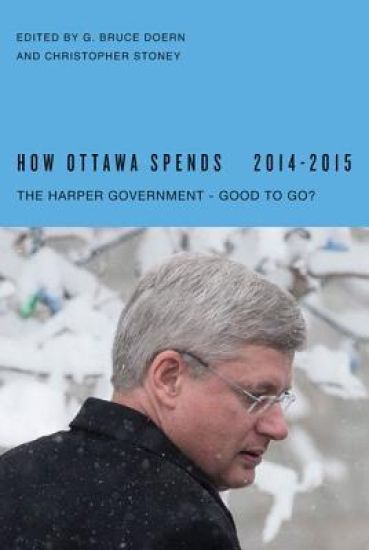
How Ottawa Spends, 2014-2015

How Ottawa Spends, 2014-2015

G. Bruce Doern; Christopher Stoney

McGill-Queen's University Press
2014
nidottu
The 2014-15 edition of How Ottawa Spends critically examines national politics and related fiscal, economic, and social priorities and policies, with an emphasis on the now long-running Harper-linked Senate scandal and the serious challenges to Harper's leadership and controlling style of attack politics. Contributors from across Canada examine the Conservative government agenda both in terms of its macroeconomic fiscal policy and electoral success since 2006 and also as it plans for a 2015 electoral victory with the aid of a healthy surplus budgetary war chest. Individual chapters examine several closely linked political, policy, and spending realms including the growing strength and nature of the Justin Trudeau-led Liberal Party challenge, the 2014 Harper Economic Action Plan, the demise of federal environmental policy under Harper's responsible resource development strategy, the Conservative's crime and punishment agenda, the growing evidence regarding the federal government's muzzling of scientists and evidence in federal policy formation, and the now five-year story of the Harper creation, treatment, and role of the Parliamentary Budget Officer.
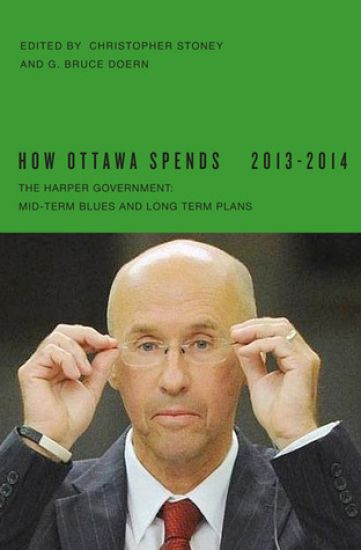
How Ottawa Spends, 2013-2014

How Ottawa Spends, 2013-2014

Christopher Stoney; G. Bruce Doern

McGill-Queen's University Press
2013
nidottu
The 2013-14 edition of How Ottawa Spends critically examines national politics, priorities, and policies with a close lens on Stephen Harper's Conservative party during the middle of their first term as a majority. Contributors from across Canada examine the federal government and its not uncommon mid-term problems but also its considerable agenda of long term plans, both set in the midst of national economic fragility and a global fiscal and debt crisis. Individual chapters examine several related political, policy, and spending realms including the Budget Action Plan, the ten year Canada Health Transfer Plan, the Canada Pension Plan, and Old Age Security reforms. The contributors also consider austerity related public sector downsizing and strategic spending reviews, national energy, and related environmental strategies, and the growing Harper practice of "one-off" federalism.
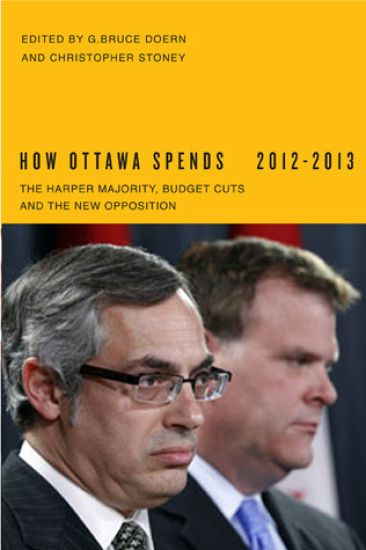
How Ottawa Spends, 2012-2013

How Ottawa Spends, 2012-2013

G. Bruce Doern; Christopher Stoney

McGill-Queen's University Press
2012
nidottu
Continuing its tradition of current, exemplary scholarship, the 2012-13 edition of How Ottawa Spends casts a critical eye at national politics, priorities, and policies, with an emphasis on the Conservative majority's mandated austerity measures and budget-cutting strategies. Leading scholars from across Canada examine a new era of majority government and a transformed political opposition both in Parliament and in provincial politics. Several closely linked political, policy, and spending realms are examined, including corporate tax reform, Conservative Party social policy, regional economic development, science and technology investments, Canada-US perimeter security and trade agreements, the rise and fall of regulatory regimes, and Canadian health care. Related governance issues such as federal infrastructure program impacts, the Harper government's Economic Action Plan impacts in Ontario, and community colleges in the federal innovation agenda, are also discussed in detail.
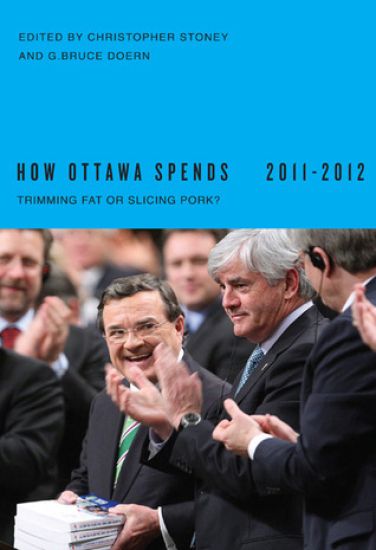
How Ottawa Spends, 2011-2012

How Ottawa Spends, 2011-2012

Christopher Stoney; G. Bruce Doern

McGill-Queen's University Press
2011
nidottu
Leading scholars from across Canada examine a new era of "life under the knife" in the context of the Harper agenda after five years in power, the partisan calculus of a minority Parliament, and a deep global recession still in crisis mode. Given the budget-related pressure for an election, the book poses questions about the degree to which the budget agenda involves the political arts of "trimming fat" versus "slicing the pork" of partisan spending. Several closely linked political, policy, and spending realms are examined, including economic stimulus, environmental assessment, energy and climate change, health care, science and technology, immigration, and northern strategy (including affordable housing). Related governance issues such as the use of new media, regulatory budget cuts, Industry Canada as an economic regulator, and federal compensation costs are also discussed in detail. Contributors include Frances Abele (Carleton University), Caroline Andrew (University of Ottawa), Vandna Bhatia (Carleton University), Neil Bradford (University of Western Ontario), Francois Bregha (Statos), David Castle (University of Edinburgh), G. Bruce Doern (Carleton University and University of Exeter), Nick Falvo (Carleton University), Mary Francoli (Carleton University), Ruth Hubbard (University of Ottawa), Derek Ireland (Carleton University), James Lahey (University of Ottawa), Douglas Macdonald (University of Toronto), Eric Milligan (Regulatory Consulting Group Inc, Ottawa), Leslie A. Pal (Carleton University), Gilles Paquet (University of Ottawa), Peter W.B. Phillips (University of Saskatchewan), Richard Schultz (McGill University), Christopher Stoney (Carleton University), Kernaghan Webb (Ryerson University), and Wei Xie (doctoral student, Carleton University).
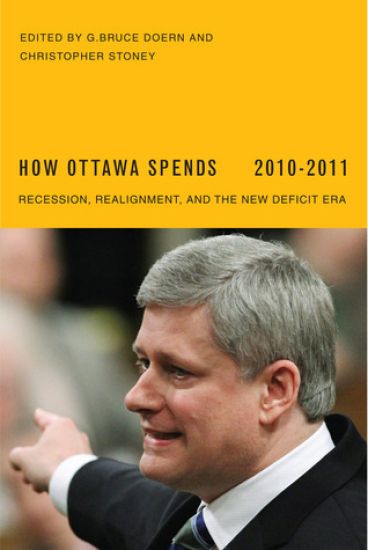
How Ottawa Spends, 2010-2011

How Ottawa Spends, 2010-2011

G. Bruce Doern; Christopher Stoney

McGill-Queen's University Press
2010
nidottu
Continuing the excellent standards and traditions of timely scholarship, the 2010-2011 edition of "How Ottawa Spends" critically examines national politics, priorities, and policies with emphasis on federal economic and social spending. Given the political and budgetary challenges posed by the recession, this year's instalment pays close attention to the growing fiscal deficit. Informed authors from across Canada examine recession-related policy fields, including the Canadian Banking system, new industrial policy pressures such as the automotive industry bailout, policies in science, technology, and innovation, and suggestions about how to resist the United States' 'buy America' trade policies. The essays in this volume also consider Canada's national, regional, and political divisiveness, the impact of the dynamic Obama Administration on Canadian domestic affairs, and governance during a time of minority government.