Kirjojen hintavertailu. Mukana 12 595 353 kirjaa ja 12 kauppaa.

Kirjailija

Christopher W. Hughes

Kirjat ja teokset yhdessä paikassa: 6 kirjaa, julkaisuja vuosilta 1999-2022, suosituimpien joukossa Japan's Remilitarisation. Vertaile teosten hintoja ja tarkista saatavuus suomalaisista kirjakaupoista.

6 kirjaa

Kirjojen julkaisuhaarukka 1999-2022.

Japan as a Global Military Power

Japan as a Global Military Power

Christopher W. Hughes

Cambridge University Press
2022
pokkari
Japan is emerging as a more prominent global and regional military power, defying traditional categorisations of a minimalist contribution to the US-Japan alliance, maintaining anti-militarism, seeking an internationalist role, or carving out more strategic autonomy. Instead, this Element argues that Japan has fundamentally shifted its military posture over the last three decades and traversed into a new categorisation of a more capable military power and integrated US ally. This results from Japan's recognition of its fundamentally changing strategic environment that requires a new grand strategy and military doctrines. The shift is traced across the national security strategy components of Japan Self-Defence Forces' capabilities, US-Japan alliance integration, and international security cooperation. The Element argues that all these components are subordinated inevitably to the objectives of homeland security and re-strengthening the US-Japan alliance, and thus Japan's development as international security partner outside the ambit of the bilateral alliance remains stunted. This title is also available as Open Access on Cambridge Core.
Japan's Remilitarisation

Japan's Remilitarisation

Christopher W. Hughes

Routledge
2017
sidottu
Is Japan on a path towards assuming a greater military role internationally, or has the recent military normalisation ground to a halt since the premiership of Junichiro Koizumi? In this book, Christopher W. Hughes assesses developments in defence expenditure, civil military relations, domestic and international military industrial complexes, Japan‘s procurement of regional and global power-projection capabilities, the expansion of US Japan cooperation, and attitudes towards nuclear weapons, constitutional revision and the use of military force. In all of these areas, dynamic and long-term changes outweigh Japan‘s short-term political logjam over security policy. Hughes argues that many post-war constraints on Japan‘s military role are still eroding, and that Tokyo is moving towards a more assertive military role and strengthened US Japan cooperation. Japan‘s remilitarisation will boost its international security role and the dominance of the US Japan alliance in regional and global security affairs, but will need to be carefully managed if it is not to become a source of destabilising tensions.
Japan's International Relations

Japan's International Relations

Glenn D. Hook; Julie Gilson; Christopher W. Hughes; Hugo Dobson

Routledge
2011
sidottu
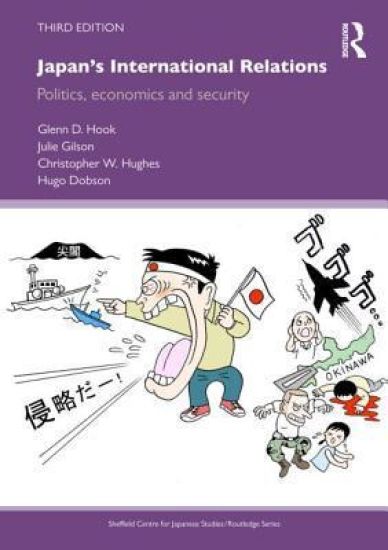
The latest edition of this comprehensive and user-friendly textbook provides a single volume resource for all those studying Japan's international relations. It offers a clear and concise introduction to the most important aspects of Japan's role in the globalized economy of the twenty-first century. The book has been fully updated and revised to include comprehensive discussions of contemporary key issues for Japan’s IR, including: the rise of China; reaction to the global economic and financial crisis since 2008; Japan’s proactive role after 9/11 and the war on terror; responses to events on the Korean Peninsula; relations with the USA and the Obama administration; relations with Russia, Central Asia and the Middle East; changing responses to an expanding and deepening European Union. Extensively illustrated, the text includes statistics, maps, photographs, summaries and suggestions for further reading, making it essential reading for those studying Japanese politics and the international relations of the Asia Pacific.A note on the cover:The cover illustration entitled 'Double Standard' is a Japanese manga penned by satirical artist Ichihanahana in November 2010 regarding rising Japanese nationalism, Japan-China tensions over the disputed territory of the Senkaku islands and the US presence in Okinawa. This manga demonstrates many of the key themes in Japan’s ties with China and the US, but also a number of other central features of Japan’s international relations as explored throughout this text.
Japan's International Relations

Japan's International Relations

Glenn D. Hook; Julie Gilson; Christopher W. Hughes; Hugo Dobson

Routledge
2011
nidottu
The latest edition of this comprehensive and user-friendly textbook provides a single volume resource for all those studying Japan's international relations. It offers a clear and concise introduction to the most important aspects of Japan's role in the globalized economy of the twenty-first century. The book has been fully updated and revised to include comprehensive discussions of contemporary key issues for Japan’s IR, including: the rise of China; reaction to the global economic and financial crisis since 2008; Japan’s proactive role after 9/11 and the war on terror; responses to events on the Korean Peninsula; relations with the USA and the Obama administration; relations with Russia, Central Asia and the Middle East; changing responses to an expanding and deepening European Union. Extensively illustrated, the text includes statistics, maps, photographs, summaries and suggestions for further reading, making it essential reading for those studying Japanese politics and the international relations of the Asia Pacific.A note on the cover:The cover illustration entitled 'Double Standard' is a Japanese manga penned by satirical artist Ichihanahana in November 2010 regarding rising Japanese nationalism, Japan-China tensions over the disputed territory of the Senkaku islands and the US presence in Okinawa. This manga demonstrates many of the key themes in Japan’s ties with China and the US, but also a number of other central features of Japan’s international relations as explored throughout this text.
Japan's Remilitarisation

Japan's Remilitarisation

Christopher W. Hughes

Routledge
2009
nidottu
Is Japan on a path towards assuming a greater military role internationally, or has the recent military normalisation ground to a halt since the premiership of Junichiro Koizumi? In this book, Christopher W. Hughes assesses developments in defence expenditure, civil–military relations, domestic and international military–industrial complexes, Japan’s procurement of regional and global power-projection capabilities, the expansion of US–Japan cooperation, and attitudes towards nuclear weapons, constitutional revision and the use of military force. In all of these areas, dynamic and long-term changes outweigh Japan’s short-term political logjam over security policy. Hughes argues that many post-war constraints on Japan’s military role are still eroding, and that Tokyo is moving towards a more assertive military role and strengthened US–Japan cooperation. Japan’s remilitarisation will boost its international security role and the dominance of the US–Japan alliance in regional and global security affairs, but will need to be carefully managed if it is not to become a source of destabilising tensions.
Japan's Economic Power and Security

Japan's Economic Power and Security

Christopher W. Hughes

Routledge
1999
sidottu
Is Japan re-emerging as a normal, or even a great, military power in regional and global security affairs? This Adelphi Paper assesses the overall trajectory of Japan’s security policy over the last decade, and the impact of a changing Japanese military posture on the stability of East Asia.The paper examines Japan’s evolving security debate, set against the background of a shifting international environment and domestic policymaking system; the status of Japan’s national military capabilities and constitutional prohibitions; post-Cold War developments in the US Japan alliance; and Japan’s role in multilateral regional security dialogue, UN PKO, and US-led coalitions of the willing. It concludes that Japan is undoubtedly moving along the trajectory of becoming a more assertive military power, and that this trend has been accelerated post-9/11. Japan is unlikely, though, to channel its military power through greatly different frameworks than at present. Japan will opt for the enhanced, and probably inextricable, integration of its military capabilities into the US Japan alliance, rather than pursuing options for greater autonomy or multilateralism. Japan’s strengthened role as the defensive shield for the offensive sword of US power projection will only serve to bolster US military hegemony in East Asia and globally.